
Beluga Whale
Delphinapterus leucas

Photo by https://www.flickr.com/photos/iwona_kellie/ / CC BY 2.0 via Wikimedia Commons
The Beluga Whale is the "canary of the sea"—a pure white, highly vocal Arctic whale that looks like it's always smiling. With their flexible, bulbous forehead (the "melon") and no dorsal fin, they're perfectly adapted to life under ice. They're among the most social and vocal of all whales, producing an incredible variety of clicks, whistles, and chirps. Their name means "white" in Russian, and their pure white coloration makes them stand out like ghosts in the dark Arctic waters. Encountering a beluga is like meeting an underwater snowman—curious, chatty, and surprisingly expressive.
🔬Classification
📏Physical Features
🌊Habitat Info
⚠️Safety & Conservation
Identification Guide
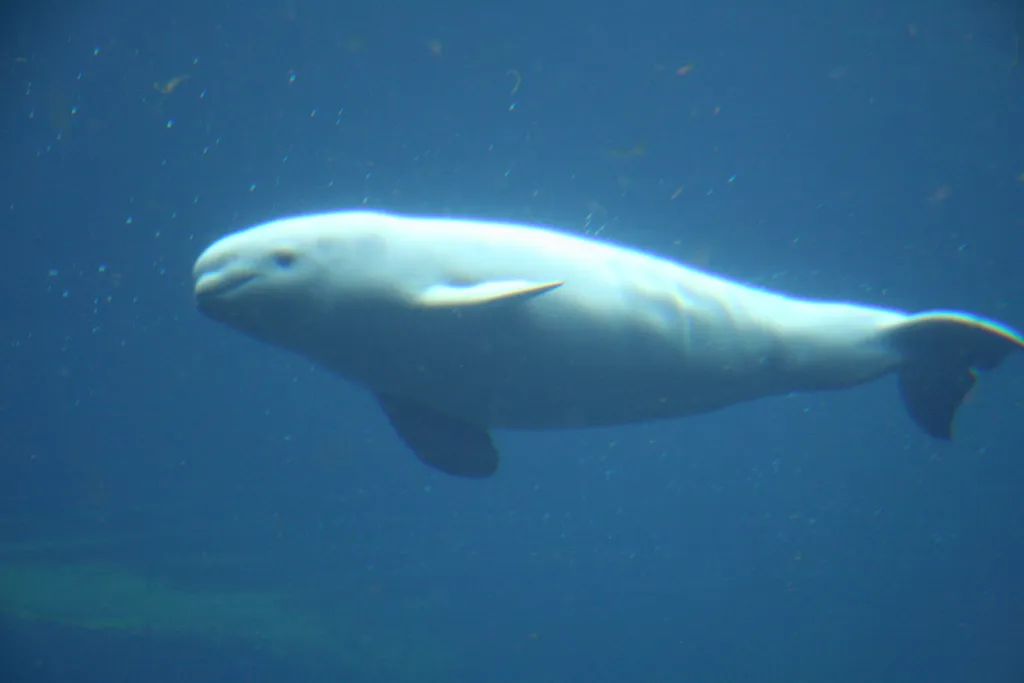
Photo by https://www.flickr.com/photos/iwona_kellie/ / CC BY 2.0 via Wikimedia Commons
Field marks:
- Pure White Color: Adults are completely white (the only all-white whale). Calves are dark grey and gradually lighten.
- No Dorsal Fin: Unlike most whales and dolphins, belugas have no dorsal fin—just a low ridge along the back. This allows them to swim under ice.
- Bulbous Melon: A large, flexible, bulbous forehead (the "melon") that can change shape. This is used for echolocation and communication.
- Flexible Neck: Unlike most whales, belugas can turn their heads up, down, and side-to-side. This is unique among cetaceans.
- Small Size: Relatively small for a whale (3–5.5 meters), making them more approachable than larger species.
- Social Behavior: Almost always seen in groups (pods) of 10–100+ individuals, often in shallow estuaries.
Differences from Similar Species
- Narwhal: Similar size and Arctic habitat, but narwhals have spots (not pure white), and males have a long tusk. Both lack dorsal fins.
- Dolphin: Smaller; has a dorsal fin; different coloration; found in warmer waters.
- Beluga (juvenile): Dark grey color (adults are white); smaller size; stays close to mother.
Juvenile vs. Adult
Calves are born dark grey or brown and gradually lighten over 5–8 years until they become pure white. Young belugas stay close to their mothers in the pod and learn vocalizations and behaviors through observation.
Top 10 Fun Facts about Beluga Whale
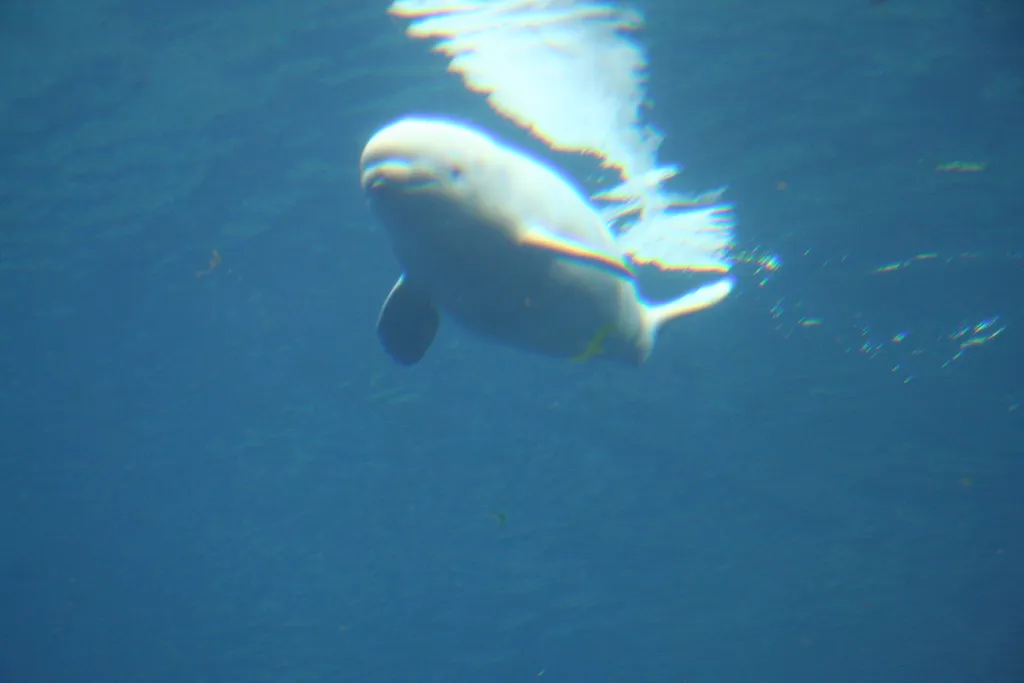
Photo by https://www.flickr.com/photos/iwona_kellie/ / CC BY 2.0 via Wikimedia Commons
1. The "Canary of the Sea"
Belugas are called the "canaries of the sea" because of their incredible vocal diversity. They produce clicks, whistles, chirps, squeals, and even sounds that mimic human speech. Scientists have identified over 50 distinct call types, and each pod has its own "dialect." You can hear them from the surface—they're one of the noisiest whales in the ocean.
2. The Flexible Melon
The bulbous forehead (the "melon") is not just for looks—it's a sophisticated acoustic lens. Belugas can change its shape by moving muscles, allowing them to focus their echolocation clicks in different directions. This makes them incredibly efficient at finding fish, even in murky Arctic waters or under ice.
3. The No-Dorsal-Fin Advantage
Unlike most whales, belugas have no dorsal fin. Instead, they have a low ridge along their back. This adaptation allows them to swim easily under ice floes and reduces heat loss in freezing Arctic waters. It's a perfect example of form following function in extreme environments.
4. The Neck Turners
Belugas are the only cetaceans that can turn their heads up, down, and side-to-side. Their cervical vertebrae are not fused (unlike other whales), giving them incredible neck flexibility. This helps them navigate complex under-ice environments and hunt along the seafloor.
5. The Annual Molt
Belugas are the only whales that molt annually. In summer, they migrate to shallow, gravelly estuaries where they rub against the bottom to shed their outer skin layer. This "spa day" is crucial for removing old, damaged skin and parasites. You might see them with patches of peeling skin during this time.
6. The Deep Divers
While they often feed in shallow water, belugas are capable of deep dives up to 1,000 meters (3,280 feet). They can hold their breath for more than 20 minutes, allowing them to access a variety of prey at different depths. Most dives, however, are much shorter (1–7 minutes) and shallower.
7. The Social Gatherings
Belugas are highly social. While they typically travel in pods of 10–20 individuals, during summer they gather in massive aggregations of hundreds or even thousands in estuaries and shallow coastal areas. These gatherings are for molting, socializing, and calving—like a beluga convention.
8. The Suction Feeders
Belugas use suction feeding to capture prey. They can create a powerful vacuum with their flexible lips, sucking fish, squid, and even marine worms directly into their mouths. This is especially useful for finding prey hidden in sand or under rocks on the seafloor.
9. The Blubber Blanket
Belugas have a thick layer of blubber that can make up to 40% of their body weight. This provides insulation in freezing Arctic waters, energy storage for long migrations, and buoyancy control. It's their built-in wetsuit, energy bar, and life jacket all in one.
10. The Name Game
The scientific name Delphinapterus leucas means "white dolphin without a fin"—a perfect description. In Russian, "belukha" means white, which is where the common name comes from. They're also called "sea canaries" for their vocalizations and "white whales" for their coloration. Despite the name "whale," they're actually more closely related to narwhals (both in the Monodontidae family).
Diving & Observation Notes
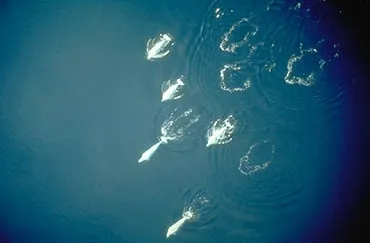
Photo by Lucero del Alba~commonswiki via Wikimedia Commons
🧭 Finding Beluga Whales
Belugas are found in Arctic and sub-Arctic waters—Canada (Churchill, Hudson Bay), Alaska, Russia, Norway (Svalbard), and Greenland. The best encounters happen in shallow estuaries during summer, where they gather in large numbers for molting and socializing. Look for their pure white bodies and listen for their vocalizations at the surface.
🤿 Approach & Behavior
- Snorkeling is Best: Most beluga encounters happen while snorkeling in shallow water, not scuba diving. They're often in estuaries that are only a few meters deep.
- Curious and Playful: Belugas are known for their curiosity. They often approach boats and snorkelers voluntarily. They seem to enjoy interaction.
- The Head Turn: Watch for their unique ability to turn their heads—they'll look at you from different angles, which is fascinating to observe.
- Respect the Pod: They travel in family groups. Don't try to separate individuals or get between group members.
📸 Photo Tips
- Wide Angle: Essential for capturing groups. A fisheye lens helps show the scale of large aggregations.
- The "Smile": Their upturned mouth gives them a permanent "smile." Try to capture this in portraits.
- The Melon: Get close enough (safely!) to capture the texture and shape of their flexible melon.
- Natural Light: In clear, shallow Arctic water, natural light can create beautiful images of their pure white bodies.
⚠️ Ethics & Safety
- No Touching: Never attempt to touch a beluga. They are wild animals, and contact can stress them or transmit diseases.
- Respect Molting Areas: During summer molting season, be especially respectful of estuaries where they gather. Don't disturb their "spa day."
- Boat Regulations: Follow local regulations for whale watching. Most places require maintaining a minimum distance (often 100 meters).
- Cold Water: Diving with belugas means cold water. Ensure you have proper cold-water gear and experience.
🌏 Local Guide Nuggets
- Churchill, Canada: The "Beluga Capital of the World." During summer (July–August), thousands of belugas gather in the Churchill River estuary. Snorkeling encounters are world-class.
- Svalbard, Norway: Belugas are common in the fjords. Boat-based encounters are popular, and the Arctic scenery is spectacular.
- Alaska (Cook Inlet): Resident population of belugas. Encounters are possible but require local knowledge and permits.
- Russian Arctic: Large populations but difficult to access. Requires expedition-level trips and special permits.
- Greenland: Belugas are found along the coast. Encounters are possible but less predictable than in Churchill.