Bobbit Worm
Eunice aphroditois
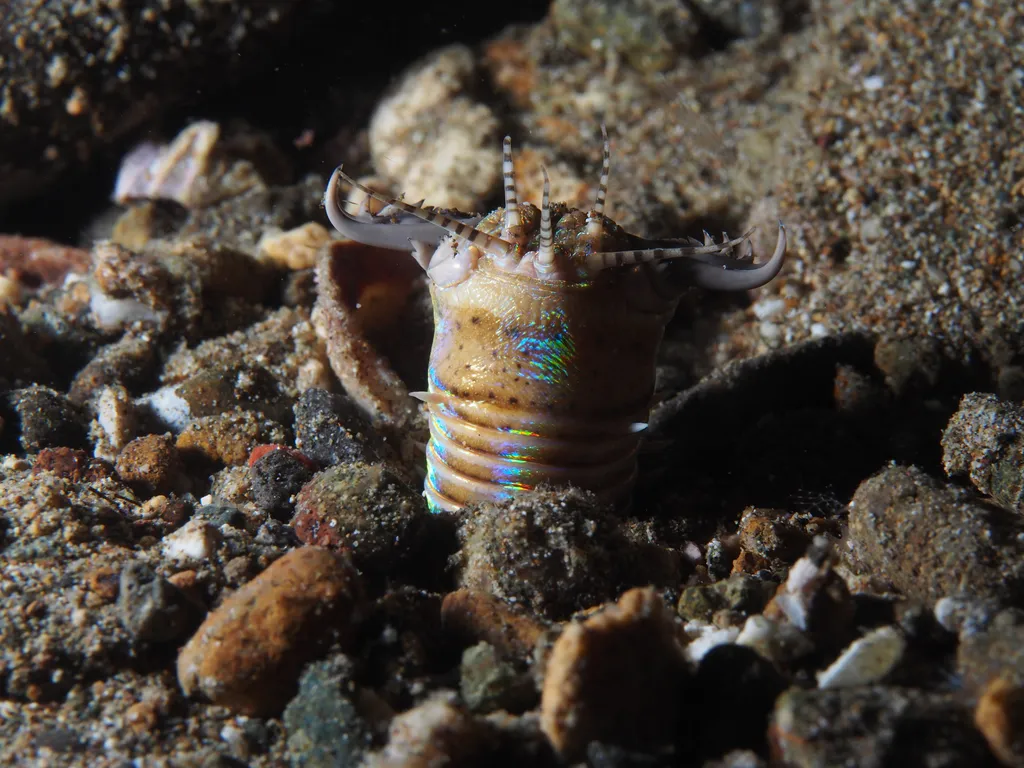
Photo by Rickard Zerpe / CC BY-SA 2.0 via Wikimedia Commons
A Bobbit-worm encounter usually begins with almost nothing: a dark opening in sand, a shallow flat depression, or a few fine head appendages breaking the surface. Most of the animal remains buried. When a fish comes within reach, an eversible muscular pharynx brings the jaw apparatus forward, the jaws grip, and the worm pulls its catch toward or into the burrow. The movement can be abrupt; the useful search image is still a patch of disturbed sediment, not a long worm laid out in the open.
“Bobbit worm” is a convenient field label rather than a safe species identification. Divers, photographers, and even older scientific records have applied it to more than one giant predatory eunicid. Eunice aphroditois in the strict taxonomic sense was described from a single 45 cm specimen from Sri Lanka, and distant records have repeatedly turned out to involve other species. A photograph can document a convincing Bobbit-worm morph, but color and a head portrait cannot settle the name.
The clearest published dive-side observations come from Air Prang in Lembeh Strait, where four field-identified animals were followed during 90 dives at 12–15 m. They stayed mostly below gently sloping black sand, ambushed during daylight, and extended farther to snatch prey at night. That makes restraint part of the encounter: keep hands and equipment outside jaw reach, and let the worm reveal its own behavior without bait, probing, or repeated torch provocation.
🔬Classification
📏Physical Features
🌊Habitat Info
⚠️Safety & Conservation
Identification Guide
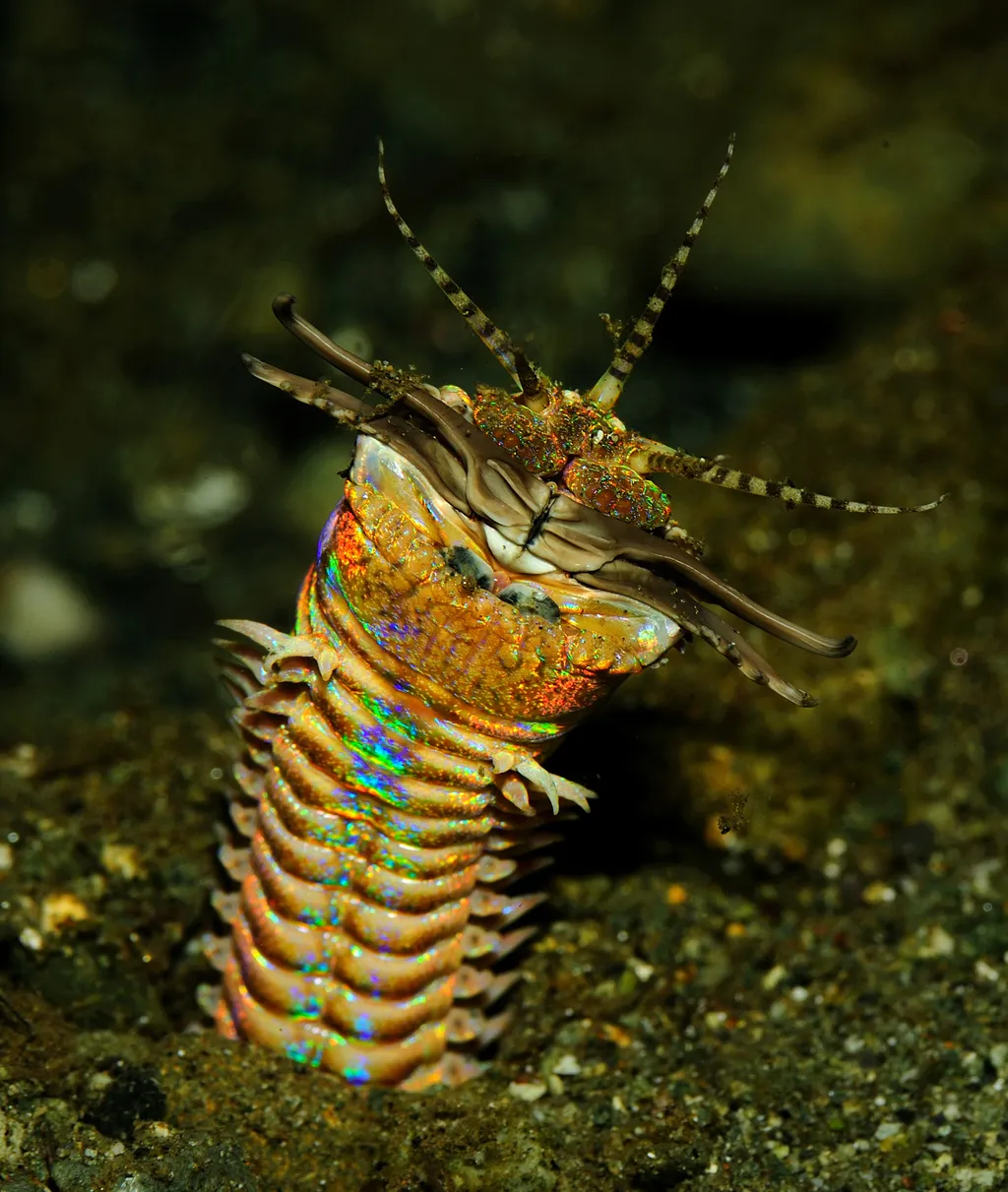
Photo by Jenny / CC BY 2.0 via Wikimedia Commons
Start with the sediment, because the animal may show little more than its head. On black sand or another soft bottom, look for a distinct opening, a shallow flat depression, or slender appendages lying close to the surface. In the Lembeh observations, most of the body and the shape of the burrow remained hidden, so a neat, fully exposed silhouette is the exception rather than the search target.
Count the head appendages correctly
A Eunice head carries five prostomial appendages: three antennae and two palps. They may appear pale or banded against a brown, purple, or red-brown head. Calling all five “antennae” is common shorthand, but the three-plus-two arrangement is the accurate anatomical description.
Color gets you only as far as a morph
Iridescence can be conspicuous, yet Bobbit-like eunicids vary with age and taxon. Brown, purple, red-brown, and differently marked appendages all occur. A colorful head at a sand opening supports “Bobbit-worm morph”; it does not securely identify Eunice aphroditois.
The decisive characters are mostly poor photo subjects
Species diagnosis may require branchial distribution, cirri, chaetae, subacicular hooks, and details of the jaws. Several are hidden, tiny, or unsuitable for routine underwater examination. Record the opening, head, appendages, visible body pattern, depth, substrate, locality, and time instead of forcing a species name from one frontal frame.
Leave uncertainty in the caption
Similar giant eunicids have travelled under the same common name, while Mediterranean reports once assigned to E. aphroditois have often been reidentified as E. roussaei. Japanese material may be reported as Eunice cf. aphroditois, and Korean work distinguishes E. flavopicta. A qualified identification is more informative than false precision.
Top 10 Fun Facts about Bobbit Worm
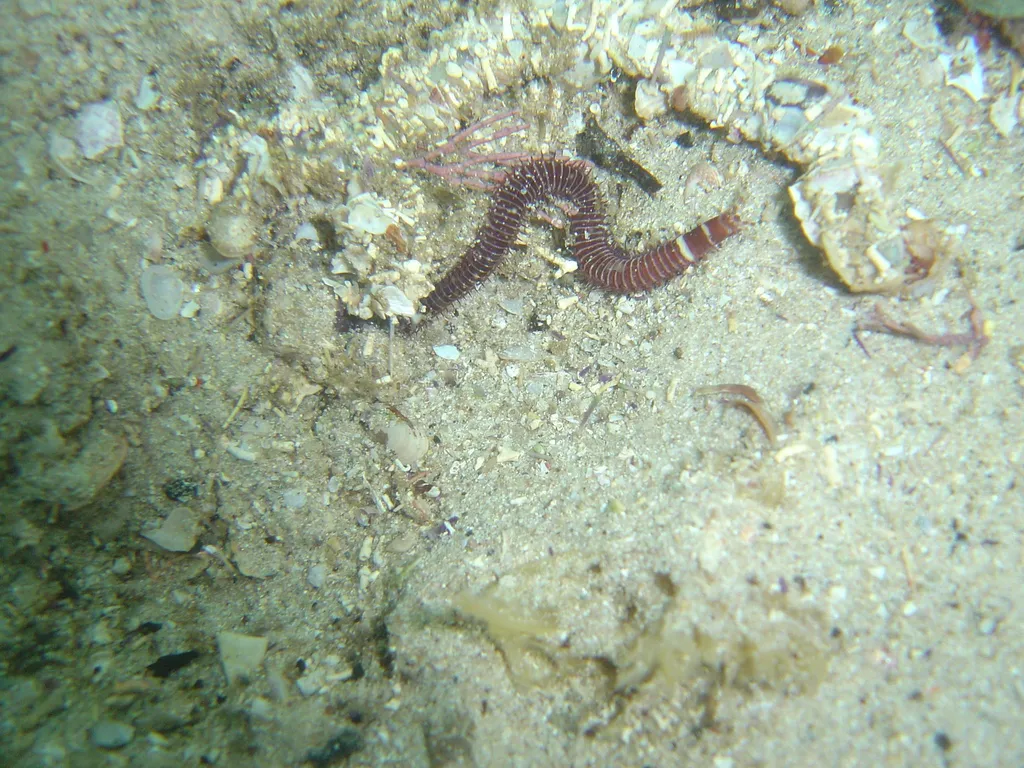
Photo by Peter Southwood / CC BY-SA 4.0 via Wikimedia Commons
1. “Bobbit worm” names a look, not one guaranteed species
The label is widely used for large, predatory eunicid worms that wait in sediment. That field convenience has a taxonomic cost: photographs and distant records placed under Eunice aphroditois may belong to other species. Unless diagnostic anatomy or genetic evidence is available, “Bobbit-worm morph” is the honest level of identification.
2. The strict species began with one 45 cm animal
Eunice aphroditois was based on a single specimen from Sri Lanka, 45 cm long, described by Pallas in 1788 as Nereis aphroditois. Historical literature also moved the name through combinations including Leodice aphroditois, while E. or Leodice gigantea appears in the older tangle. A long synonym list does not turn every giant Eunice record into the same species.
3. Five head projections do not mean five antennae
The head plan is three antennae plus two palps. All five arise from the prostomium and can form the most visible part of a buried animal, which explains the familiar shorthand. Keeping the terms straight matters when a photograph is compared with a formal description.
4. The jaws ride on an eversible pharynx
The feeding apparatus combines dorsal maxillae and ventral mandibles with a muscular pharynx that can be turned outward. In the Lembeh field study, buried worms gripped fish with the jaws and drew them toward or into the burrow. That mechanism also explains why a quiet-looking opening deserves working distance.
5. A 299 cm specimen is real—and still needs an asterisk
One Japanese worm historically assigned to E. aphroditois measured 299 cm, weighed 433 g, and had 673 segments. Those measurements are documented. Modern uncertainty concerns the species assignment, not the ruler, so the specimen cannot justify calling three metres normal or even treating one metre as a typical length.
6. Daylight does not mean the ambush is switched off
At Air Prang, the four field-identified worms remained mostly buried and took fish during daytime observations. At night they protruded farther and actively snatched prey. The study supports a difference in how much of the animal is exposed and how it attacks, not a simple “nocturnal only” label.
7. Fish can read marks in the sand
Researchers recorded 54 initiations of fish mobbing. The visible cue was a burrow opening in 40.7% of cases, a flat depression in 33.3%, appendages in 18.5%, an observed predation event in 5.5%, and no visible cue in 1.9%. These figures describe what prompted fish at that study site; they are not encounter probabilities for divers.
8. One fish fights back with water
Scolopsis affinis was observed directing jets of water at exposed burrows, sometimes making the worm retreat. The behavior turns a nearly featureless patch of sand into a brief ecological scene: mobbing fish may be responding to a predator that is still largely invisible.
9. A torch can become part of the experiment
Torch beams sometimes triggered attacks in the Lembeh observations, although the sensory mechanism was not resolved. Light response should therefore be recorded cautiously rather than explained as a proven visual trigger. Repeatedly provoking the animal for a strike changes the behavior being photographed and can place nearby fish at risk.
10. The bite is mechanical; venom remains unproven
Large Eunice worms have jaws capable of inflicting a serious bite. No primary biochemical or anatomical evidence has demonstrated venom glands or a prey-injected toxin in E. aphroditois, and claims of toxic chaetae are unsupported. The practical boundary is simple: no touching, probing, feeding, or equipment inside jaw range.
Diving & Observation Notes
Photo by Georgina Jones / CC BY-SA 4.0 via Wikimedia Commons
Finding the nearly invisible animal
In Lembeh, the documented setting was a gently sloping black-sand bottom with scattered low coral blocks at 12–15 m. Ask a guide whether a known opening has been observed recently, then watch the sediment for a hole, a shallow flat depression, or a few head appendages. Fish clustering or jetting water at one patch of sand may reveal activity, but the published cue percentages describe fish mobbing, not your odds of finding a worm. Day dives can show ambushes; night observations may show the animal extending farther.
Approach without manufacturing a strike
Settle at a distance that keeps fingers, gauges, camera parts, and loose equipment beyond the jaws. Good buoyancy matters more than closing the gap: fin wash can erase surface clues, fill the opening with silt, or disturb an unseen burrow. A torch beam sometimes preceded attacks in the field study, but the mechanism remains unknown. Use light sparingly and do not sweep it back repeatedly to make the worm lunge.
Photograph the evidence you actually have
Begin with a habitat frame that includes the opening or depression; it shows why the animal is hard to find. If the head appears, a steady sequence can document the three antennae, two palps, visible color, and degree of emergence. Note locality, depth, substrate, time, and observed behavior. Those records are more useful than a tight portrait labelled to species with unwarranted confidence, since the diagnostic branchiae, cirri, chaetae, hooks, and jaw details may remain out of sight.
Leave the burrow and its neighbors intact
Do not bait fish toward the opening, stage predation, feed the worm, probe it, or excavate the sediment for a body-length photograph. Avoid repeated light provocation and keep fins off the bottom. Finish with the sand surface, burrow entrance, nearby fish, and low coral blocks as undisturbed as you found them; the encounter should document an ambush predator, not create an ambush on demand.