Psychedelic Frogfish
Histiophryne psychedelica
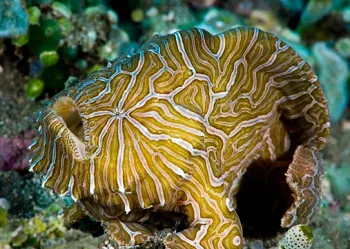
Photo by David Hall / seaphotos.com / CC BY-SA 3.0 via Wikimedia Commons
The Psychedelic Frogfish is the holy grail of Ambon muck diving—a species so rare, so bizarre, and so visually loud that finding one can eclipse an entire trip. Described to science only in 2009 from specimens collected in Ambon Bay, it has since become the poster child for "critter diving" at its most obsessive.
Unlike classic frogfishes, it has no esca (lure) on its forehead, a flat, wide face, and a color pattern that looks hand-painted: swirling pink and white stripes over peach skin. It does not walk gracefully—it hops and jets across the rubble like a wind-up toy, squeezing into holes when threatened.
Positively identified wild sightings remain essentially Ambon-only. Guides may go years between individuals; when one reappears, the local dive community treats it like a celebrity sighting.
🔬Classification
📏Physical Features
🌊Habitat Info
⚠️Safety & Conservation
Identification Guide
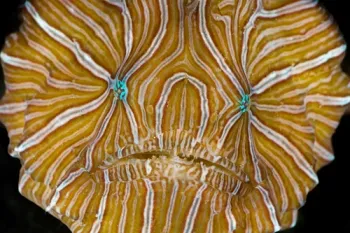
Photo by David Hall / seaphotos.com / CC BY-SA 3.0 via Wikimedia Commons
Swirling Fingerprint Pattern
Look for concentric rings and maze-like pink-white stripes on a peach or yellow-brown body. The pattern is species-specific and stable—it does not shift like a typical camouflaging frogfish.
No Lure, Flat Face
Histiophryne psychedelica lacks the classic illicium (fishing rod) on the snout. The head is broad and flattened compared with Antennarius-style frogfishes.
Small, Fleshy, Scaleless
Skin is flabby and soft; dorsal and ventral fins are incorporated into the body outline for camouflage. Adults reach only about 15 cm—this is a true macro subject.
Hopping Locomotion
When it moves, watch for jet propulsion (gulping water, expelling through gill openings) or awkward hopping rather than the slow "walking" of hairy or painted frogfishes.
Top 10 Fun Facts about Psychedelic Frogfish
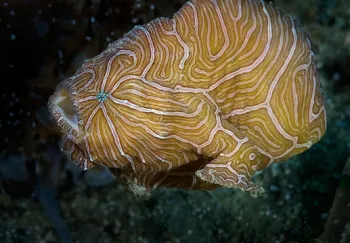
Photo by David Hall / seaphotos.com / CC BY-SA 3.0 via Wikimedia Commons
1. Science's Newest Frogfish Celebrity
Histiophryne psychedelica was formally described in 2009 by Pietsch, Arnold, and Hall in Copeia, based on specimens from Ambon and earlier mystery photos from Bali dating to 1992. The International Institute for Species Exploration named it one of the top 10 new species of 2009.
2. Named for the Pattern, Not the Era
The epithet psychedelica refers to the swirling concentric stripes covering the head, body, and fins—not 1960s counterculture. Researchers compared the maze-like pigment to a fingerprint or paisley fabric.
3. No Lure on the Forehead
Most frogfishes wave a modified dorsal spine (illicium) tipped with a bait (esca) to attract prey. This species completely lacks that apparatus, forcing ichthyologists to rethink how it hunts in rubble without a classic anglerfish lure.
4. Hops Instead of Walks
Observers describe locomotion more like hopping or bouncing across the substrate than the deliberate pectoral-fin walking of many Antennarius frogfishes. When speed matters, it uses jet propulsion—gulping water and shooting it out through restricted gill openings.
5. Fixed Color—No Mood Camouflage
Typical frogfishes can shift pattern and hue to match surroundings. Psychedelic frogfish keep the same swirling stripes; scientists think the pattern mimics certain hard corals rather than adapting live.
6. First Wild Photos Were a Sensation
Buck Randolph, Fitrie Randolph, and Toby Fadirsyair of Maluku Divers photographed wild individuals in January 2008 at Ambon—headline news across diving media before the species even had a Latin name.
7. Preserved Specimens Shrink and Fade
When fixed in formalin and stored in ethanol, specimens shrank about 23% within four months—especially the fleshy cheeks—and all color faded to white. Stripes remained visible only under a dissecting microscope, linking them to the mysterious 1992 Bali "paisley anglers."
8. Egg-Carrying Females
Like some other Histiophryne, females may carry eggs externally on the body, folding pectoral and tail fins around them to form a protective pouch and wiggling to aerate the clutch. A gravid female sighting in Ambon Bay is considered exceptionally special.
9. Each Individual's Pattern Is Unique
Subtle differences in stripe layout let local guides distinguish separate individuals when multiple fish appear in the same season—treating them almost like named residents.
10. Ambon Bay—or Nowhere
Despite the original description mentioning Bali, confirmed recreational sightings cluster in Ambon Bay and nearby Baguala Bay. It is not a Lembeh or Raja Ampat regular; chasing it means booking Ambon muck dives and accepting that absence is normal.
Diving & Observation Notes
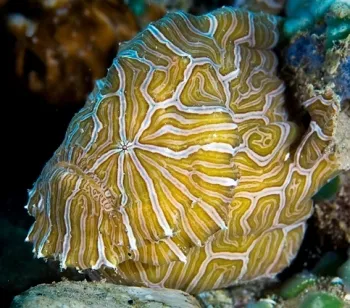
Photo by David Hall / seaphotos.com / CC BY-SA 3.0 via Wikimedia Commons
🧭 Book Ambon, Not a Macro Wishlist Elsewhere
This is an Ambon Bay specialty. Plan multiple muck dives with operators who track local sightings (Laha, Maluku Divers, Dive Into Ambon, etc.) rather than assuming Lembeh or Wakatobi will deliver.
⏳ Manage Expectations—Years Between Sightings
Local logs show multi-year gaps between individuals. Treat a sighting as lottery luck; do not structure an entire Indonesia trip around guaranteed views.
🔦 Shallow Rubble Habitat
Most finds sit in 5-7 m coral rubble and black sand, often tucked under debris. Good buoyancy, a patient guide, and willingness to hover in silty shallows beat fast swimming.
📷 Macro Setup and Ethics
Use 60–100 mm macro, focus on the face pattern and fin details. Never touch, move rubble, or block the fish into a hole—populations are tiny and disturbance can displace the only known individual on a slope.
🐟 Behavior Cues
If it moves, you may see jet propulsion or hopping—rare, memorable footage. Give space; repeated crowding stresses cryptic fish and trains guides to rush divers through.