Seaweed
Marine macroalgae (Chlorophyta, Phaeophyceae, Rhodophyta)
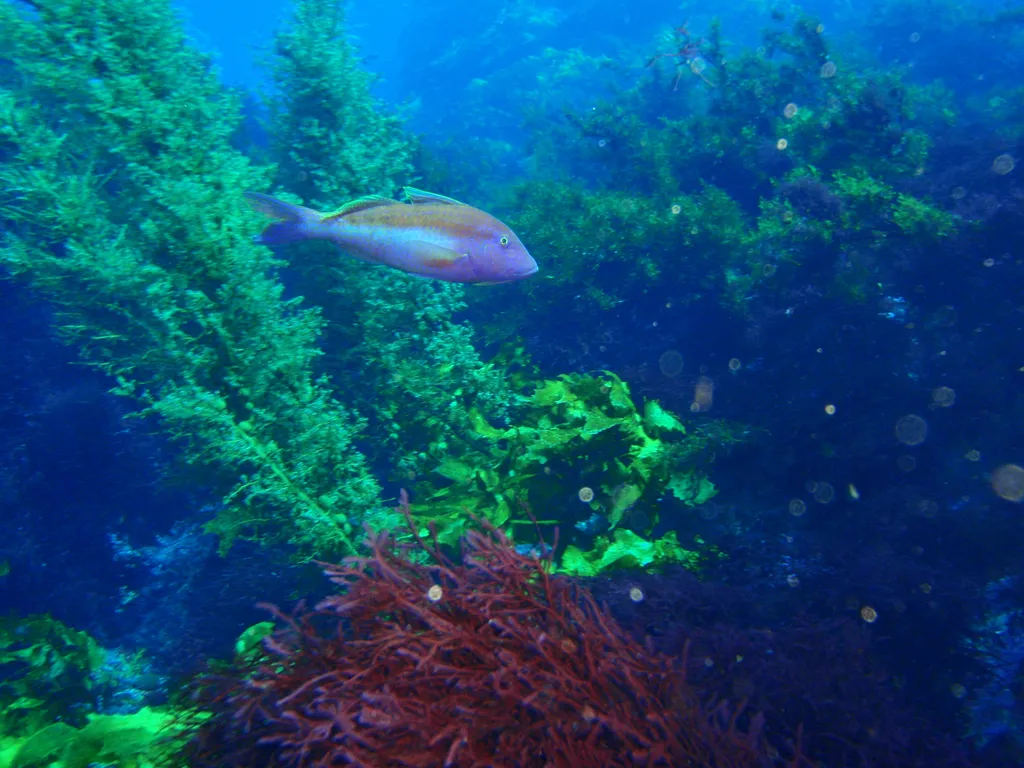
Photo by Peter Southwood / CC BY-SA 3.0 via Wikimedia Commons
For divers used to chasing fish and corals, seaweed can seem like mere background foliage—until you drop into a kelp forest or macroalgae-dominated reef and realize it's the architecture the entire ecosystem is built on. Seaweeds are large marine algae rather than true plants or animals, but they play plant-like roles: fixing carbon via photosynthesis, producing oxygen, and forming three-dimensional habitat. From towering kelp "trees" swaying in the surge to low, turf-like carpets on tropical reefs, seaweed shapes everything from light levels to current patterns. Fish graze on them, invertebrates hide in them, and many iconic species—from weedy seadragons to kelp bass—are impossible to understand without their algal backdrop. For cold-water divers, seaweed is the reef; for tropical divers, algal cover can signal both healthy productivity and, when overgrown, ecosystems under stress.
🔬Classification
📏Physical Features
🌊Habitat Info
⚠️Safety & Conservation
Identification Guide
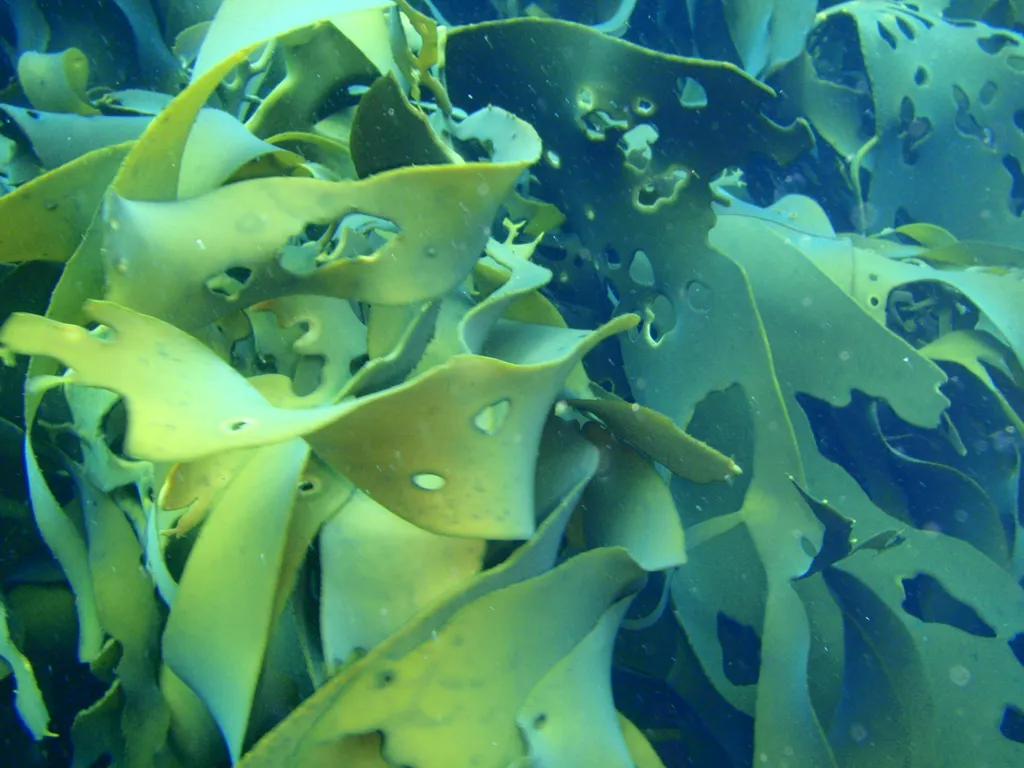
Photo by Peter Southwood / CC BY-SA 3.0 via Wikimedia Commons
- Not a Single Group: "Seaweed" covers green, brown, and red macroalgae—look at overall form rather than trying to force them into one category
- Holdfast, Stipe, Blade: Many large species have a root-like holdfast, a stem-like stipe, and leaf-like blades or fronds (especially kelps)
- Turf vs Canopy: Distinguish low, hair-like or mat-forming turfs from tall canopy-formers (kelps, Sargassum, large red algae)
- Color by Depth: Greens often dominate shallows; browns (including kelps) in mid-depth high-energy zones; reds deeper where red light is filtered out
- Texture: From fleshy and rubbery (kelps) to crisp, calcified (coralline algae) or filamentous and hair-like (turf algae)
- Attachment: Typically anchored to rock, shells, or pebbles; rarely truly free-floating except in drifting Sargassum mats
- No Polyp or Skeleton: Unlike corals and hydroids, no calcareous cups or polyps; tissue is continuous and plant-like
- Seasonal Changes: In temperate zones, note strong seasonal growth—lush spring/summer canopies vs reduced winter cover
Top 10 Fun Facts about Seaweed
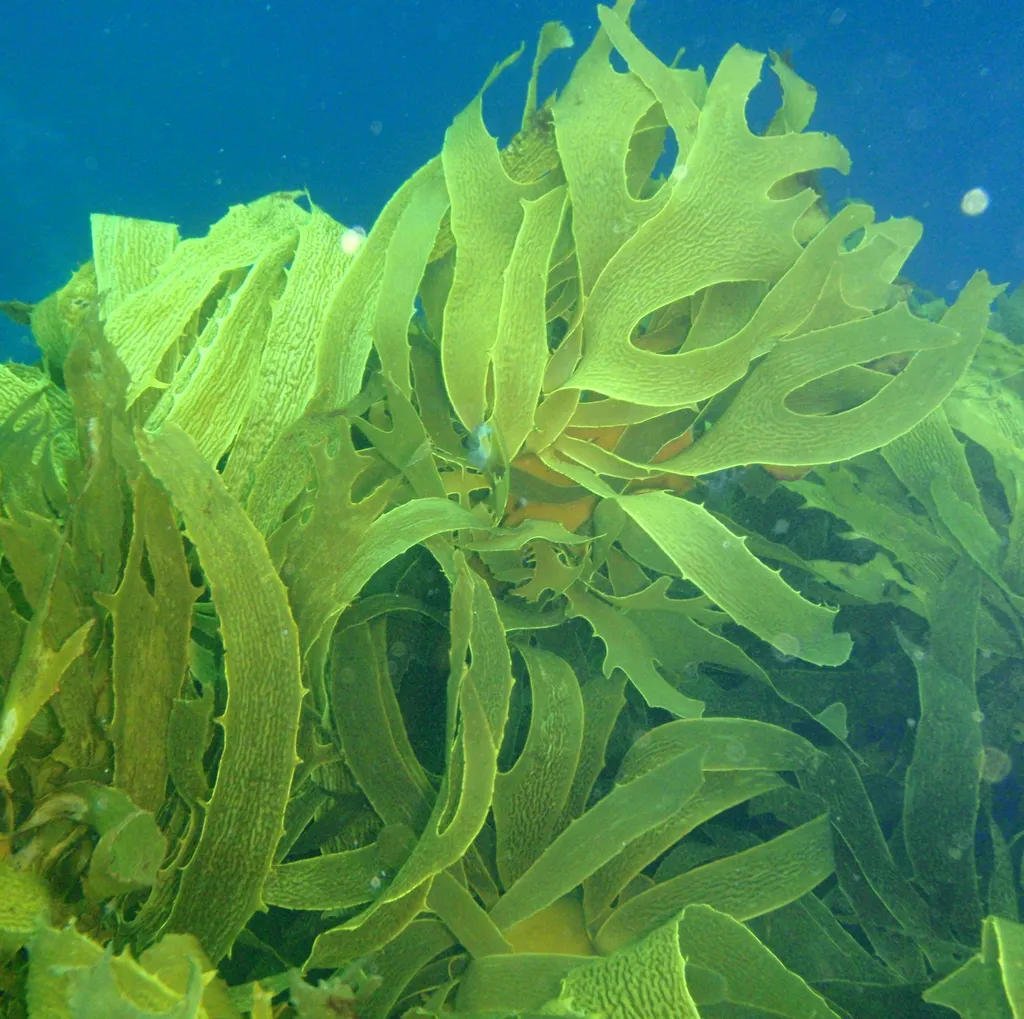
Photo by Peter Southwood / CC BY-SA 3.0 via Wikimedia Commons
1. Not Plants, Not Animals, But Primary Producers
Seaweeds are macroalgae, not true vascular plants and certainly not animals, but ecologically they act as the primary producers of rocky coasts and many reefs. They lack roots, vascular tissue, and flowers; instead, they absorb nutrients directly across their surfaces and use simple holdfasts to anchor to substrate. Despite this simplicity, they drive entire food webs, converting sunlight and dissolved nutrients into biomass that feeds herbivorous fishes, sea urchins, snails, and countless invertebrates. For divers, this means that a lush algal reef—especially in cold water—is often a sign of high productivity, not neglect.
2. Kelp Forests: Underwater Rainforests
Large brown seaweeds known as kelps (order Laminariales) form some of the most spectacular habitats in the ocean: kelp forests. Species like Macrocystis pyrifera (giant kelp) can grow over 30 meters tall, forming canopies that rival terrestrial forests in complexity and productivity. These forests create vertical structure from seafloor to surface, hosting distinct communities in the canopy, mid-water, and understory. Sea otters, seals, rockfish, nudibranchs, and countless others depend on kelp forests for food, shelter, and nursery grounds. For divers, swimming through a healthy kelp forest in clear water—shafts of light cutting through swaying fronds—is one of the closest things underwater to walking through a cathedral.
3. The Color Code: Green, Brown, and Red
Seaweeds are grouped into three main types based largely on their pigments. Green algae (Chlorophyta) have chlorophyll a and b like land plants, giving them vivid green colors and often inhabiting shallow, well-lit zones. Brown algae (Phaeophyceae), including kelps and Sargassum, contain fucoxanthin in addition to chlorophyll, producing brown, olive, or golden hues; they dominate temperate rocky shores and many mid-depth surge zones. Red algae (Rhodophyta) possess phycobiliproteins that absorb blue and green light, allowing them to photosynthesize efficiently in deeper or shaded water; they range from delicate feathery forms to crustose coralline algae that cement reefs together. For divers, noticing which colors occur at which depths can give quick clues about light conditions and habitat type.
4. Habitat Engineers and Carbon Sinks
Seaweeds are major habitat engineers. Large canopy-forming species like kelps and Sargassum radically alter light, current, and sedimentation patterns, creating sheltered understories where different species can thrive. Turf algae and coralline algae stabilize rubble and provide settlement cues for invertebrate larvae and corals. Some seaweed-dominated systems, especially kelp forests and dense Sargassum belts, act as significant carbon sinks, sequestering CO₂ in biomass and sediments. As interest grows in "blue carbon" strategies, seaweeds are being recognized as key players in coastal carbon dynamics. For divers, this means that algal structure is not just scenery—it's infrastructure that shapes who lives where.
5. Boom, Bust, and Urchin Barrens
Seaweed communities can shift dramatically between lush forests and urchin barrens—rocky areas scraped nearly bare by overgrazing sea urchins. When predators of urchins (like sea otters, certain fish, and lobsters) are removed by fishing or hunting, urchin populations can explode, mowing down kelp and other macroalgae faster than they can regrow. The result is a low-diversity, low-structure habitat dominated by urchins and encrusting algae. Conversely, when urchin numbers are controlled, kelp can rebound, bringing back canopy structure and associated biodiversity. For divers, seeing both healthy kelp forests and nearby urchin barrens is a powerful illustration of top-down control in marine ecosystems—and a reminder of how quickly human actions can cascade through food webs.
6. Tropical Turf and Phase Shifts
On tropical reefs, seaweed often exists as low turf algae or fleshy macroalgae growing between corals. In healthy, herbivore-rich systems, grazing fishes and urchins keep algal growth in check, allowing corals to dominate the substrate. But when herbivores are overfished, nutrients increase, or corals die from bleaching or disease, seaweeds can undergo a phase shift, overgrowing dead skeletons and preventing new coral settlement. These algal-dominated states can be stable and hard to reverse. For divers, a reef covered in thick brown or green algae rather than live corals is often a sign of ecological imbalance—too few grazers, too many nutrients, or repeated disturbance. Yet even these reefs may host unique macro life (nudibranchs, blennies, cryptic fishes) adapted to algal canopies.
7. Edible Forests: From Sushi to Snacks
Humans have harvested seaweed for millennia for food, fertilizer, and industry. Edible seaweeds like nori (Pyropia), kombu (Saccharina and related kelps), and wakame (Undaria) are staples in East Asian cuisines and now widely consumed globally. They provide fiber, vitamins, minerals, and unique flavors (umami). Seaweeds are also sources of industrial compounds like agar, carrageenan, and alginate, used in everything from food gels to cosmetics and pharmaceuticals. For divers, recognizing cultivated seaweed farms—rows of ropes with suspended fronds—adds another dimension to understanding coastal seascapes, especially in regions like Japan, Korea, and parts of China and Europe.
8. Chemical Weapons and Defenses
Seaweeds can't run from grazers, so they fight back with chemistry and structure. Some produce tough, leathery tissues or calcify their cell walls (like coralline algae) to wear down herbivore teeth. Others synthesize secondary metabolites—bitter, spicy, or toxic compounds—that deter feeding or inhibit competitors and fouling organisms. These chemical defenses can shape which herbivores eat which algae and can even influence larval settlement of invertebrates and corals. Scientists are exploring algal compounds for potential antiviral, antibacterial, and anticancer drugs. For divers, this means that not all green or brown "salad" on the reef is equally palatable—some patches are chemical minefields carefully tuned by evolution.
9. Drifting Islands: Sargassum and Floating Rafts
Some brown algae, notably Sargassum, form free-floating rafts that can cover vast areas of the ocean. The Sargasso Sea in the North Atlantic is named for these algae, which create a unique pelagic habitat supporting specialized fishes, crabs, and invertebrates. In recent years, massive Sargassum blooms in the tropical Atlantic have created drifting wrack lines that impact coastlines in the Caribbean and West Africa—good habitat at sea but a nuisance (and potential hazard) when they rot on beaches. For divers, encountering Sargassum rafts offshore can be a chance to see juvenile fishes, pelagic nudibranchs, and other open-ocean drifters sheltering among the fronds.
10. Climate Change, Heatwaves, and Shifting Forests
Seaweed communities are on the front lines of climate change. Marine heatwaves have already wiped out iconic kelp forests in some regions (e.g., parts of Western Australia and Northern California), replacing them with urchin barrens or turf-dominated states. Warming waters and changing currents shift species ranges poleward, while stronger storms can rip out shallow algal canopies. Ocean acidification may affect calcifying algae like corallines that help cement reefs. At the same time, some opportunistic seaweeds may expand under higher CO₂ and nutrient conditions. For divers, changes in seaweed cover over just a few years can be dramatic—favorite kelp sites turning barren, or new algal species appearing where they were once rare. Watching these shifts in real time is both scientifically fascinating and personally sobering.
Diving & Observation Notes
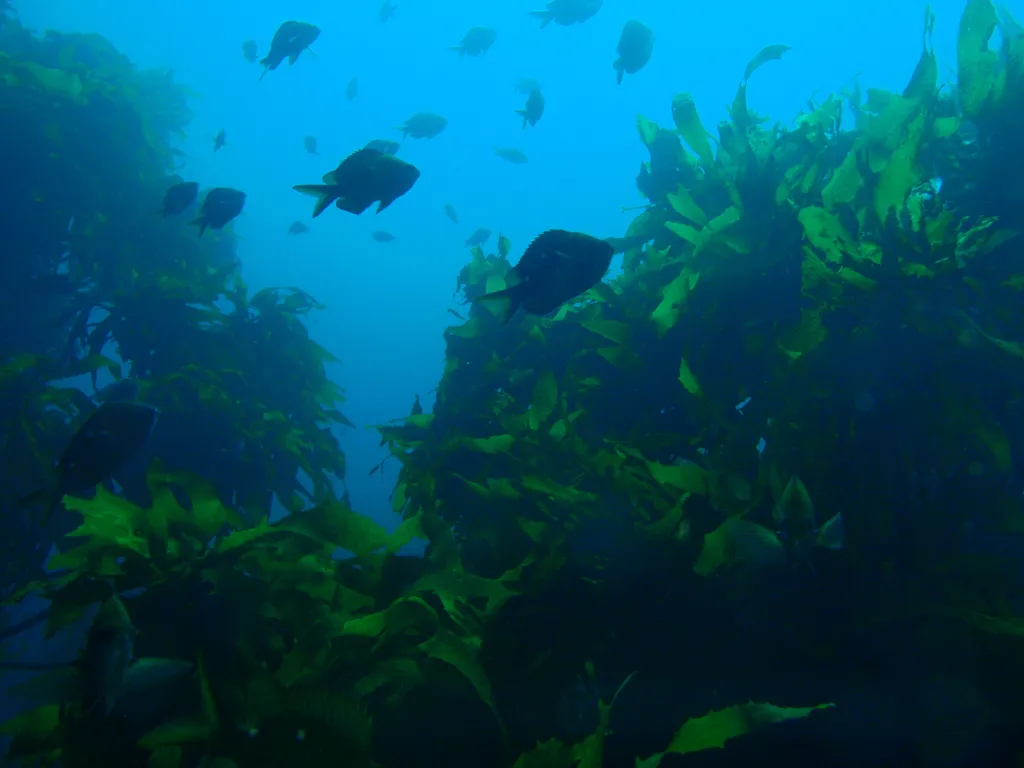
Photo by Peter Southwood / CC BY-SA 3.0 via Wikimedia Commons
🧭 Finding Seaweed
- Cold-Water Coasts: Look for kelp forests and dense macroalgae on rocky temperate shorelines.
- Tidal Zones: Explore intertidal and shallow subtidal zones for diverse green, brown, and red algal forms.
- Reef Edges: On tropical reefs, scan rubble and rock faces for turf and fleshy macroalgae between coral colonies.
- Seasonal Timing: In temperate seas, spring and summer offer peak canopy growth and best "forest" conditions.
🤿 Behavior & Observation
- Swaying Canopies: Watch how fronds move with surge and currents—great for understanding local hydrodynamics.
- Grazing Patterns: Look for bite marks, urchin scars, and fish grazing lines on blades and stipes.
- Micro-Habitats: Examine holdfasts and understory for snails, crabs, nudibranchs, and camouflaged fishes.
- Phase States: Note whether an area is forested (kelp-dominated), barren (urchin-dominated), or coral vs algae dominated.
📸 Photo Tips
- Wide-Angle in Kelp: Use wide lenses to capture towering kelp and light beams; shoot toward the sun for dramatic silhouettes.
- Color Balance: In green or brown water, careful white balance or filters help restore natural colors.
- Macro in Turf: In tropical turf zones, switch to macro for blennies, gobies, and macro critters hiding in the algae.
- Motion: Use slower shutter speeds in kelp forests to capture motion blur of fronds for a sense of movement.
- Backscatter Control: Kelp forests and algal reefs can be particle-heavy—good strobe positioning is crucial.
⚠️ Safety & Ethics
- Entanglement Risk: In dense kelp or Sargassum, secure long hoses and accessories; move slowly to avoid tangles.
- Buoyancy: Avoid crashing into holdfasts or ripping blades—seaweed structure takes seasons to grow.
- No Unnecessary Harvest: Don't rip or collect algae while diving; respect local harvest rules.
- Respect Grazers: Don't disturb key herbivores (e.g., urchins, otters, large fish) that maintain algal balance.
🌏 Best Locations
- California & Pacific Northwest (USA/Canada): Iconic giant kelp forests and bull kelp beds.
- Japan & Korea: Extensive kelp and edible seaweed aquaculture and natural forests.
- UK & Ireland: Temperate kelp reefs with rich invertebrate life.
- New Zealand & Southern Australia: Diverse macroalgal reefs and kelp forests.
- Mediterranean: Cystoseira and other brown algal forests on rocky coasts.