
Thresher Shark
Alopias (genus - 3 species)
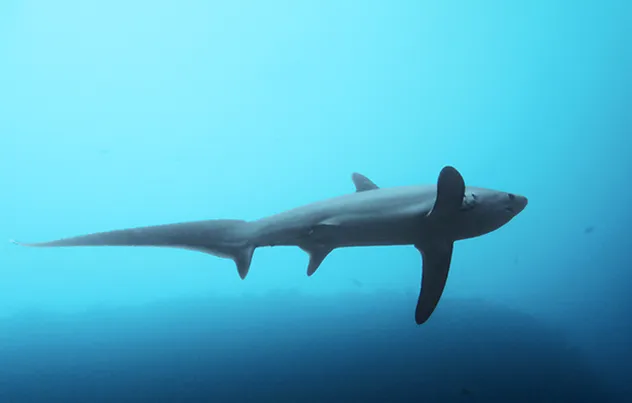
Photo by Jun V Lao / CC BY-SA 4.0 via Wikimedia Commons
If nature held a "most improbable body modification" contest, thresher sharks would be strong contenders with their tail that's literally as long as their entire body. That scythe-shaped caudal fin isn't just evolutionary extravagance - it's a devastating hunting weapon that these sharks wield like a medieval flail, whipping it at speeds exceeding 80 mph to stun entire schools of fish in a single strike. Despite this fearsome hunting ability, thresher sharks are among the ocean's gentlest giants, possessing tiny teeth and mouths so small they couldn't bite a human even if they wanted to (which they emphatically don't). For divers willing to make pre-dawn dives at specific locations like Malapascua Island in the Philippines, witnessing thresher sharks gliding gracefully through blue water, their impossibly long tails trailing like silk ribbons, represents one of diving's most elegant and privileged encounters.
🔬Classification
📏Physical Features
🌊Habitat Info
⚠️Safety & Conservation
Identification Guide

Photo by Petter Lindgren / CC BY-SA 3.0 via Wikimedia Commons
- Extremely Long Tail: Scythe-shaped tail fin as long as or longer than body
- Small Dorsal Fin: Much smaller than tail fin
- Large Eyes: Particularly prominent in bigeye species
- Pointed Snout: Short, conical head
- Slender Build: Streamlined, fusiform body
- Small Mouth: Tiny teeth, small gape
- Coloration: Metallic blue-gray back, clean white belly
- Species Distinctions:
- Common: Largest, rounded pectoral tips, back extends over pectorals
- Pelagic: Smallest, straight pectoral edges, white extends above pectorals
- Bigeye: Huge eyes, deep grooves on head
Top 10 Fun Facts about Thresher Shark
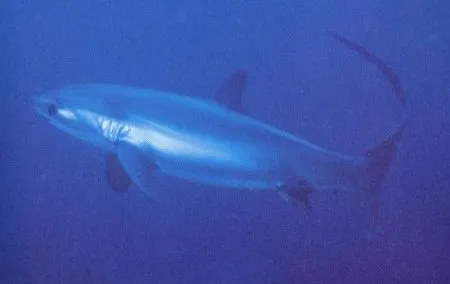
Photo by Kevin Deacon / CC BY-SA 3.0 via Wikimedia Commons
1. The Ultimate Tail Whip: Nature's Fastest Strike
The thresher shark tail isn't just long - it's a precision weapon capable of incredible speeds. High-speed underwater photography has captured tail whips reaching speeds of 80 mph (130 km/h) - faster than a cheetah runs. The physics are brutal: the shark approaches a fish school, brakes hard using its pectoral fins, then swings the tail overhead in a blurring arc. The tip of the tail creates a shockwave in the water that stuns or kills multiple fish simultaneously through cavitation bubbles and pressure waves. Scientists have documented single tail strikes stunning up to seven fish at once. Success rate? About 50%, but one successful strike can provide multiple meals. It's like using a bullwhip made of muscle and cartilage traveling at highway speeds.
2. Half Shark, Half Tail: Extreme Body Proportions
In most thresher shark species, the tail accounts for roughly 50% of total body length. A 6-meter common thresher shark has a 3-meter tail - as long as an adult human is tall. This creates bizarre proportions: the actual "shark" body is relatively small and slender, looking almost comically undersized for the massive tail appendage. This extreme tail length comes with trade-offs: threshers are slower swimmers than similarly-sized sharks, less agile in confined spaces, but absolutely devastating in open water hunting. The tail also makes them vulnerable to fishing gear - they're easily entangled in nets where other sharks might escape.
3. Three Species, Three Niches
The thresher family contains three distinct species with different adaptations. The common thresher (Alopias vulpinus) is largest at up to 6 meters, found in coastal and open ocean worldwide, and the most frequently encountered by humans. The bigeye thresher (A. superciliosus) has enormous eyes adapted for deep water hunting, undertakes daily vertical migrations (deep during day, shallow at night), and possesses a special vascular system (rete mirabile) to maintain brain temperature during depth changes. The pelagic thresher (A. pelagicus) is smallest at 3 meters, exclusively tropical/subtropical, and found primarily in Indo-Pacific waters. Each species has refined tail-whipping for their specific hunting environment.
4. Malapascua Miracle: The Only Reliable Thresher Dive
Malapascua Island in the Philippines holds a unique distinction: it's the only place on Earth where divers can reliably see thresher sharks on recreational dives. At Monad Shoal, a underwater plateau at 20-30 meters, pelagic threshers ascend from deep water to visit cleaning stations every dawn. These sharks normally inhabit depths of 100-300+ meters and are nocturnal, making surface encounters virtually impossible elsewhere. But at Malapascua's cleaning stations, divers making 5-6am dives have >90% chance of encountering threshers being serviced by cleaner wrasse. It's become a pilgrimage site for shark enthusiasts, transforming a small Philippine island into a global diving destination entirely through this one species.
5. Gentle Giants: Tiny Teeth, Zero Threat
Despite their formidable hunting ability, thresher sharks pose zero threat to humans. Their teeth are tiny - designed for gripping small fish, not tearing flesh - and their mouths are remarkably small relative to body size. They couldn't effectively bite a human even if motivated, and they're emphatically not motivated. Threshers are among the most timid large sharks, typically fleeing from divers rather than investigating. There are zero recorded fatalities from thresher shark attacks worldwide, and the handful of recorded "attacks" were cases of panicked sharks thrashing their tails while caught in nets, accidentally striking fishermen. In the water with divers, they're graceful, cautious, and completely non-aggressive.
6. Breaching Behavior: Why Jump?
Thresher sharks are among the few shark species that regularly breach - leaping completely out of the water. Videos show them launching themselves 3+ meters into the air, sometimes performing complete rotations. But why? Theories include: 1) stunning birds on the surface (some evidence supports this), 2) removing parasites through impact, 3) communication/social display, 4) pure play behavior, 5) escaping predators (orcas hunt threshers). The most dramatic theory suggests they use breaching as a hunting technique for seabirds, timing their leap to coincide with diving birds, stunning them mid-air with the tail. Whatever the reason, witnessing a thresher breach is spectacular - a 6-meter shark executing an aerial ballet.
7. Tragic Reproduction: Intrauterine Cannibalism
Thresher shark reproduction involves a gruesome process called oophagy - embryos eating eggs inside the mother's uterus. Females produce many eggs, but only 2-4 pups survive to birth. Inside each of the two uteri, the first embryo to develop teeth begins consuming unfertilized eggs and smaller embryos, essentially cannibalizing siblings before birth. The surviving pups are born very large - up to 1.5 meters long - having spent months feasting on their would-be siblings. This strategy produces few offspring but ensures they're large enough to avoid many predators. Combined with late maturity (8-14 years) and slow reproduction (every 1-3 years), this makes thresher populations extremely vulnerable to overfishing.
8. Deep-Eye Adaptation: The Bigeye's Superpower
The bigeye thresher has eyes that can be 10cm in diameter - among the largest eyes relative to body size of any shark. These massive eyes contain specialized adaptations: high rod cell density for low-light vision, a tapetum lucidum (reflective layer) to amplify available light, and the ability to rotate upward to scan above while swimming horizontally. Most remarkably, they possess a vascular heat exchange system that keeps the eyes and brain 5-10°C warmer than surrounding water, allowing efficient function during rapid depth changes. This allows bigeyes to hunt in the deep scattering layer (200-500m) during day and follow prey to surface at night - a vertical migration of hundreds of meters daily.
9. Conservation Crisis: Fishing's Collateral Damage
All three thresher species are IUCN listed as Vulnerable to Critically Endangered. The problem? Their tails make them extraordinarily vulnerable to fishing gear - longlines, gillnets, and trawls easily entangle the elongated caudal fin. They're caught as both target species (meat, fins, liver oil) and bycatch. Some populations have declined >80% in recent decades. Their late maturity and slow reproduction mean populations can't recover quickly. The beautiful tail that makes them fascinating to divers is precisely what makes them easy to catch and slow to recover. Protection efforts focus on banning targeting, requiring release of bycatch, and creating marine protected areas around key habitats like Malapascua.
10. The Photographer's Challenge: Blue Water Grace
Photographing thresher sharks presents unique challenges that make quality images rare and valuable. They're shy and keep distance, approaching close only at cleaning stations. The tail creates composition challenges - getting both head and tail tip in frame requires wide angle or significant distance. They move continuously and gracefully, making focus difficult. Most encounters happen in deep blue water with no reference points, requiring skilled buoyancy and awareness. And crucially, the best encounters happen at dawn in 20-30m depth, meaning low light and deeper nitrogen loading. Yet the payoff - images of a thresher suspended in blue with that impossible tail gracefully curved - represents some of diving's most iconic shark photography.
Diving & Observation Notes
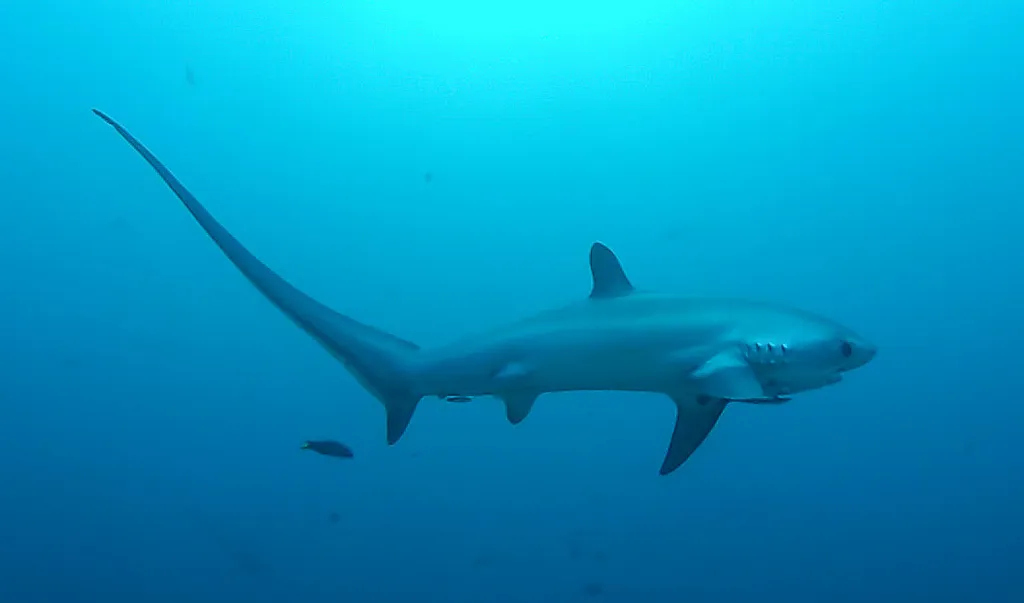
Photo by Thomas Alexander / CC BY-SA 4.0 via Wikimedia Commons
🧭 Finding Thresher Sharks
- Malapascua (Philippines): The only reliable place in the world for daily sightings.
- Monad Shoal: A sunken island at 20-30m depth where they come to be cleaned at dawn.
- Timing: Early morning (4:30 AM - 7:00 AM) is the peak time.
🤿 Behavior & Observation
- Cleaning Stations: They visit specific coral heads to have parasites removed by cleaner wrasse.
- Shy Giants: They are timid and easily spooked. Stay low and still.
- No Chasing: Never swim towards them; let them circle and approach you.
📸 Photo Tips
- Low Light: High ISO (800+) and fast lenses are needed for pre-dawn deep dives.
- No Strobes: Flash photography is strictly forbidden at Monad Shoal to avoid scaring them.
- Silhouettes: Look for opportunities to shoot them against the surface light.
- Wide Angle: Essential to fit the incredibly long tail in the frame.
⚠️ Ethics
- Designated Areas: Stay behind the rope or marker lines at cleaning stations.
- Silence: Minimize noise and bubbles to encourage closer passes.
- Respect: These are vulnerable species; observe without disturbing their cleaning routine.
🌏 Best Locations
- Malapascua (Philippines): The undisputed capital for thresher shark diving.
- Fuvahmulah (Maldives): Occasional sightings in deep water.
- Brother Islands (Red Sea): Rare but possible encounters on deep drop-offs.
Best Places to Dive with Thresher Shark

Malapascua
Malapascua is a small island off the northern tip of Cebu famed for its resident thresher sharks. Every morning at dawn, divers ride out to Monad Shoal and sit on a coral plateau 20–30 m deep, quietly watching as pelagic threshers rise from the abyss to use the cleaning station. But the excitement doesn’t end once the sharks disappear into the blue—around the island you’ll find coral‑covered pinnacles, drift dives, walls and gentle reef slopes teeming with life. Macro hunters can stalk flamboyant cuttlefish, pygmy seahorses and frogfish in the muck around Dauin, while wide‑angle lovers will enjoy schooling jackfish, batfish and barracuda at sites like Bugtong Bato and Gato Island. A relaxed village atmosphere, white‑sand beaches and day trips to neighbouring islands such as Kalanggaman or Capitancillo round out the experience.
Socorro
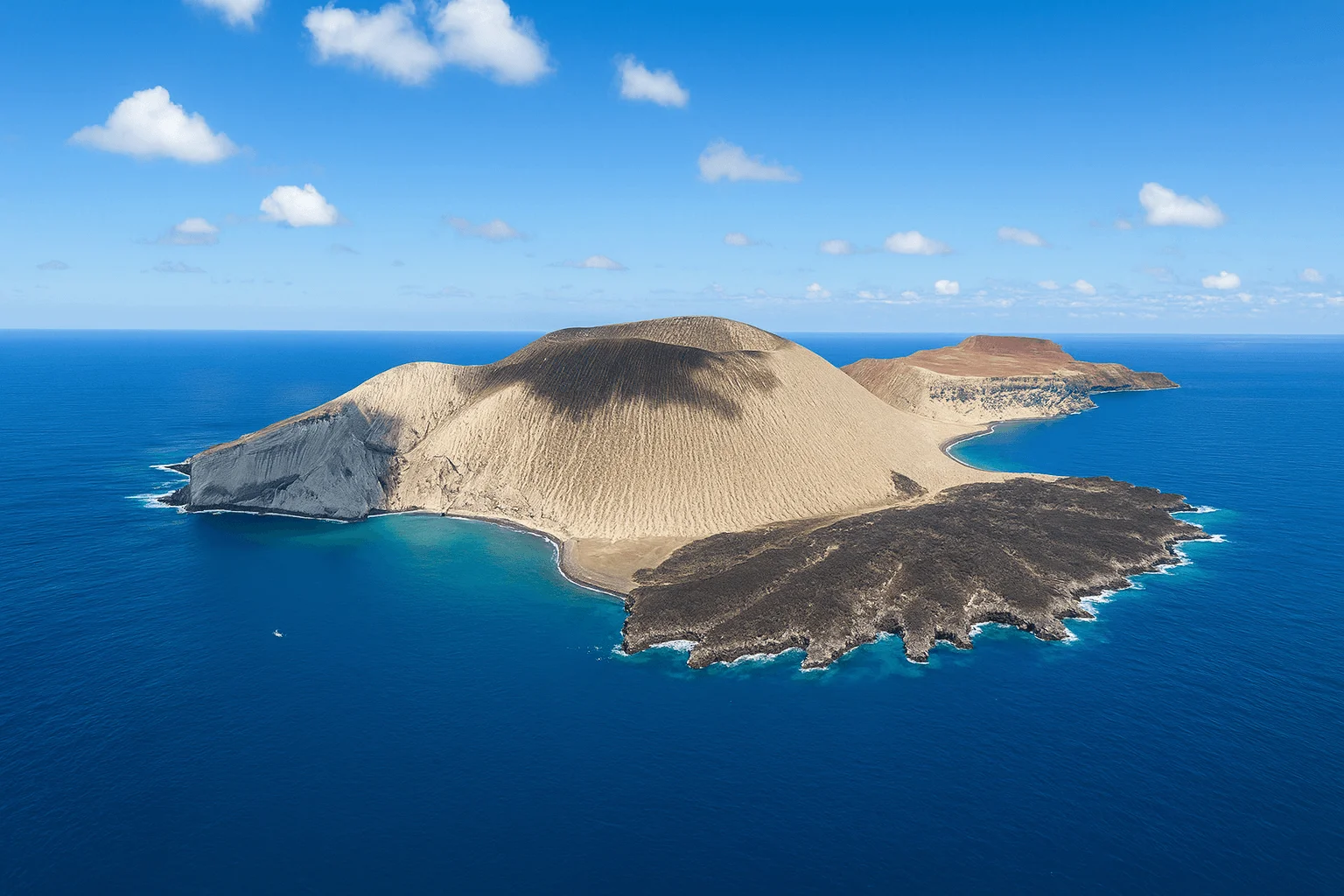
The Revillagigedo Archipelago—better known simply as Socorro—is Mexico’s answer to the Galápagos. Located 400 km off the Baja California coast, this remote chain of volcanic islands (San Benedicto, Socorro, Roca Partida and Clarion) can only be reached by liveaboard. The reward for the 24‑hour crossing is a pelagic wonderland where giant Pacific manta rays circle close enough to touch, hammerhead sharks school in the blue, and humpback whales breach beside the boat. Rugged pinnacles and walls drop into deep blue water, attracting a myriad of large predators and making Socorro one of the world’s great big‑animal dive destinations.

Maldives
Scattered across the Indian Ocean like strings of pearls, the Maldives’ 26 atolls encompass more than a thousand low‑lying islands, reefs and sandbanks. Beneath the turquoise surface are channels (kandus), pinnacles (thilas) and lagoons where powerful ocean currents sweep past colourful coral gardens. This nutrient‑rich flow attracts manta rays, whale sharks, reef sharks, schooling jacks, barracudas and every reef fish imaginable. Liveaboards and resort dive centres explore sites such as Okobe Thila and Kandooma Thila in the central atolls, manta cleaning stations in Baa and Ari, and shark‑filled channels like Fuvahmulah in the deep south. Diving here ranges from tranquil coral slopes to adrenalin‑fuelled drifts through current‑swept passes, making the Maldives a true pelagic playground.