
Walrus
Odobenus rosmarus
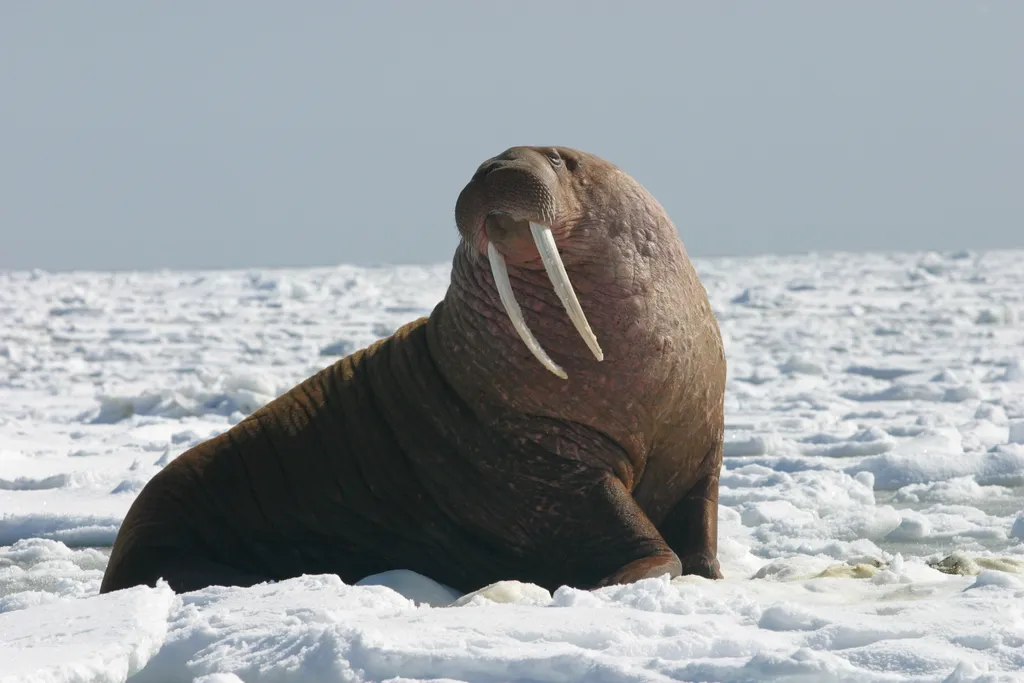
Photo by Joel Garlich-Miller via Wikimedia Commons
The Walrus is the Arctic's gentle giant—massive, whiskered, and equipped with the most impressive tusks in the marine world. With their long, ivory tusks (up to 1 meter) and 700 sensitive whiskers, they are perfectly adapted to life in the frozen north. They use their tusks as ice picks, social tools, and status symbols, while their whiskers act as underwater "fingers" to detect clams buried in the seafloor. Encountering a walrus underwater is rare and special—these are the true "tooth walkers" of the Arctic.
🔬Classification
📏Physical Features
🌊Habitat Info
⚠️Safety & Conservation
Identification Guide
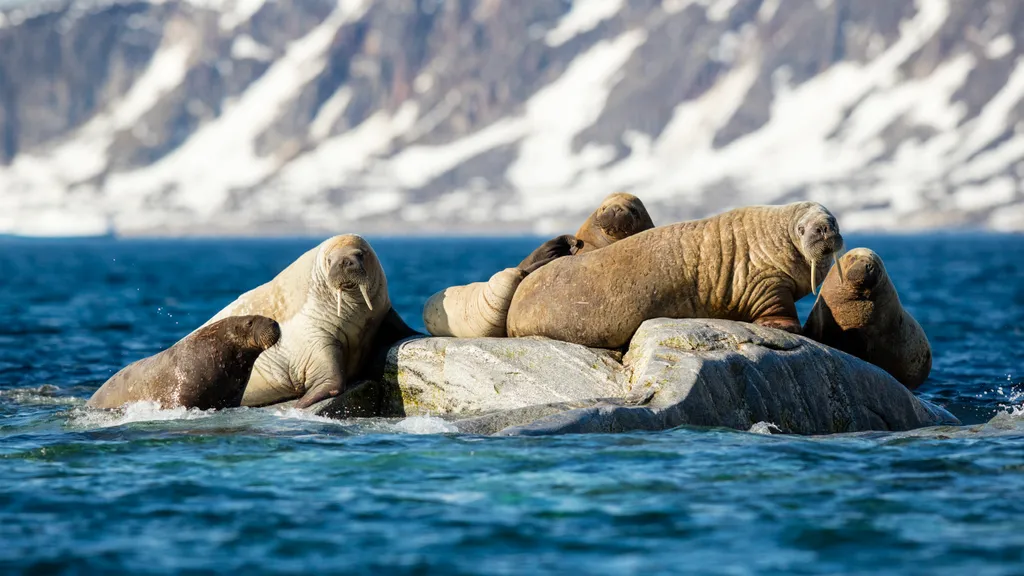
Photo by Godot13 / CC BY-SA 4.0 via Wikimedia Commons
Field marks:
- Long Tusks: The most obvious feature—elongated upper canine teeth that can reach 1 meter (3.3 feet) in length. Both males and females have tusks, but males' are longer and thicker.
- Whiskers (Vibrissae): Dense "mustache" of 400–700 stiff, sensitive whiskers around the mouth and snout.
- Massive Size: Very large, robust body. Adult males can weigh up to 2,000 kg (4,400 lbs).
- Thick Skin: Wrinkled, thick skin (up to 10 cm on neck and shoulders), especially in males.
- Small Ear Flaps: Small external ear flaps (unlike true seals which have none).
- Color Change: Skin can appear pale (cold) or pink/reddish (warm) depending on blood flow.
Differences from Similar Species
- Seal: Much smaller; no tusks; smooth skin; cannot use tusks to haul onto ice.
- Sea Lion: Smaller; no tusks; has external ear flaps but much smaller than walrus; different habitat (temperate/tropical, not Arctic).
- Elephant Seal: Large but no tusks; found in different regions (not Arctic); different body shape.
Juvenile vs. Adult
Calves are born without visible tusks (they start growing after a few months). Young walruses are smaller and have smoother, less wrinkled skin. Adult males are significantly larger and have longer, thicker tusks than females.
Top 10 Fun Facts about Walrus
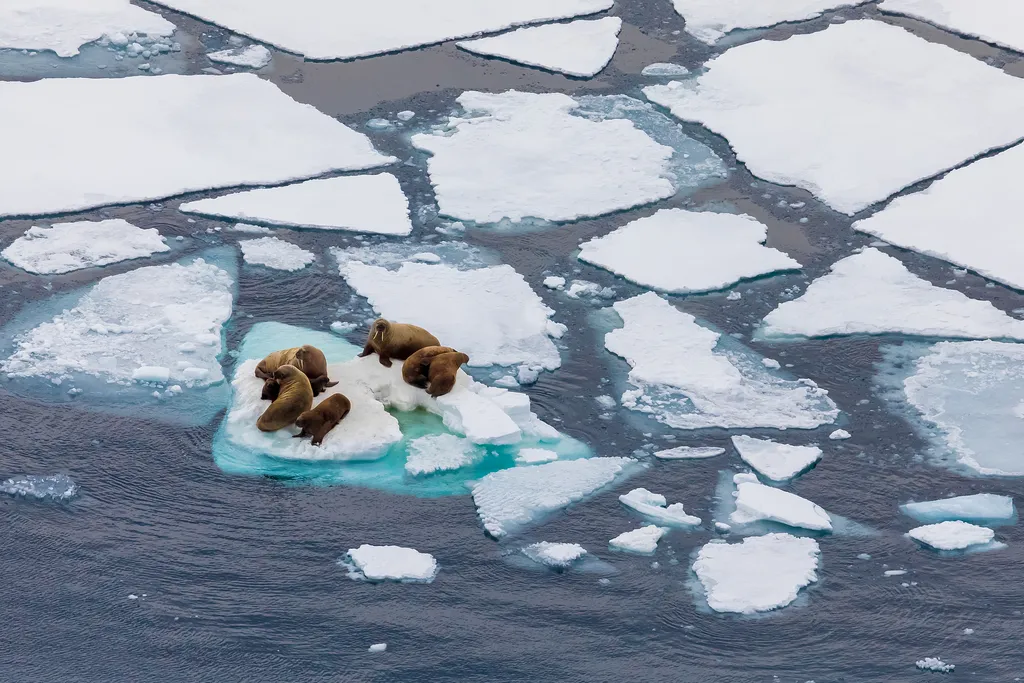
Photo by Kirill.uyutnov / CC BY-SA 4.0 via Wikimedia Commons
1. The "Tooth Walker"
The scientific name Odobenus means "tooth walker" in Greek. Walruses use their tusks like ice axes, hooking them into ice floes and using them as leverage to haul their massive bodies (up to 2,000 kg) out of the water. Watching a walrus "walk" up an ice floe using only its tusks is one of nature's most impressive feats of engineering.
2. The 700 Whisker Mustache
Walruses have the most impressive facial hair in the animal kingdom—400 to 700 stiff, sensitive whiskers (vibrissae) arranged in dense rows around their mouths. These whiskers are so sensitive they can detect clams buried 30 cm deep in the seafloor. They work like underwater fingers, allowing walruses to "feel" their way through the dark, murky Arctic seafloor.
3. The Suction Feeding
Walruses don't crush shells with their teeth. Instead, they use powerful suction to extract clams, mussels, and other bivalves from their shells. They create a vacuum with their mouth and literally suck the meat out, leaving empty shells behind. They can consume 3,000–6,000 clams in a single feeding session.
4. The Deep Diver
While they typically forage at depths of 10–100 meters, walruses are capable of extraordinary deep dives. Some individuals have been recorded diving to depths exceeding 500 meters (1,640 feet). They can hold their breath for up to 30 minutes, though most dives last 2–5 minutes.
5. The Blushing Skin
Walruses have a unique ability to change color. In cold water, blood vessels constrict, making their skin appear pale or white. When they warm up (on land or in shallow water), blood vessels dilate, and their skin can turn pink or even bright red. This is a form of thermoregulation—they're literally blushing to cool down.
6. The Social Huddle
Walruses are highly social and form massive aggregations called "haul-outs" on ice or land. These can number in the thousands—imagine a sea of brown, tusked bodies piled on top of each other. They use vocalizations (barks, grunts, clicks, whistles) to communicate, creating a constant cacophony.
7. The Tusk Hierarchy
Tusks are status symbols. Longer, thicker tusks indicate dominance and age. Males use their tusks to establish social hierarchy, engaging in displays and sometimes combat. The tusks can also be used defensively against predators like polar bears. In some populations, tusks can grow up to 1 meter long.
8. The Ice Breaker
Walruses use their tusks to break through ice from below, creating breathing holes. They can maintain these holes in ice that's meters thick, using their tusks and powerful head movements to keep them open. This is crucial for survival in the frozen Arctic, where ice can be several meters thick.
9. The Arctic Specialist
Walruses are found only in the Arctic—they're the most northerly pinniped. There are two subspecies: Atlantic walrus (found in the North Atlantic and Arctic Ocean) and Pacific walrus (found in the Bering and Chukchi Seas). They're perfectly adapted to life on and under ice.
10. The Long Life
Walruses are long-lived, with a lifespan of up to 40 years in the wild. They reach sexual maturity slowly (males at 8–10 years, females at 5–7 years) and have a long gestation period (15–16 months). This slow reproductive rate, combined with threats from climate change and hunting, makes them vulnerable to population decline.
Diving & Observation Notes
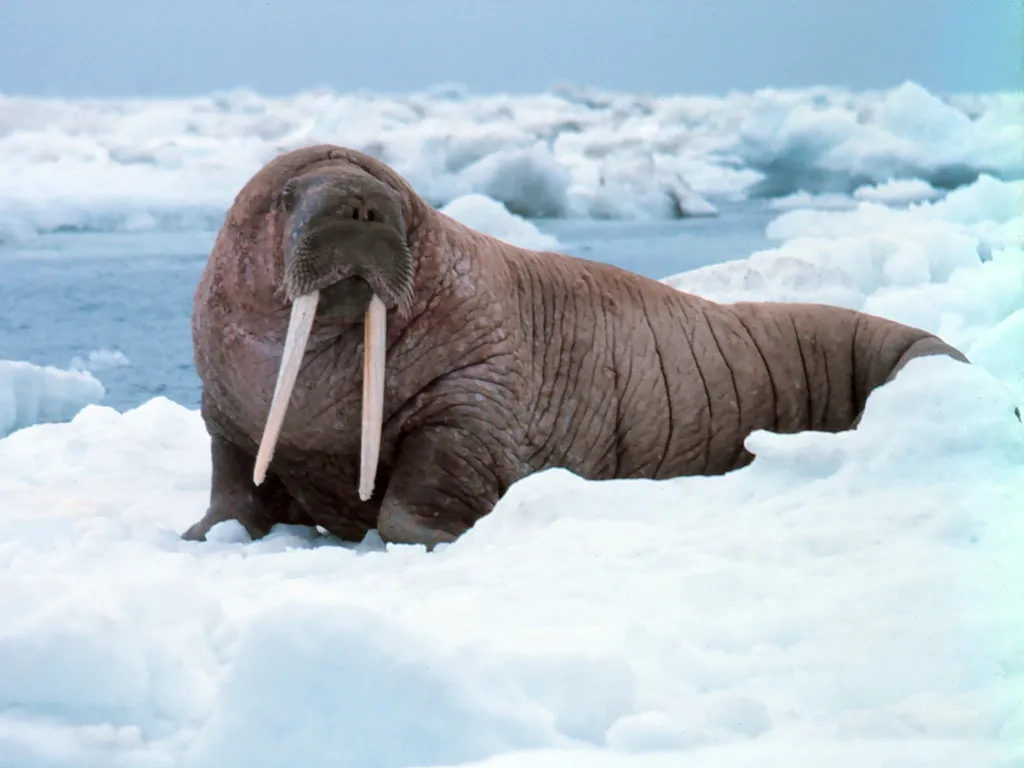
Photo by Captain Budd Christman via Wikimedia Commons
🧭 Finding Walruses
Walruses are found only in the Arctic—Svalbard, Alaska, Canada, Greenland, and the Russian Arctic. Look for them near ice floes, haul-out sites on land, or in shallow coastal waters where they forage for clams. The best encounters happen when they're in the water, foraging on the seafloor.
🤿 Approach & Behavior
- Extreme Caution: Walruses are large, powerful animals. While generally not aggressive toward divers, they can be dangerous if threatened or if you get between a mother and calf.
- Respect Distance: Maintain a respectful distance (at least 10–15 meters). Don't approach too closely, especially if they're on ice or land.
- Tusk Awareness: Be very aware of their tusks. They can move quickly and use their tusks defensively. Never get between a walrus and its escape route.
- Ice Diving: Diving with walruses often requires ice diving skills. This is advanced diving and should only be attempted with proper training and equipment.
📸 Photo Tips
- Wide Angle: Essential for capturing their massive size. A fisheye lens helps show their impressive tusks and whiskers.
- The Mustache Shot: Get close enough (safely!) to capture the incredible detail of their 700 whiskers. It's a unique feature.
- Tusk Detail: The tusks are their signature feature. Try to capture them in profile or from the front to show their impressive length.
- Natural Light: In clear Arctic water, natural light can create beautiful images, especially when they're near the surface.
⚠️ Ethics & Safety
- No Touching: Never attempt to touch a walrus. They are wild animals and can be unpredictable. Their tusks are extremely sharp.
- Respect Haul-Outs: If walruses are on ice or land, keep your distance. Disturbing them can cause stampedes, which can be fatal for young or weak individuals.
- Climate Sensitivity: Walruses are highly sensitive to climate change. Be aware that their habitat is rapidly changing, and encounters may become rarer.
- Polar Bear Risk: In areas where walruses are found, polar bears may also be present. Be aware of your surroundings.
🌏 Local Guide Nuggets
- Svalbard (Norway): One of the most accessible places to see walruses. Boat trips to haul-out sites are common, and diving encounters are possible in summer.
- Alaska (USA): Pacific walruses are found in the Bering and Chukchi Seas. Specialized Arctic diving tours are available.
- Arctic Canada: Atlantic walruses are found along the northern coast. Ice diving with walruses is possible but requires extreme cold-water experience.
- Greenland: Both Atlantic and Pacific walruses can be found. Remote locations require specialized expeditions.
- Russian Arctic: Large populations but difficult to access. Requires special permits and expedition-level logistics.