
Flamboyant Cuttlefish
Metasepia pfefferi
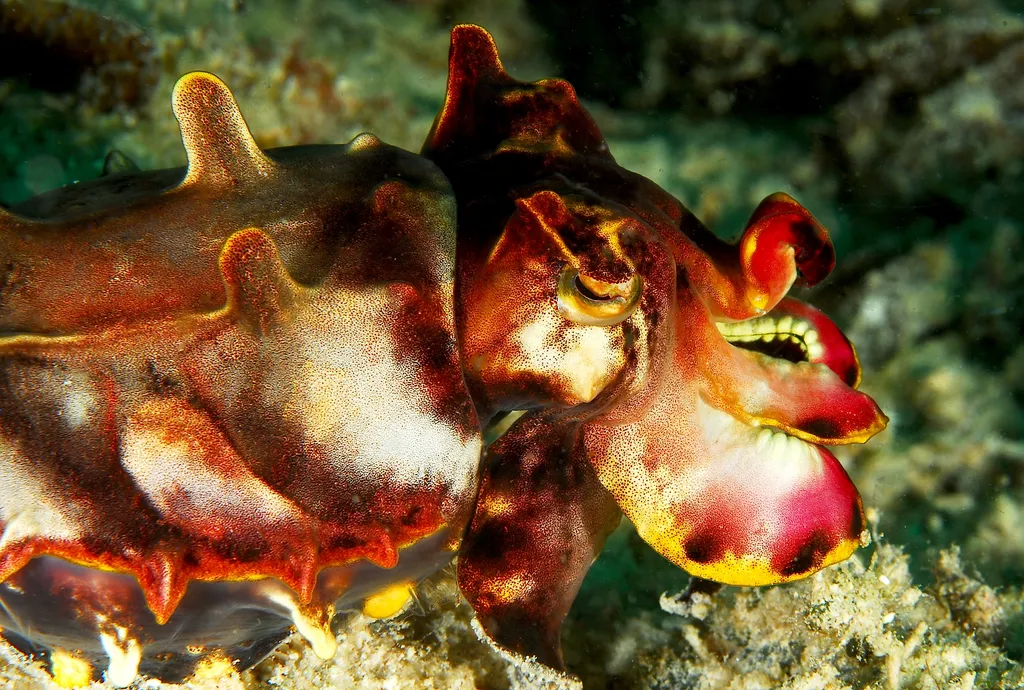
Photo by Jenny (JennyHuang) from Taipei / CC BY 2.0 via Wikimedia Commons
The Flamboyant Cuttlefish (Metasepia pfefferi) is the muck diver's walking rainbow—a dwarf cephalopod that abandoned mid-water hovering for life on the sand. Most of the time it vanishes as a drab brown smudge on black volcanic silt; alarm it and it erupts into pulsing black-white-yellow-purple waves with red arm-tip flashes in under a second—a classic aposematic warning backed by genuinely toxic muscle tissue. Unlike reef cuttlefish that jet and hover, this species ambles across the seabed on blade-like arm tips, hunting shrimp and crabs in broad daylight on the same muck slopes where you chase frogfish and mimic octopus. Small, spectacular, and hands-off: one of the most coveted macro subjects in the Indo-Pacific, and one of the few cephalopods you should never touch.
Taxonomic note: WoRMS now accepts the name Ascarosepion pfefferi (2023 reclassification); Metasepia pfefferi remains widely used in field guides and dive literature.
🔬Classification
📏Physical Features
🌊Habitat Info
⚠️Safety & Conservation
Identification Guide
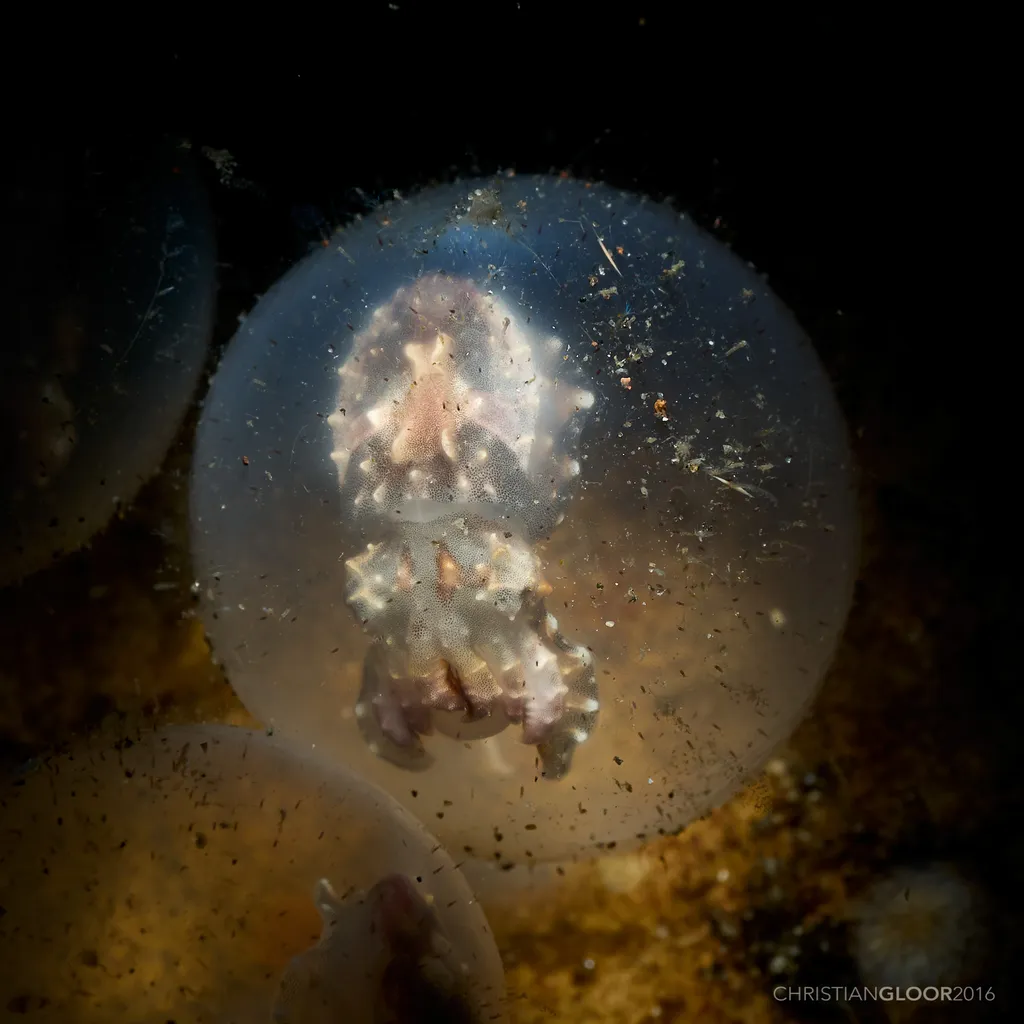
Photo by Christian Gloor from Wakatobi Dive Resort / CC BY 2.0 via Wikimedia Commons
Search black sand or muddy rubble slopes at 5–15 m for a small patch that moves along the bottom—not a hovering cuttlefish. Key field marks:
- Walking gait on lower arm tips; body stays on or just above the substrate
- Broad, blade-like arms relative to a compact mantle
- Cryptic mode: dark brown mottling that matches silt and shell hash—this is what you see 90% of the time
- Flamboyant mode: black-white-yellow-purple rippling bands with red flashes at arm tips—only when disturbed, hunting intensely, or courting
- Tiny anterior cuttlebone (diamond-shaped, far shorter than the mantle)—explains the benthic lifestyle
Don't Confuse With
- Common reef cuttlefish (Sepia spp.): larger, hover and jet over reef or sand; longer cuttlebone; not toxic; rarely walk
- Broadclub cuttlefish (Sepia latimanus): much larger (mantle to ~50 cm); hovers mid-water; bold zebra displays but no walking habit
- Stumpy/Reaper cuttlefish (Metasepia tullbergi): sister species that also walks; drabber brown tones, lacks the vivid aposematic palette; Japan/West Pacific
- Mimic octopus: eight arms only (no feeding tentacles), no cuttlebone; white teardrop + U marks on mantle
Juvenile vs. Adult
Hatchlings emerge as miniature adults—already walking and color-shifting. Females grow to roughly twice male size; both sexes are dwarf cuttlefish with total arm span usually under ~10 cm.
Top 10 Fun Facts about Flamboyant Cuttlefish
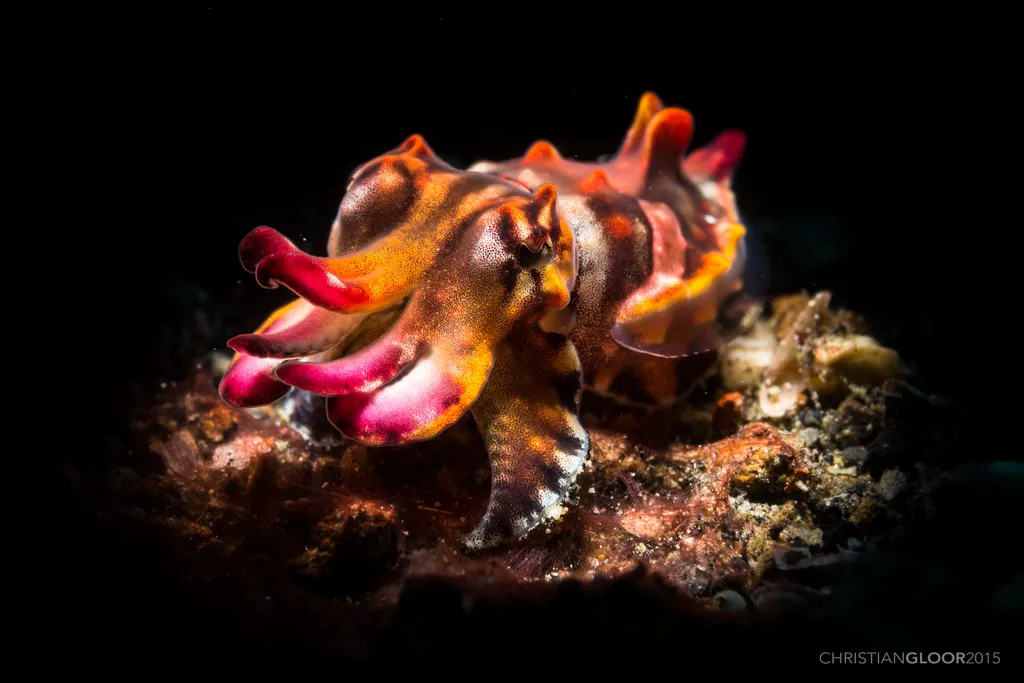
Photo by Christian Gloor from Wakatobi Dive Resort / CC BY 2.0 via Wikimedia Commons
1. The Only Cuttlefish That Walks
Every other cuttlefish you've met hovers like a submarine—adjusting its cuttlebone and fin to hang in the water column. The flamboyant cuttlefish said no thanks. Its cuttlebone is a tiny diamond parked in the front two-thirds of the mantle, far too small to support neutral buoyancy. So it ambles across the sand on the tips of its lower arms, rippling the broad arm membranes like a slow-motion caterpillar. Divers who expect cephalopod elegance get something closer to a psychedelic slug—and that's exactly the point. Staying benthic keeps it on the muck slopes where shrimp and crabs are abundant, and away from mid-water predators that hunt hovering cuttlefish.
2. Two Modes: Invisible Brown Lump vs. Walking Neon Sign
Hanlon's lab at the Marine Biological Laboratory clocked the switch from cryptic dark brown to full flamboyant display in roughly 700 milliseconds—faster than you can raise a camera. Most of the time the animal is a camouflaged smudge indistinguishable from silt. Threatened, hunting, or courting, it fires up rippling waves of black, white, yellow, and purple that pulse along the body and arms. The transition isn't random decoration; it's a context-dependent signal—hide when safe, scream "don't eat me" when cornered. For photographers, the frustration is real: the best colors appear when you should back off, not crowd in.
3. Toxic Muscle Behind the Fireworks
This isn't bluffing. Flamboyant cuttlefish are one of the few venomous cephalopods, with a unique toxin in their muscle tissue. The psychedelic display is classic aposematism—advertising unpalatability the way poison frogs flash bright colors. Literature has compared the toxicity to blue-ringed octopus levels, though contact risk for divers is low if you simply don't touch or eat them. The vivid palette isn't for your Instagram; it's for predators that might otherwise snap up a bite-sized mollusk on an open sand flat. Observe from distance, never handle, and definitely don't order it at a seafood market.
4. The Microscopic Buoyancy Failure
A normal cuttlebone runs nearly the full length of the mantle—an internal float that lets reef cuttlefish hover effortlessly. The flamboyant's is a stubby diamond sitting anteriorly, occupying only about two-thirds of the front mantle. It's the anatomical reason this species can't hover and doesn't try. Evolution traded mid-water agility for a life spent crawling and hunting on exposed bottom, where a long float would be useless weight. Beachcombers won't find these bones washed up often; the animals are small, tropical, and rarely strand—but the short bone is the key to understanding every behavior you see on a muck dive.
5. Invisible Harpoons: The Shooting Tentacles
Tucked between the eight arms are two feeding tentacles that shoot out to 2–3 body lengths in a lightning strike. Near-transparent when extended, they're almost invisible against sand until they snap shut on a shrimp or crab. The walking gait looks slow and deliberate; the kill is anything but. Watch a hunting individual prowling black sand by day—the tentacle launch is the money shot, but it happens fast. Macro shooters who pre-focus on the head and wait for a stalking approach often capture the one frame where the tentacles blur forward while the body stays in cryptic brown.
6. Day Shift on the Black Sand Beat
Most cuttlefish are crepuscular or nocturnal—you find them at dusk or on night dives, hovering over reef edges. The flamboyant cuttlefish flips the schedule: it's a diurnal hunter that prowls open muck slopes in full daylight, sharing the same sand flats as frogfish, mimic octopus, and wonderpus. That daytime activity makes it a signature muck-diving subject—no red torch required. Guides at Lembeh, Dauin, and Anilao know the tire reefs, rubble patches, and shell-scattered flats where pairs hunt openly. Slow, patient slope searches at dive start and end are your best bet.
7. Courtship Flames: Small Males, Big Displays
Sexual dimorphism runs strong—females reach roughly twice the size of males. During courtship, even the smaller males erupt into flamboyant color patterns to impress the larger female, pulsing the same psychedelic waves you'd see in an alarm display. It's a reminder that the "fire" isn't only fear; it's also reproductive advertising. Mating involves a modified left ventral arm called the hectocotylus, which transfers a sperm packet directly into the female's mantle cavity. After breeding, adults enter senescence—the short life of a semelparous cephalopod racing toward a single reproductive event.
8. A Life Measured in Months, Not Years
Flamboyant cuttlefish live roughly 18–24 months from hatch to death. They hatch as fully formed mini-adults—already walking, already color-shifting—skip a helpless larval stage, grow fast, breed once, and die. This semelparous lifestyle explains why they're notoriously difficult in aquariums: even expert keepers struggle to maintain them for a full natural lifespan, and wild collection for the trade removes animals that rarely reproduce in captivity. The ethical call for divers is simple: watch wild, never buy. The show on black sand is free; the animal behind the glass is often a short-lived tragedy.
9. Transparent Eggs Under the Rubble
Females lay eggs hidden beneath shells, debris, or rubble on the muck slope—not the ink-dipped grape clusters you see from reef Sepia. The egg cases are transparent, letting you watch the embryo develop if a guide points out a clutch. Hatchlings emerge ready to walk and hunt, miniature copies of the adults. Finding eggs is a bonus on a critter dive; resist the urge to flip every shell—disturbing substrate stresses the habitat and may expose clutches to predators. If your guide shows you a nest, keep fins up and lights angled away from prolonged blast.
10. Sister Species and Aquarium Trade Pressure
Metasepia tullbergi (stumpy/reaper cuttlefish) shares the walking habit but wears drabber brown camouflage without the circus colors—don't confuse the two on a Japan or West Pacific muck site. Meanwhile, M. pfefferi is highly sought in the aquarium trade for its colors, yet it's hard to keep, short-lived, and often collected from fragile shallow muck. Coastal habitat loss and diver traffic on popular critter sites add pressure. IUCN lists the species as Data Deficient (2012 assessment)—not Endangered on paper, but the combination of trade, habitat squeeze, and disturbance warrants a look-don't-touch, don't-collect ethic from every diver who celebrates finding one.
Diving & Observation Notes
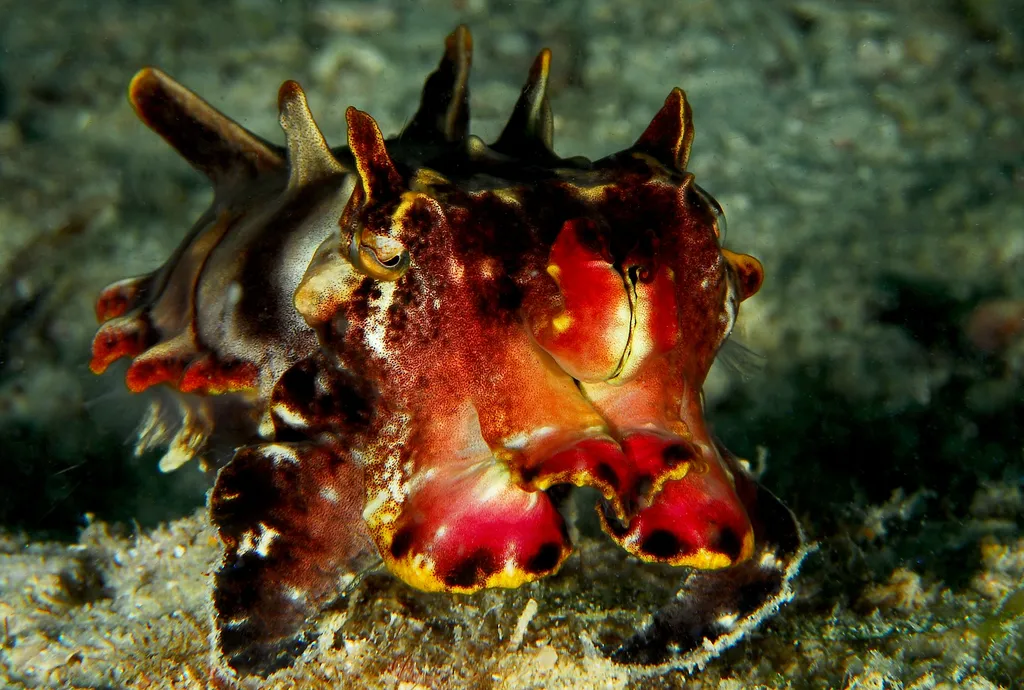
Photo by Jenny (JennyHuang) from Taipei / CC BY 2.0 via Wikimedia Commons
🧭 Finding Them
Slow-search black sand or silt slopes at 5–15 m—look for a small colored patch walking on the sand, not a hovering cuttlefish. Hot zones include Lembeh Strait tire reefs and rubble, Dauin Pyramids (Dumaguete), Anilao muck sites, Sipadan-area sand patches, Malapascua slopes, Puerto Galera black sand, and Banda Sea muck fringes. Co-occurs with frogfish and mimic octopus on the same slopes—ask your guide for known territories before the dive. Self-guided divers: crawl the slope at dive start and end when diurnal critters are most active; scan for slow lateral movement along the bottom.
🤿 Approach & Behavior
Most encounters are cryptic brown—the flamboyant display appears when disturbed, hunting intensely, or courting. Do not prod, dig sand, or repeatedly strobe to force the color show; stress shortens performances and damages fragile muck habitat. Approach low and lateral; never block its walking path across open bottom. If it flares aposematic colors, back off and give space—that's a toxicity warning, not an invitation to crowd. Keep fins high; one sweep buries the subject and everyone else's visibility.
📸 Photo Tips
Video beats stills for the pulsing color waves—run continuous recording once you find a walker. 60 mm or 100 mm macro with a diopter for tight head shots; shoot from a low angle on the sand to capture the walking gait. Patience pays: wait for hunting stalks and tentacle strikes rather than chasing a flare. Pre-focus on the mantle when it's in cryptic mode—the best behavior sequences often start from boring brown. Diffused light preserves texture; avoid blasting a flared individual at point-blank range.
⚠️ Ethics
TOXIC—do not touch. No handling, no collecting, no buying wild specimens for aquariums (trade pressure, short lifespan, poor captive survival). Don't chase for photos or dig substrate to uncover hidden individuals. Shallow muck is fragile—no fin-sweeping the bottom; worm beds, burrows, and egg clutches under shells are easily destroyed. One calm, distant observation beats a dozen harassed flares—and keeps the animal hunting naturally for the next diver.
Best Places to Dive with Flamboyant Cuttlefish
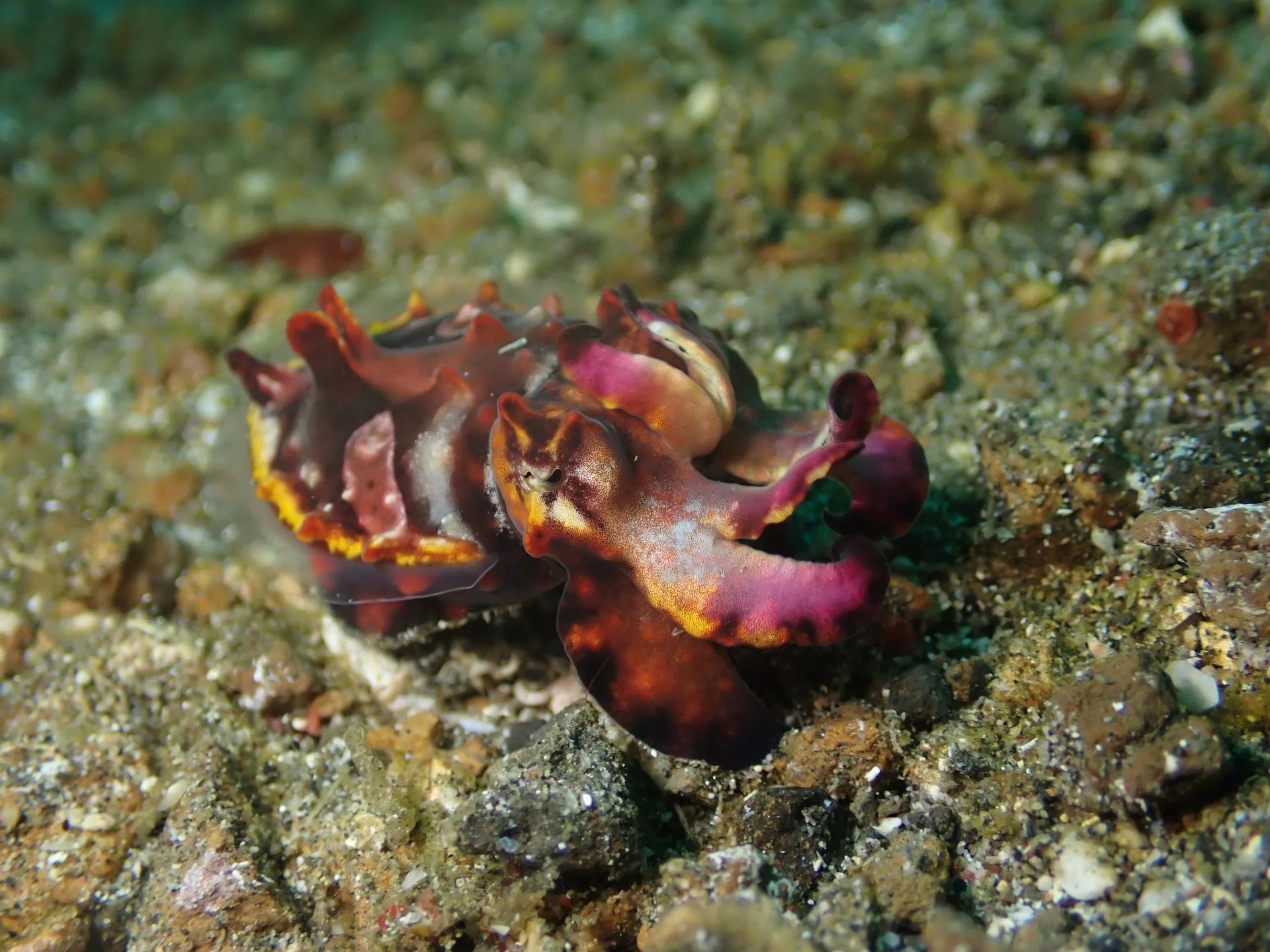
Lembeh
The Lembeh Strait in North Sulawesi has become famous as the muck‑diving capital of the world. At first glance its gently sloping seabed of black volcanic sand, rubble and discarded debris looks bleak. Look closer and it is teeming with weird and wonderful life: hairy and painted frogfish, flamboyant cuttlefish, mimic and blue‑ringed octopuses, ornate ghost pipefish, tiny seahorses, shrimp, crabs and a rainbow of nudibranchs. Most dives are shallow and calm with little current, making it an ideal playground for macro photographers. There are a few colourful reefs for a change of scenery, but Lembeh is all about searching the sand for critter treasures.
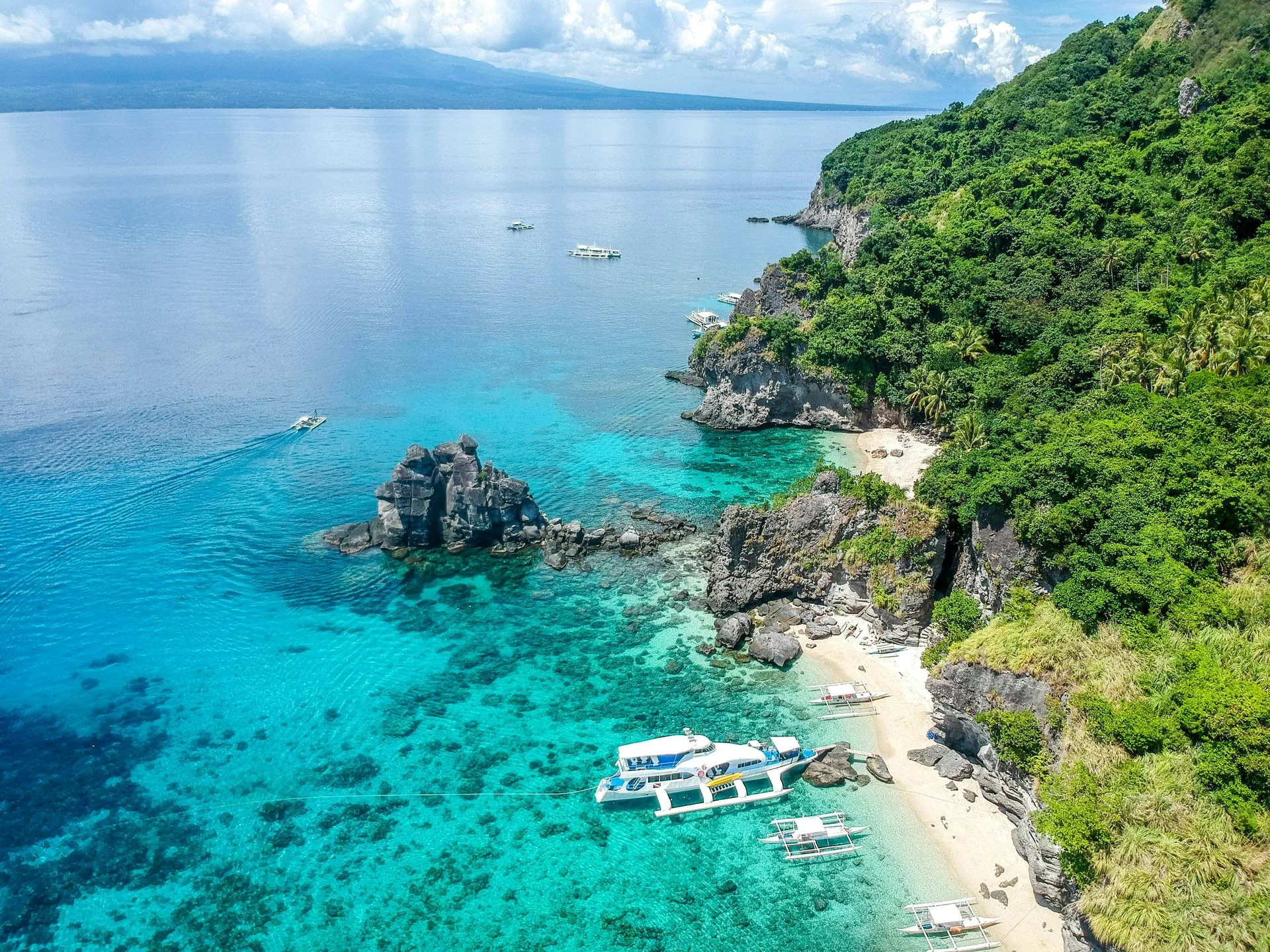
Dumaguete
Dumaguete on the southeast coast of Negros is the jumping‑off point for some of the Philippines’ most diverse diving. Along the nearby town of Dauin, a series of shallow marine sanctuaries and black‑sand slopes hide critters galore: frogfish, flamboyant cuttlefish, mimic octopus, ghost pipefish, seahorses, pipefish and nudibranchs. Artificial reefs made from car tyres and pyramids provide extra habitat. Offshore, Apo Island’s walls and plateaus burst with hard and soft corals, schooling jacks and barracudas, and friendly green turtles. With day trips to Oslob’s whale sharks or Bais’ dolphin‑watching, and excursions to nearby Siquijor, Dumaguete offers a perfect mix of macro muck diving and classic coral reefs.
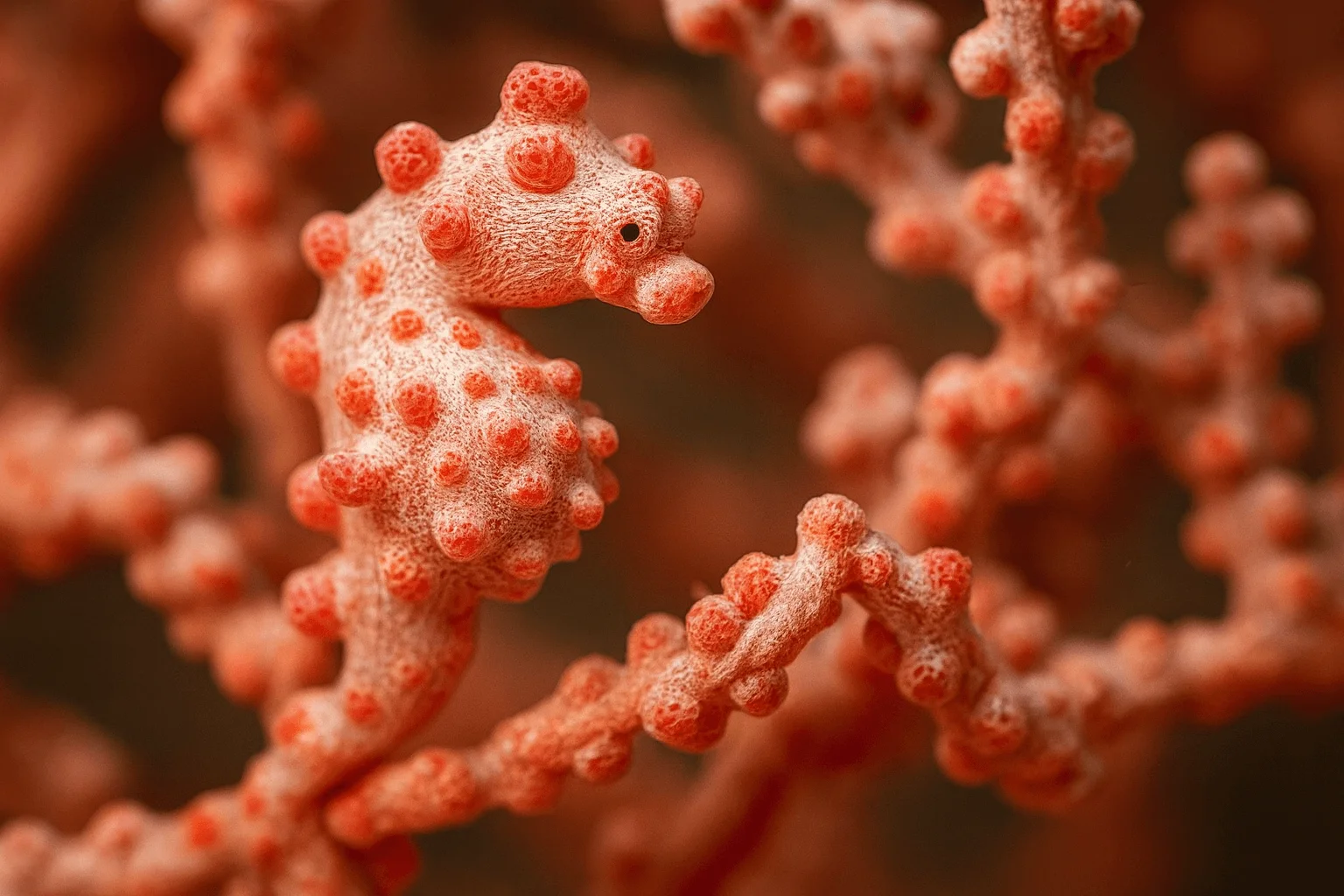
Anilao
Anilao, a small barangay in Batangas province just two hours south of Manila, is often called the macro capital of the Philippines. More than 50 dive sites fringe the coast and nearby islands, offering an intoxicating mix of coral‑covered pinnacles, muck slopes and blackwater encounters. Critter enthusiasts come for the legendary muck dives at Secret Bay and Anilao Pier, where mimic octopuses, blue‑ringed octopuses, wonderpus, seahorses, ghost pipefish, frogfish and dozens of nudibranch species lurk in the silt. Shallow reefs like Twin Rocks and Cathedral are covered in soft corals and teem with reef fish, while deeper sites such as Ligpo Island feature gorgonian‑covered walls and occasional drift. Because Anilao is so close to Manila and open year‑round, it’s the easiest place in the Philippines to squeeze in a quick diving getaway.
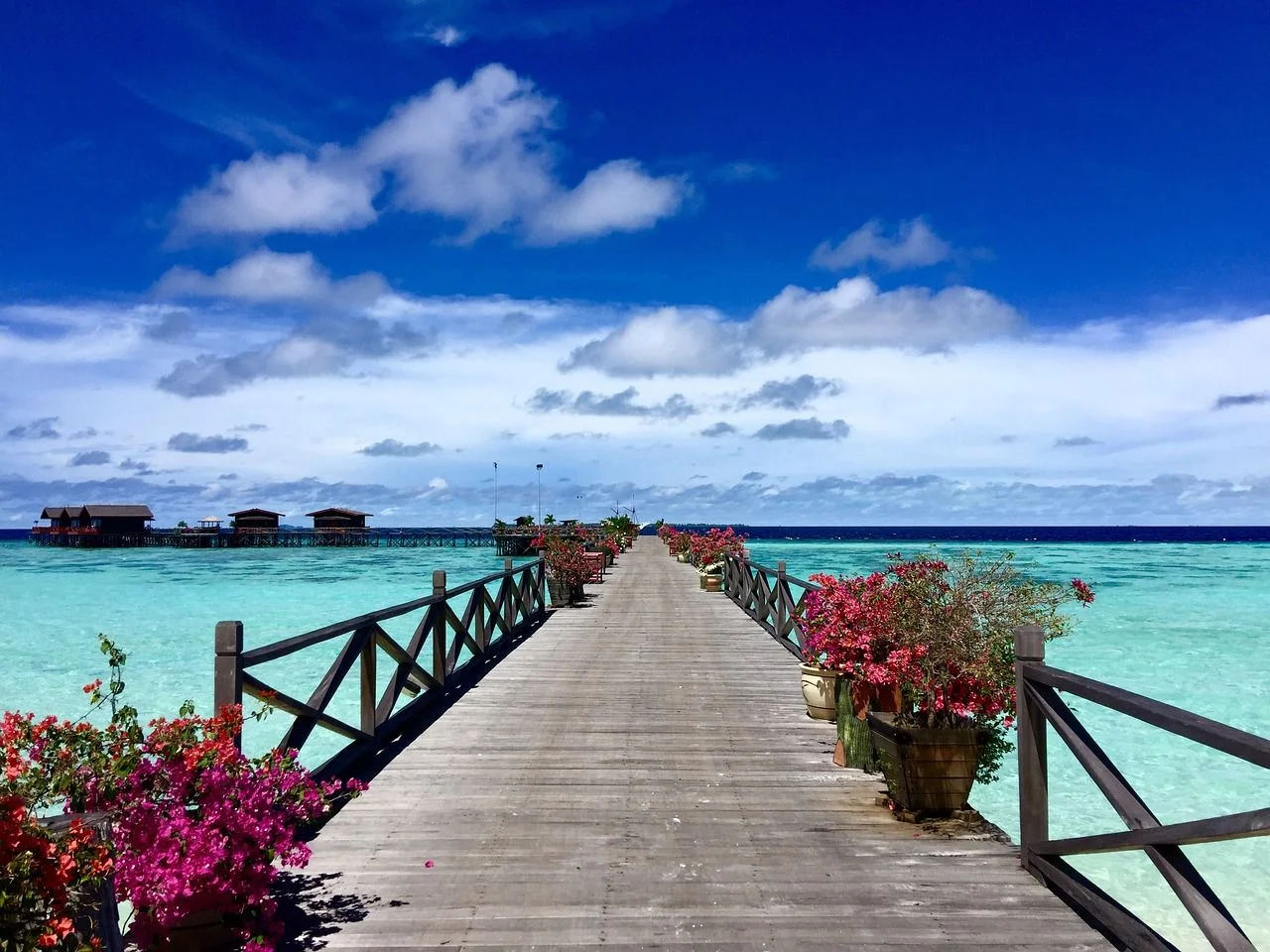
Sipadan & Semporna
Sipadan Island off the coast of Sabah is Malaysia’s crown jewel of diving – a steep limestone pinnacle rising more than 600 metres from the sea floor and teeming with pelagic life. Currents sweep past vertical walls encrusted in hard and soft corals, bringing in barracudas, jacks, reef sharks and bumphead parrotfish in breathtaking numbers. Nearby Mabul and Kapalai offer an entirely different experience on shallow sand‑slope reefs and artificial structures, where flamboyant cuttlefish, frogfish, mandarin fish and other macro critters hide among sponges and tyres. With limited daily permits, a visit to Sipadan is a privilege; most divers base themselves in the frontier town of Semporna or at water‑bungalow resorts on Mabul and Kapalai and make day trips into the park.
Malapascua
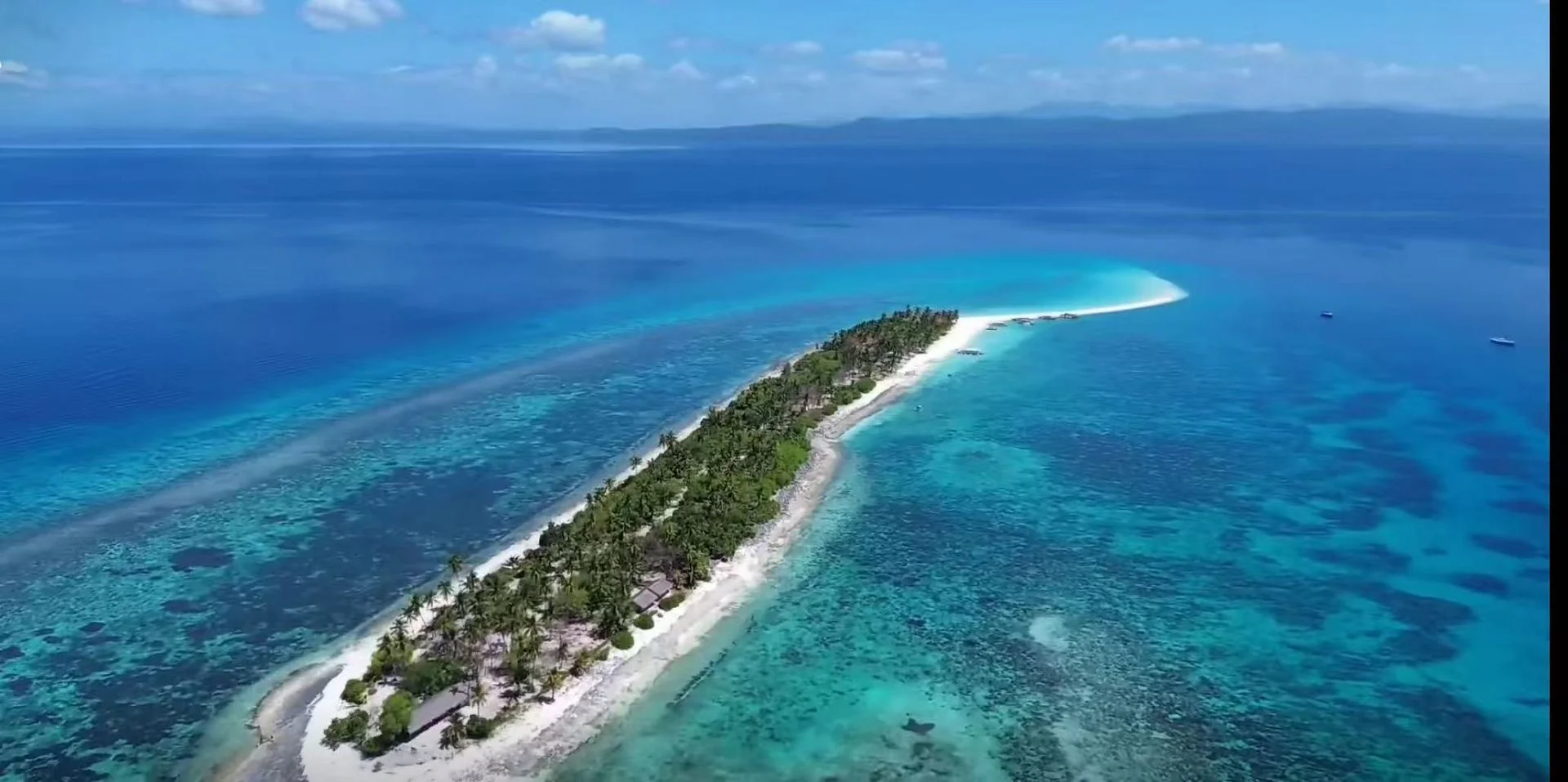
Malapascua is a small island off the northern tip of Cebu famed for its resident thresher sharks. Every morning at dawn, divers ride out to Monad Shoal and sit on a coral plateau 20–30 m deep, quietly watching as pelagic threshers rise from the abyss to use the cleaning station. But the excitement doesn’t end once the sharks disappear into the blue—around the island you’ll find coral‑covered pinnacles, drift dives, walls and gentle reef slopes teeming with life. Macro hunters can stalk flamboyant cuttlefish, pygmy seahorses and frogfish in the muck around Dauin, while wide‑angle lovers will enjoy schooling jackfish, batfish and barracuda at sites like Bugtong Bato and Gato Island. A relaxed village atmosphere, white‑sand beaches and day trips to neighbouring islands such as Kalanggaman or Capitancillo round out the experience.
Puerto Galera
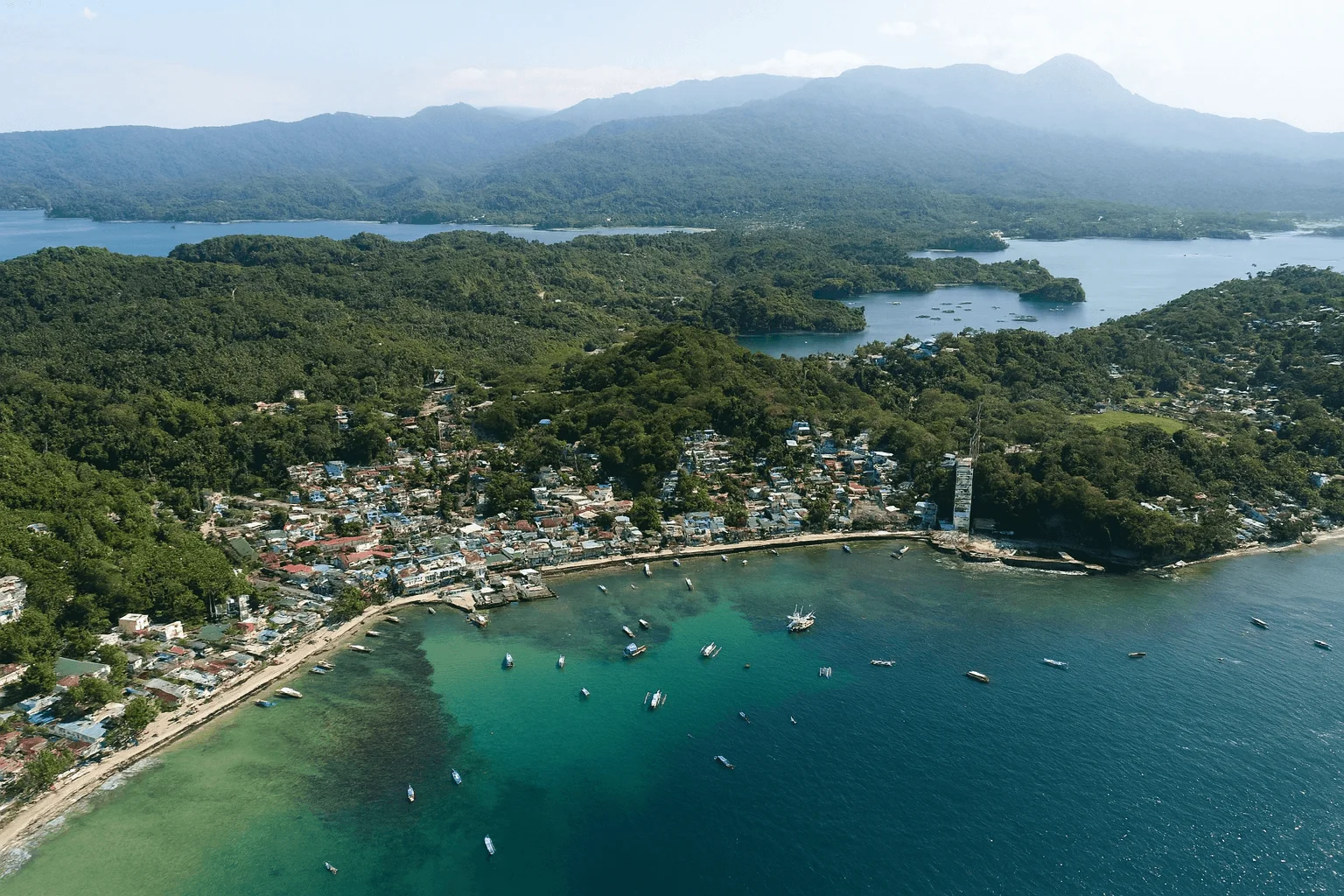
Puerto Galera sits on the northeast tip of Mindoro Island in the Philippines and has long been rated among Asia’s best and most diverse diving areas. The town faces the Verde Island Passage – part of the Coral Triangle – so its reefs host an incredible mix of hard and soft corals, seahorses, frogfish and other critters alongside schooling jacks and occasional pelagics. More than forty sites line the bays and headlands around Sabang and Small La Laguna, meaning everything from easy house‑reef dives and shallow muck sites to current‑swept canyons and colourful wrecks is only a short boat ride away. Currents are governed by the lunar cycle; strong spring tides around full and new moon create exciting drift dives, while neap tides offer gentle conditions that are perfect for macro photography. Because the water stays warm all year (27–30 °C) and visibility often reaches 15–30 m, Puerto Galera attracts both beginners and experienced divers seeking a fun, affordable destination with lively nightlife on land.
Banda Sea
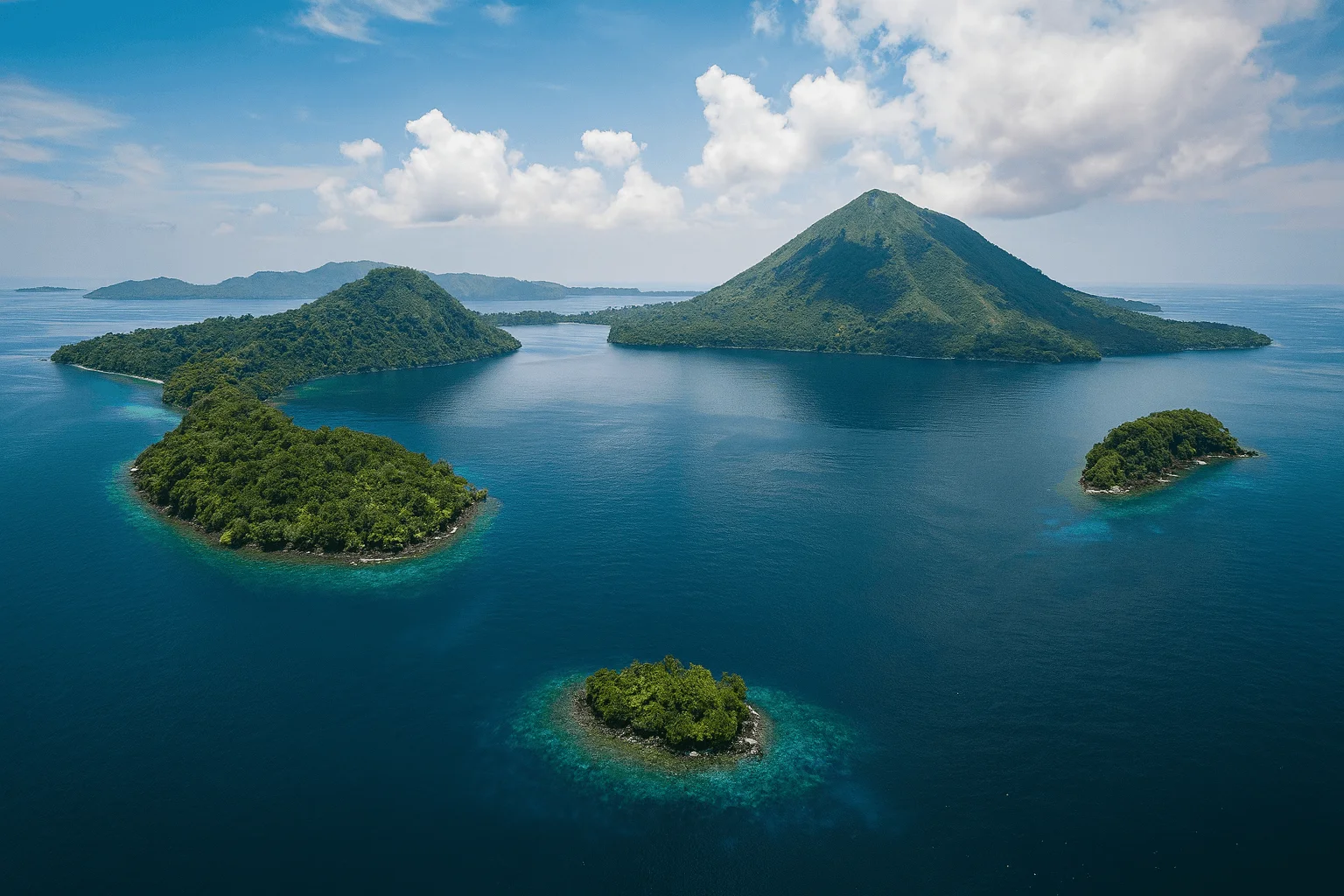
Hidden between Indonesia’s Maluku Islands lies the Banda Sea – an untouched stretch of ocean famous for its schools of hammerhead sharks and abundant sea snakes. Part of the Coral Triangle, this remote sea spans over half a million square kilometres and plunges to depths beyond 7 km. Cold, nutrient‑rich upwellings feed pristine reefs bursting with life: imagine gliding along steep walls encrusted with giant gorgonians while dogtooth tuna, thresher sharks and squadrons of mobula rays cruise past. Volcanic islands such as Manuk and Gunung Api rise from the blue, their warm vents attracting banded sea kraits by the dozen and drawing divers from all over the world. Because there are no large towns here, the Banda Sea is usually explored on liveaboards – the reward is some of Indonesia’s wildest and most exhilarating diving.