
Hairy Shrimp
Phycocaris simulans
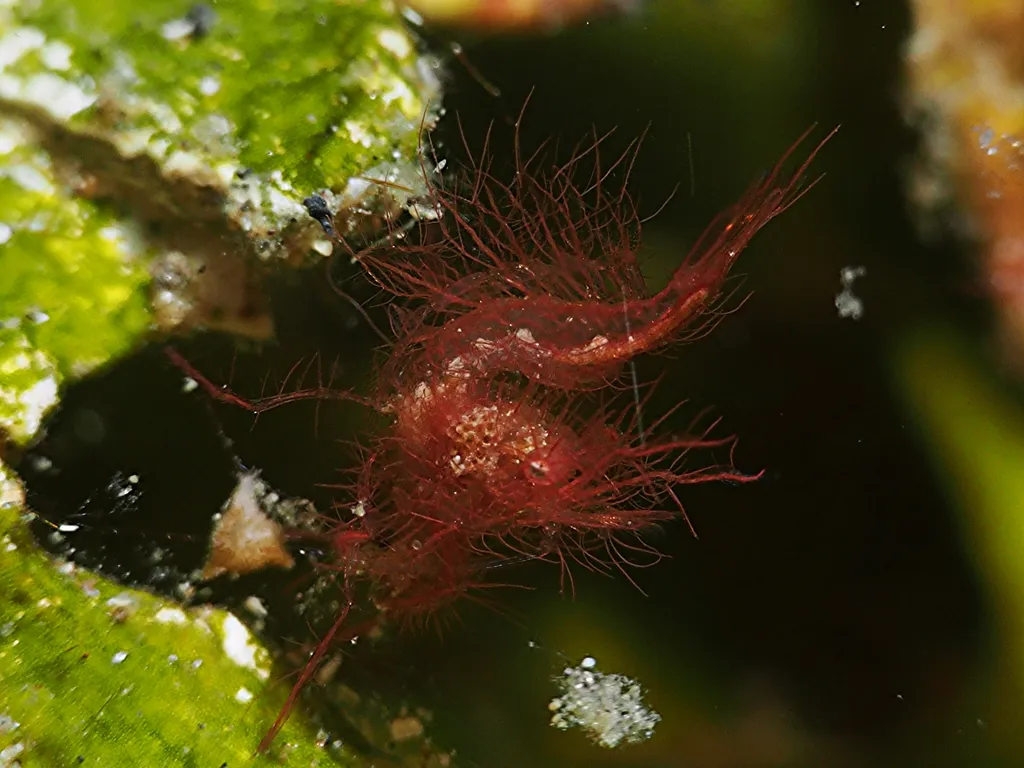
Photo by Rickard Zerpe / CC BY-SA 2.0 via Wikimedia Commons
The Hairy Shrimp (Phycocaris simulans) is macro diving reduced to a single skill: stopping on what looks like bare dead coral and realizing the "algae tip" is breathing. At 1–5 mm it sits in filamentous red and green turf, among tunicates, or on rubble, camouflaged so completely that most divers swim past hundreds of them without knowing.
Guides in Lembeh, Anilao, and Romblon treat this as a prestige find for sharp-eyed teams. Color is not a reliable field ID—the same species can be scarlet, dusty brown, lemon, pale white, or green. What matters is the swan-neck posture (abdomen cocked up), the rayed "sunburst" hairs around the eye stalk, and hairs exactly where cornea meets stalk. Once you lock those marks, every fuzzy speck on dead Acropora tables becomes suspicious in the good way.
🔬Classification
📏Physical Features
🌊Habitat Info
⚠️Safety & Conservation
Identification Guide
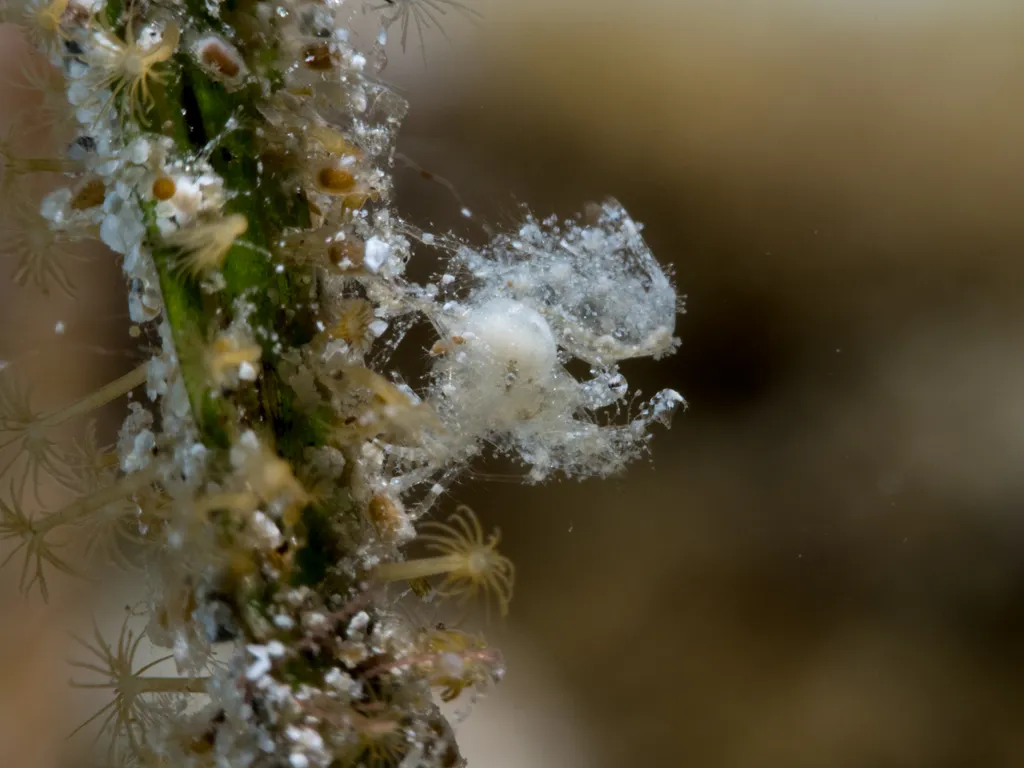
Photo by Rickard Zerpe / CC BY 2.0 via Wikimedia Commons
Ignore open sand. Work dead coral tables, rubble with algal turf, and mixed tunicate patches on gentle reef slopes.
Key Field Marks
- Size typically 1–5 mm (easy to miss even with a diopter)
- Body coated in filament-like hairs that match surrounding turf
- Tail/abdomen often held upright (swan-like silhouette)
- Ray-like lines around the eye; hairs at cornea–stalk junction are diagnostic for the genus
Search Pattern
Slow hover over one dead coral head at a time. Let surge reveal motion—hairy shrimp often rock left-right rather than walk. Ask guides to check known "algae stations" rather than hunting random sand.
Confusions
- Other tiny hippolytids and algal mimics can share color; confirm eye-stalk hairs and posture
- Detached algal tufts do not hold a rigid swan silhouette or visible egg mass under the abdomen
Top 10 Fun Facts about Hairy Shrimp
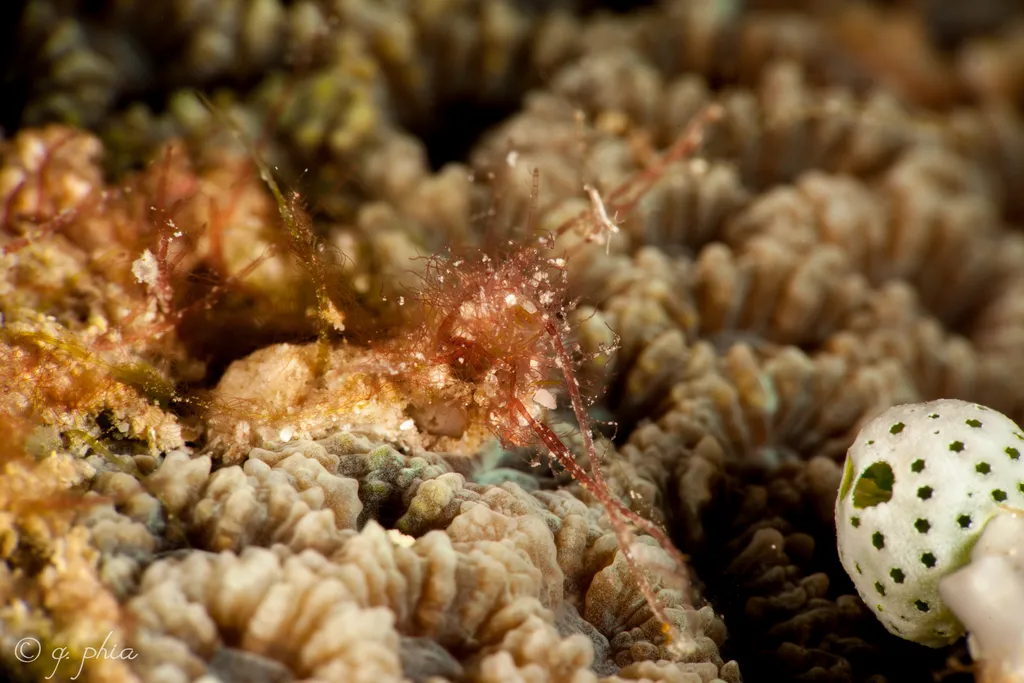
Photo by q phia / CC BY 2.0 via Wikimedia Commons
1. Camouflage Is the Entire Strategy
Hairy shrimp do not rely on speed or sheltering holes. Their filament coat makes them morphologically continuous with algal turf—divers are essentially looking for a discontinuity that is almost not there.
2. Color Is Disposable
Red individuals dominate some Bali sites; green ones are treated as rare prizes. The same species can be white, yellow, brown, purple, or green depending on the patch it occupies.
3. The Swan Pose Is a Tell
Even when color blends perfectly, the cocked abdomen creates a tiny upright silhouette. Macro shooters who learn that outline find animals that "disappear" in still frames.
4. Eye Sunbursts Betray Identity
Rayed hairs around the eye create a miniature sunburst. Combined with hairs exactly at the cornea–stalk junction, this separates Phycocaris from many other hippolytids.
5. They Prefer Drift Over Swimming
They can swim, but most dive observations show them rocking with surge or hitching detached algae until a new foothold appears.
6. Egg Belts Are Common Sightings
Berried females are frequently photographed; abdomen-up posture conveniently exposes the egg mass under good strobe light.
7. Macro Difficulty Is Optical, Not Geographic
The species ranges widely across the Indo-West Pacific (Andamans to Japan, Australia, Maldives, Philippines, Indonesia). Hard sightings come from size and camouflage, not extreme endemism.
8. Dead Coral Is Productive Habitat
A half-meter dead Acropora table coated in filamentous algae, sponges, and tunicates can be a better station than living reef. Sheltered slopes beat blasted current.
9. First Maldives Record Was at 20 m
A 2016 biodiversity survey on Ari Atoll logged an individual motionless on red algal turf over dead tabular Acropora—a textbook microhabitat for the species.
10. Ethics = Do Not "Groom" the Turf
Blasting silt, fanning algae aside, or rearranging rubble for a cleaner shot destroys the exact camouflage matrix that makes the animal findable next dive.
Diving & Observation Notes
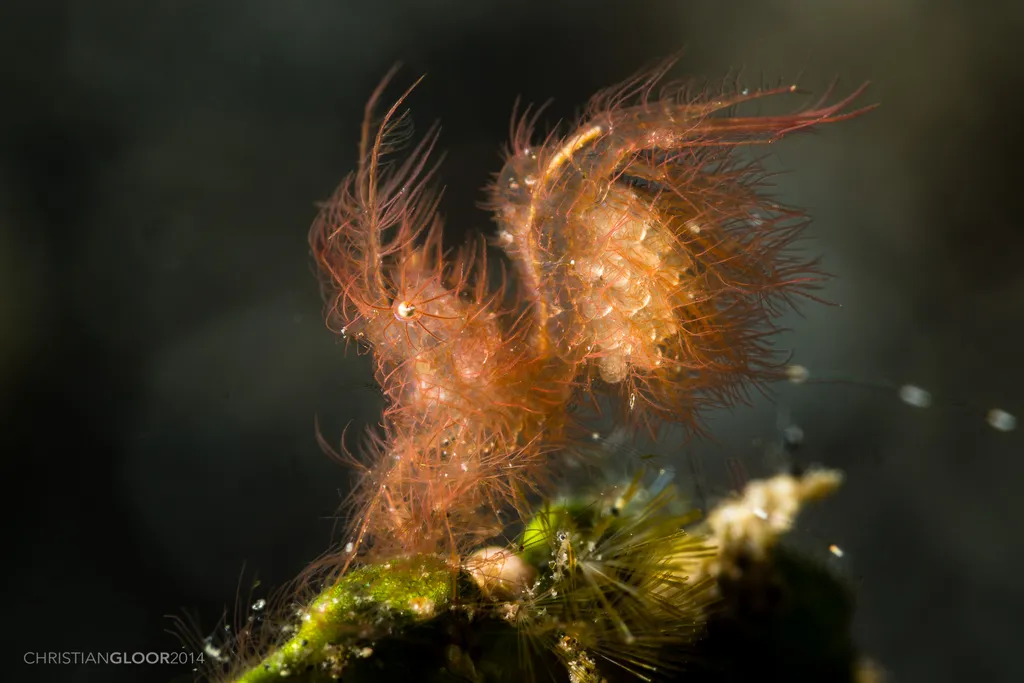
Photo by Christian Gloor from Wakatobi Dive Resort / CC BY 2.0 via Wikimedia Commons
🧭 Finding Stations
Brief your guide for hairy shrimp specifically. Productive habitats are filamentous algae on dead coral and rubble, mixed tunicate patches, and quiet mid-slope pockets. Lembeh and Anilao guides often know temporary "stations" that move with turf growth.
🤿 Approach & Behavior
Arrive low and slow. The animal rarely bolts; you lose it when you silt the frame or let surge bump your housing into the coral. Pause 30–60 seconds and watch for rock-side oscillation before committing to a framing.
📷 Photo Tips
This is a diopter / super-macro subject. Prefer mild side light to lift hair texture and eye rays without blowing out pale individuals. Focus stacking helps on land; in water, settle buoyancy first, then inch in. If you see eggs, expose the abdomen without rotating the substrate.
🤝 Ethics
No handling, no "cleaning" algae away for composition, no squeezing into the turf with a snorkel tip. Leave the station intact so the same patch remains usable for later groups.
Best Places to Dive with Hairy Shrimp
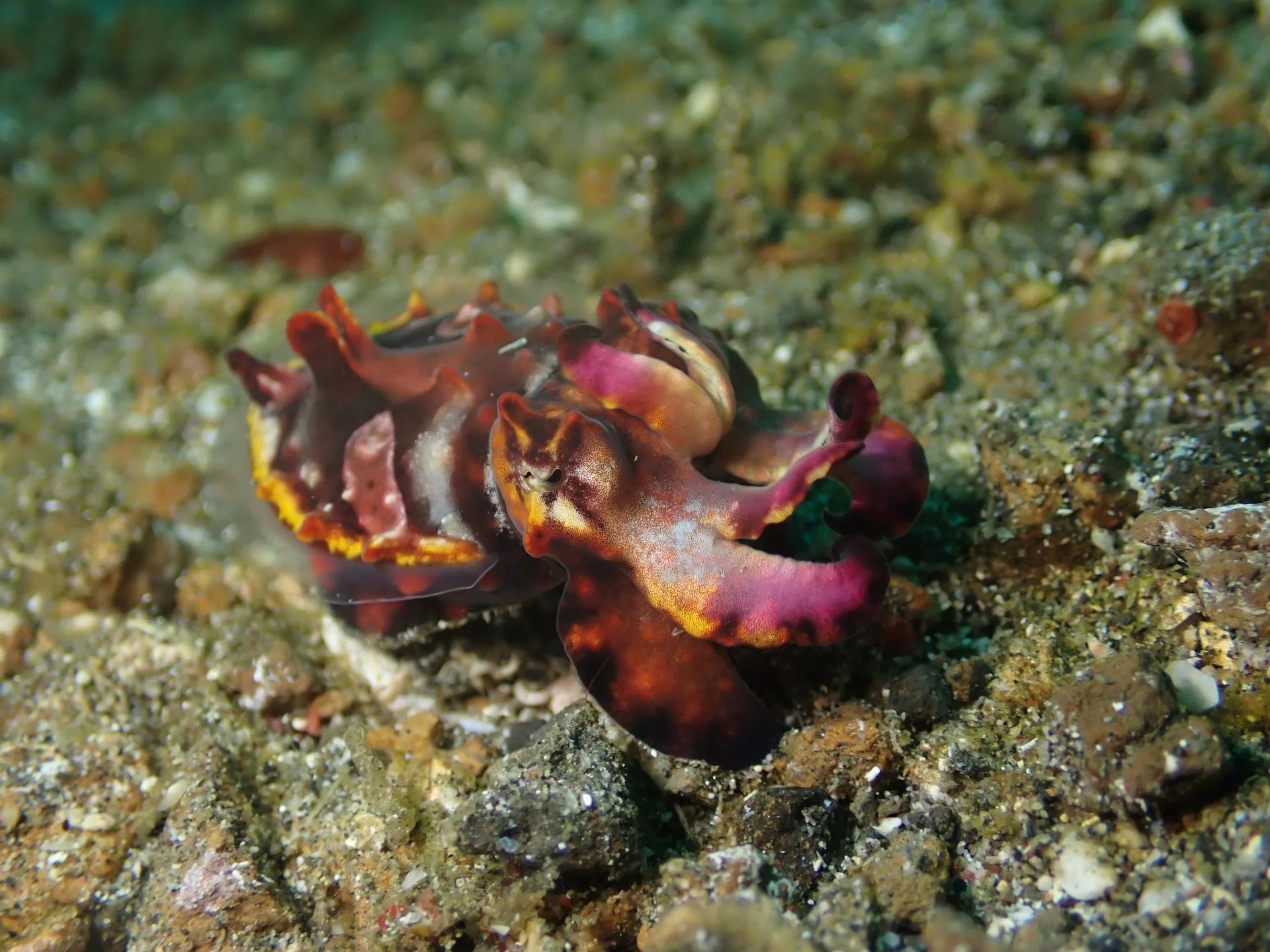
Lembeh
The Lembeh Strait in North Sulawesi has become famous as the muck‑diving capital of the world. At first glance its gently sloping seabed of black volcanic sand, rubble and discarded debris looks bleak. Look closer and it is teeming with weird and wonderful life: hairy and painted frogfish, flamboyant cuttlefish, mimic and blue‑ringed octopuses, ornate ghost pipefish, tiny seahorses, shrimp, crabs and a rainbow of nudibranchs. Most dives are shallow and calm with little current, making it an ideal playground for macro photographers. There are a few colourful reefs for a change of scenery, but Lembeh is all about searching the sand for critter treasures.
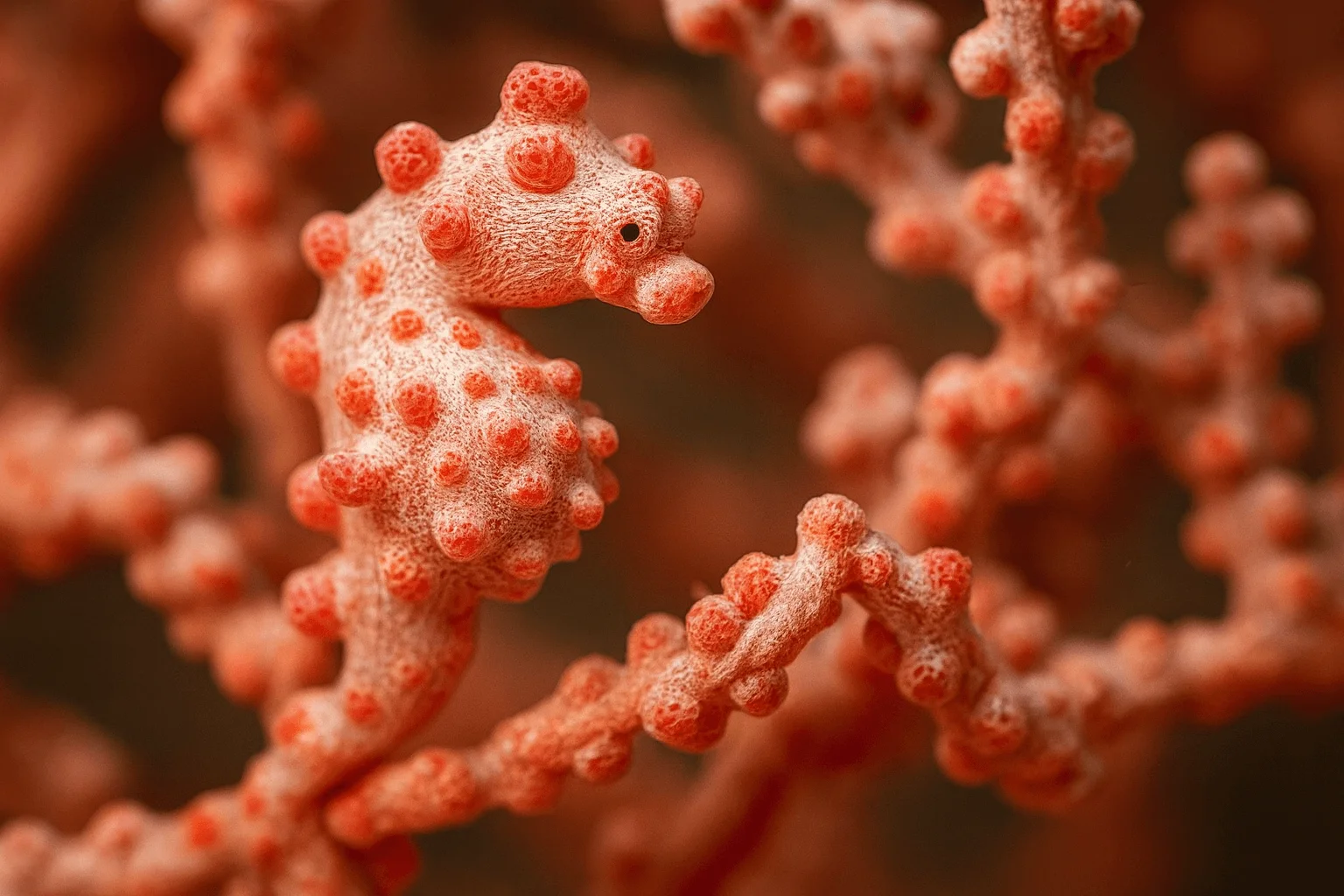
Anilao
Anilao, a small barangay in Batangas province just two hours south of Manila, is often called the macro capital of the Philippines. More than 50 dive sites fringe the coast and nearby islands, offering an intoxicating mix of coral‑covered pinnacles, muck slopes and blackwater encounters. Critter enthusiasts come for the legendary muck dives at Secret Bay and Anilao Pier, where mimic octopuses, blue‑ringed octopuses, wonderpus, seahorses, ghost pipefish, frogfish and dozens of nudibranch species lurk in the silt. Shallow reefs like Twin Rocks and Cathedral are covered in soft corals and teem with reef fish, while deeper sites such as Ligpo Island feature gorgonian‑covered walls and occasional drift. Because Anilao is so close to Manila and open year‑round, it’s the easiest place in the Philippines to squeeze in a quick diving getaway.
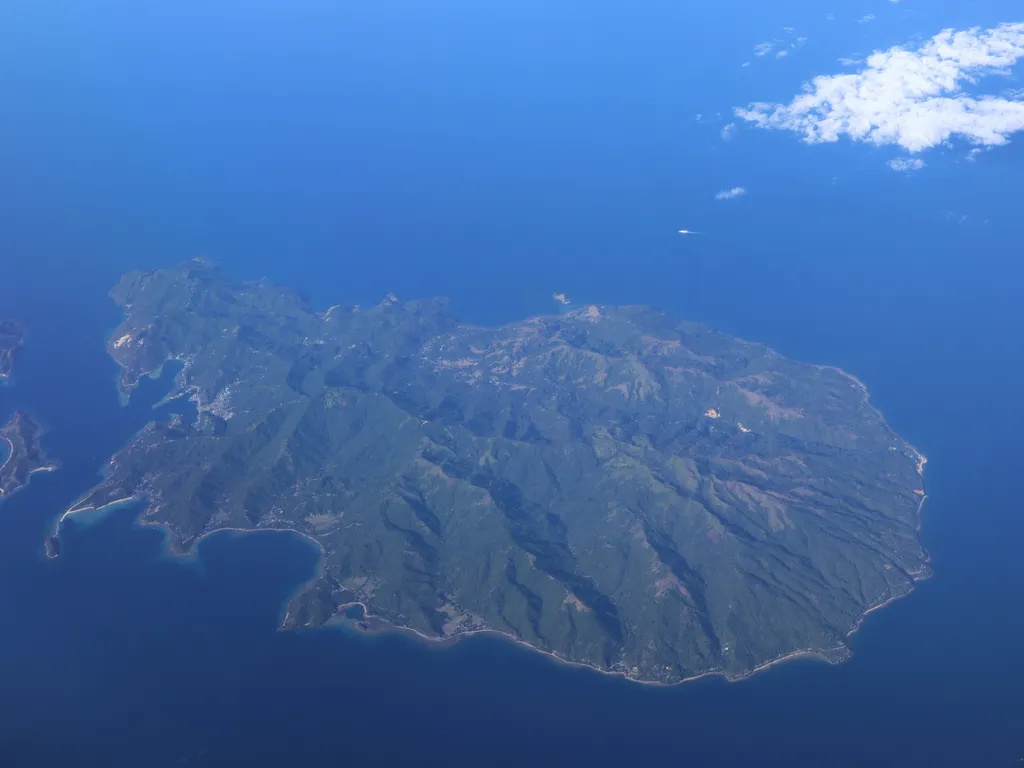
Romblon
Romblon is the Philippines' quiet answer to Lembeh—a province of small islands in the Sibuyan Sea where muck slopes, fan-coral walls and marine sanctuaries stack up without the resort sprawl. Most divers base in Lonos on Romblon Island, a short hop from Tablas, and spend days hopping between black-sand critter hunts and healthier reef drops. Signature finds include wunderpus, flamboyant cuttlefish, blue-ringed octopus, four pygmy seahorse species, Melibe colemani and Cyerce nudibranchs, plus eagle rays, sea snakes and schooling fish on the outer sites. Add a chimney dive at The Blue Hole on Tablas, cavern walls at Agpanabat, and night blackwater drifts over Romblon Pass when you want something stranger than another frogfish portrait.
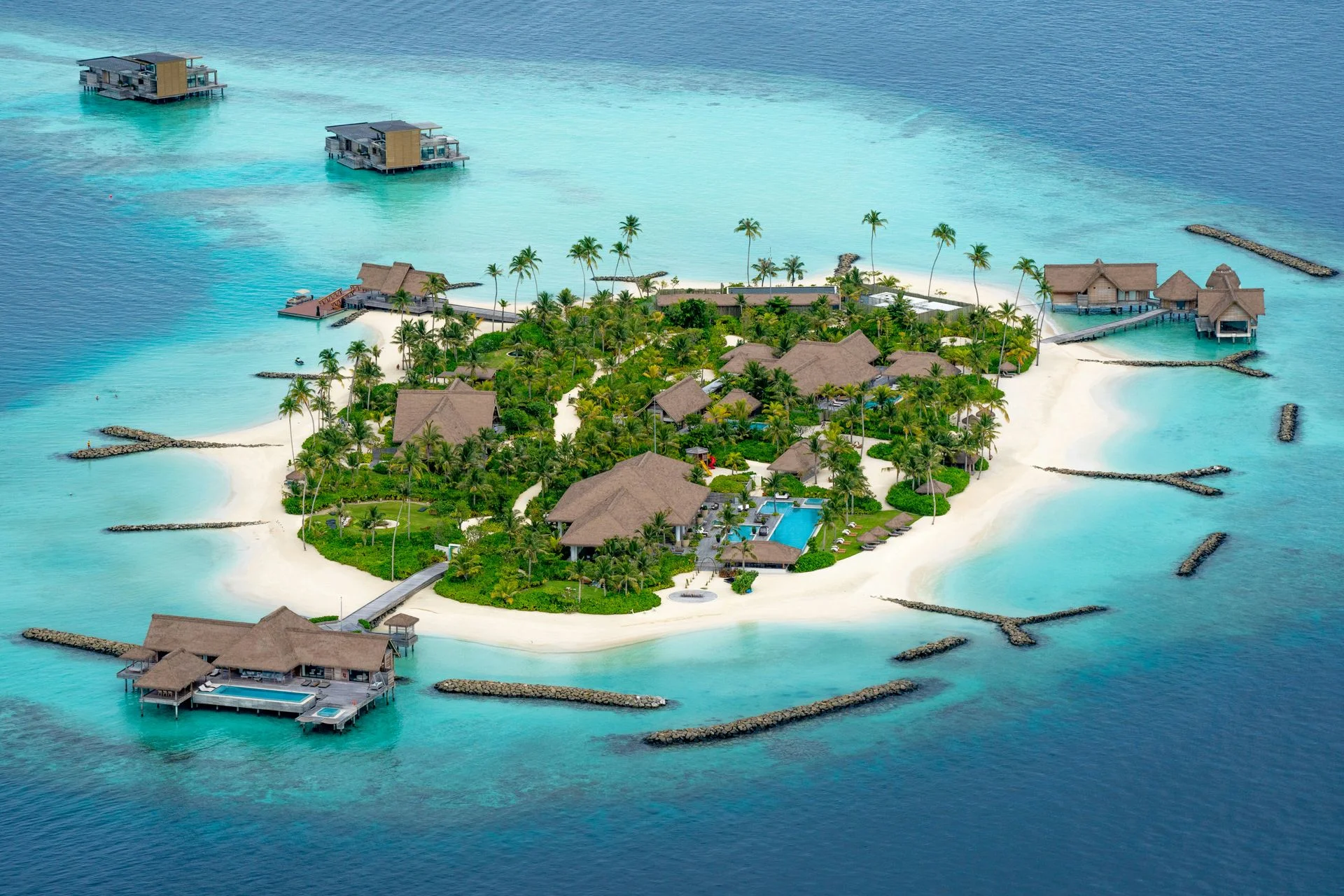
Maldives
Scattered across the Indian Ocean like strings of pearls, the Maldives’ 26 atolls encompass more than a thousand low‑lying islands, reefs and sandbanks. Beneath the turquoise surface are channels (kandus), pinnacles (thilas) and lagoons where powerful ocean currents sweep past colourful coral gardens. This nutrient‑rich flow attracts manta rays, whale sharks, reef sharks, schooling jacks, barracudas and every reef fish imaginable. Liveaboards and resort dive centres explore sites such as Okobe Thila and Kandooma Thila in the central atolls, manta cleaning stations in Baa and Ari, and shark‑filled channels like Fuvahmulah in the deep south. Diving here ranges from tranquil coral slopes to adrenalin‑fuelled drifts through current‑swept passes, making the Maldives a true pelagic playground.
Tulamben(Bali)
Tulamben sits on Bali’s northeast coast and is best known for the USAT Liberty shipwreck – a 125‑metre cargo ship torpedoed in WWII that now lies just a short swim from shore. Warm water, mild currents and straightforward shore entries make diving here relaxed for all levels. Besides the wreck, divers can explore coral gardens, black‑sand muck sites and dramatic drop‑offs. Macro lovers will find nudibranchs, ghost pipefish, mimic octopus and pygmy seahorses, while big‑fish fans can encounter schooling jackfish, bumphead parrotfish and reef sharks. With a compact coastline packed with variety, Tulamben delivers world‑class wreck and critter diving without long boat rides.
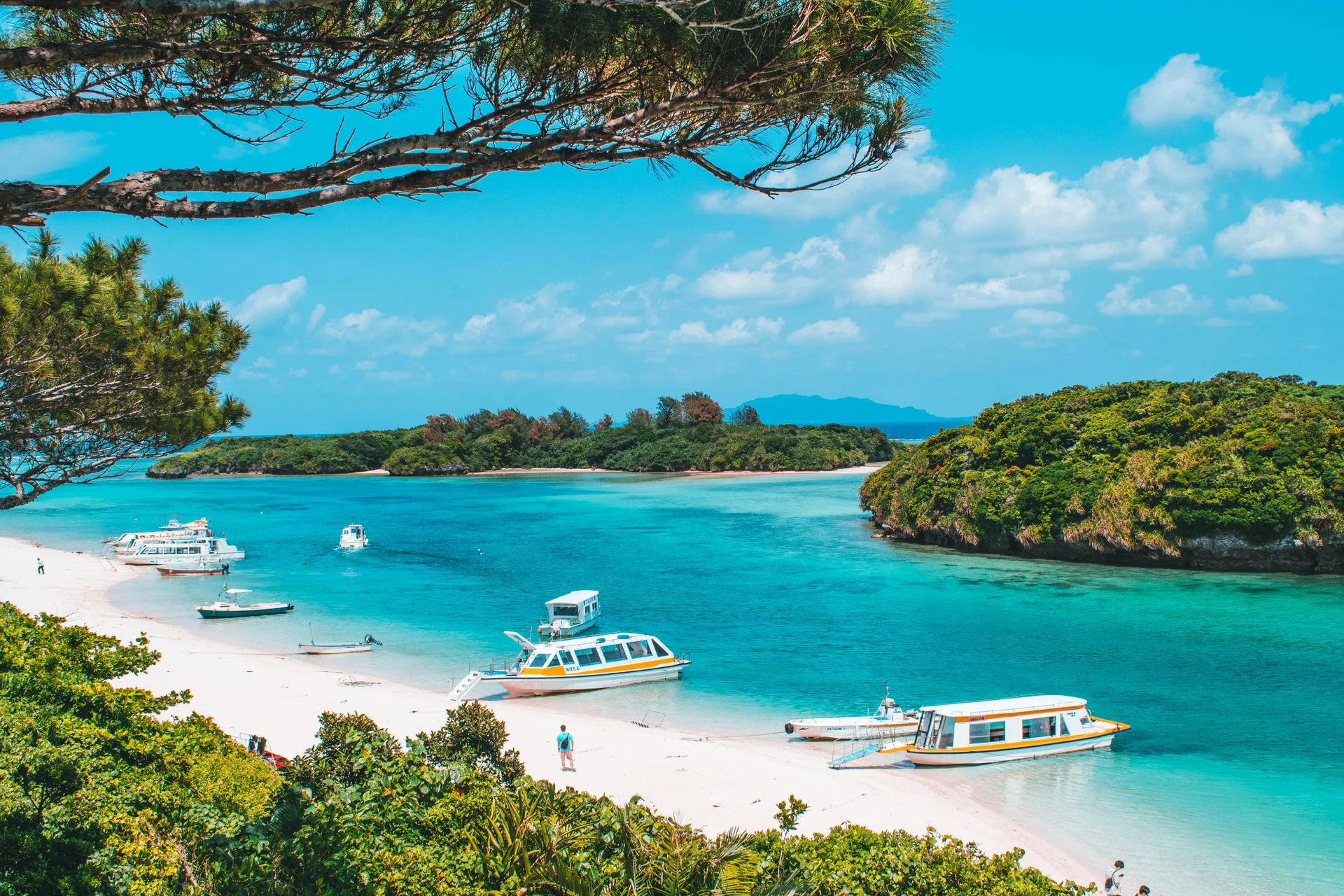
Okinawa
Straddling the subtropical Ryūkyū chain in Japan’s far south, Okinawa Prefecture is a mosaic of islands offering everything from shallow coral gardens to deep wrecks and wild drift dives. The main island provides easy access to the vibrant reefs of the Kerama National Park, where Tokashiki and Zamami Islands boast pristine hard corals, sea fans and more turtles than you can count. Just offshore, Cape Manza’s Dream Hole drops through a chimney into a colourful cavern system teeming with soldierfish, angelfish and feather stars. Further north, history buffs can dive the 100‑metre USS Emmons, a WWII destroyer resting intact at 35–40 m. Closer to shore, Cape Maeda’s Blue Cave offers an easy swim‑through with magical blue light – but expect crowds. Away from the main island, Okinawa’s outer islands extend the experience: Ishigaki’s Manta Scramble (April–Nov) promises manta ray ballets, Yonaguni’s currents bring hammerhead sharks in winter, and Miyako’s caves and tunnels deliver topography diving at its finest. Whether you crave reef fish, big pelagics, swim‑throughs or macro critters, Okinawa’s warm, clear waters offer a Japanese diving adventure for every level of diver.