Scalloped Hammerhead Shark
Sphyrna lewini
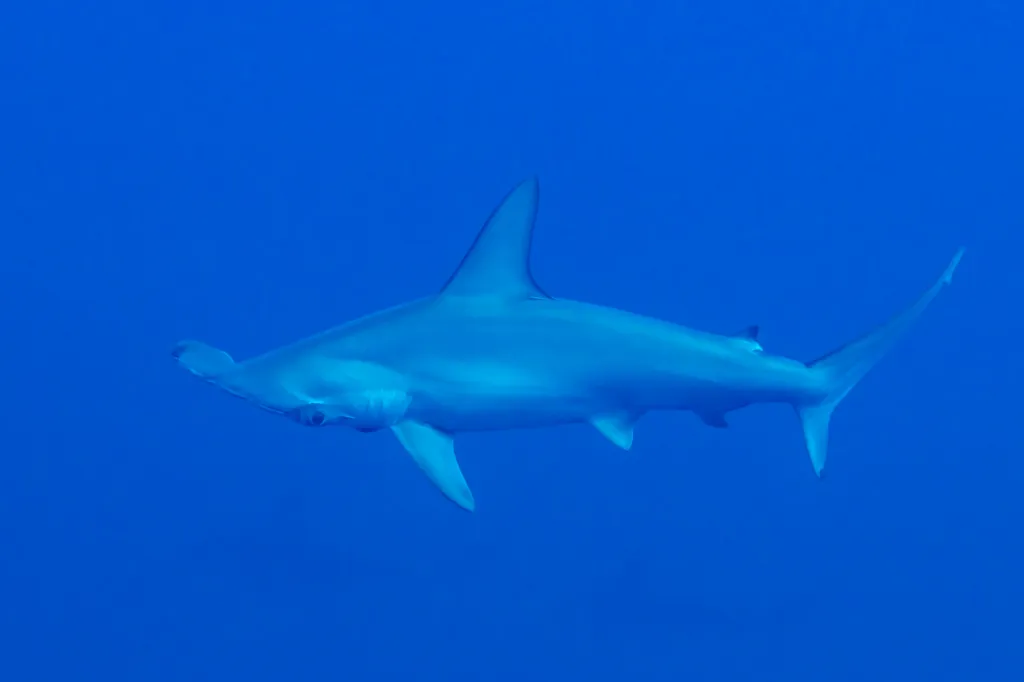
Photo by Diego Delso / CC BY-SA 4.0 via Wikimedia Commons
The Scalloped Hammerhead is the most common hammerhead on the planet — and the one most likely to rewrite your dive log in a single blue-water minute. Sphyrna lewini carries a cephalofoil with a scalloped front edge (central notch plus lateral indentations), not the straight T-bar of a great hammerhead or the rounded bonnet of a bonnethead. Adults school in numbers that can run from dozens to hundreds over seamounts and volcanic islands, then peel off at night to hunt alone or in small groups.
For divers, the species sits at the intersection of bucket-list spectacle and conservation urgency. Galápagos (Darwin and Wolf), Mexico's Revillagigedo/Socorro chain, La Paz's El Bajo seamount, and pockets of the Red Sea and Banda Sea deliver the classic overhead-wall-of-sharks moment — usually at 25–40 m on current-washed drop-offs. IUCN lists scalloped hammerheads as Critically Endangered; gillnet fisheries, fin trade, and slow reproduction have collapsed populations across much of their range. Treat every encounter as a privilege, not a guarantee.
🔬Classification
📏Physical Features
🌊Habitat Info
⚠️Safety & Conservation
Identification Guide
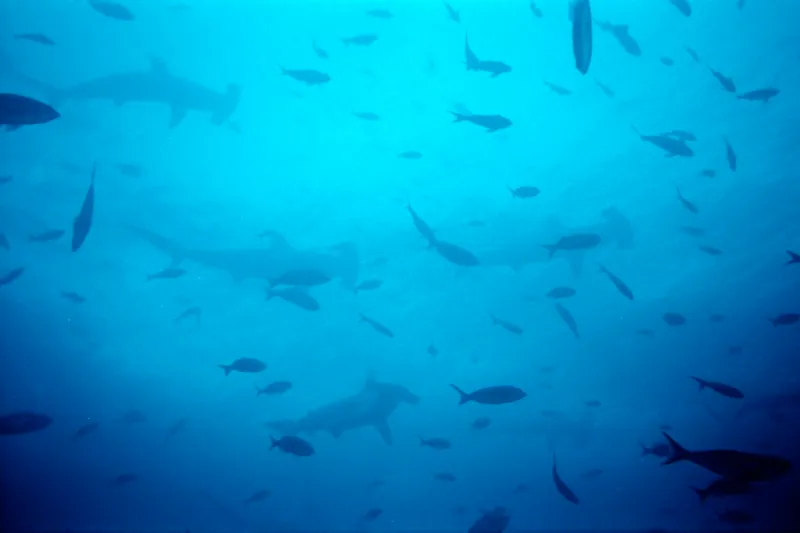
Photo by daren_ck / CC BY 2.0 via Wikimedia Commons
Field marks:
- Scalloped cephalofoil — front margin has a prominent central notch with additional scalloped indentations on each side (not straight like S. mokarran)
- Moderately tall first dorsal fin — origin over or slightly behind pectoral insertions; low second dorsal and pelvic fins
- Grey to olive-brown dorsal colour — fades to white on belly; no bold stripes
- Narrow "wings" on the head with rear margins swept backward
- Pectoral fin tips often tipped grey or black on the underside
- Size — most dive encounters 2–2.5 m; larger females to ~3 m+
Differences from Similar Species
- Great Hammerhead (Sphyrna mokarran): Much larger (to 6 m), straight cephalofoil without scalloped notches, taller first dorsal set farther forward; usually solitary.
- Smooth Hammerhead (Sphyrna zygaena): Smooth, unnotched cephalofoil front margin; more temperate distribution.
- Bonnethead (Sphyrna tiburo): Small, shovel-shaped head; shallow coastal species.
- Scalloped Bonnethead (Sphyrna corona): Smaller, recently split species with similar head shape — check regional range.
Behaviour Clues
Daytime tight schools over seamounts; individuals often swim with pectoral fins angled down. At night schools break up for benthic hunting. Juveniles use shallow inshore nurseries; adults encountered on pelagic dives are typically subadults and adults.
Top 10 Fun Facts about Scalloped Hammerhead Shark
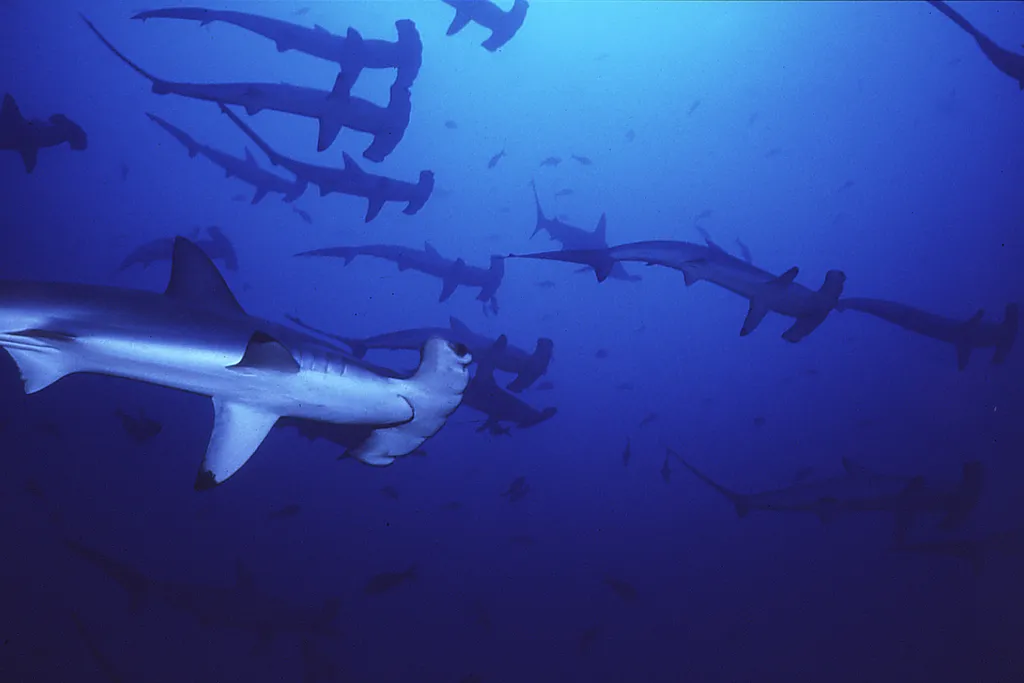
Photo by Seawatch.org via Wikimedia Commons
1. The Hammerhead Everyone Meets First
Sphyrna lewini is the most widely distributed and numerically dominant hammerhead species globally — found in warm temperate and tropical waters of the Atlantic, Indian, and Pacific. That ubiquity is exactly why its collapse is so alarming: when the "common" hammerhead vanishes from a seamount, the whole ecosystem signal changes.
2. A Head Built for Electroreception
The cephalofoil isn't just for turning — it spreads ampullae of Lorenzini across a wider plane than any other shark group, letting scalloped hammerheads pin down buried stingrays, flatfish, and cephalopods in sand. Some research suggests the head also improves stereo vision and hydrodynamic lift during tight turns in schools.
3. Schooling by Day, Solo by Night
Adults aggregate in hundreds at seamounts and island drop-offs during daylight — Galápagos schools of 200+ are documented — then disperse after dark to hunt benthically. The daytime wall is a social/thermodynamic puzzle researchers still debate (predator confusion, navigation, mating?).
4. Females Run the Deep Water
Adult females often live offshore in deeper water, moving onto continental shelves to mate and give birth. Litters average ~17 pups after 9–10 months gestation. Females in the eastern Pacific have been tracked moving 700 km between island chains.
5. Magnetic Highways
Like smooth hammerheads, scalloped hammerheads use Earth's magnetic field for long-distance navigation between daytime aggregation sites and nocturnal feeding grounds — "magnetic highways" along the seafloor linking seamount to seamount.
6. Galápagos: The Gold Standard
Darwin and Wolf islands remain among the planet's most reliable scalloped hammerhead schools — sometimes mixed with silkies and Galápagos sharks. Abundance peaks around January; lowest around May. The Galápagos Marine Reserve also hosts nursery sites discovered in 2017.
7. Mexico's Two Pelagic Corridors
Socorro (Revillagigedo) delivers schooling hammerheads at Roca Partida and Benedicto pinnacles on liveaboard itineraries. La Paz's El Bajo seamount — three peaks in blue water northeast of Los Islotes — is famous for summer/early-fall scalloped schools without needing a 24-hour crossing (though currents demand Advanced profiles).
8. Critically Endangered — Fastest Collapse in the Family
IUCN Critically Endangered status reflects estimated global population declines exceeding 80% in three generations. Hammerheads are exceptionally vulnerable to gillnets because their wide heads tangle easily. CITES Appendix II regulates international trade.
9. Occasionally Displays Threat Posture
Documented cases exist of scalloped hammerheads showing classic threat displays (arched back, exaggerated swimming) when divers approach too closely — rare on open-water pelagic dives but worth remembering on seamount ascents.
10. Not the Shark at Tiger Beach
Divers chasing hammerheads in the Bahamas usually meet great hammerheads (S. mokarran), not scalloped. Know your target species and destination — scalloped schools are a Pacific/Indian Ocean + select Atlantic seamount game, not a Caribbean sandy-bottom default.
Diving & Observation Notes
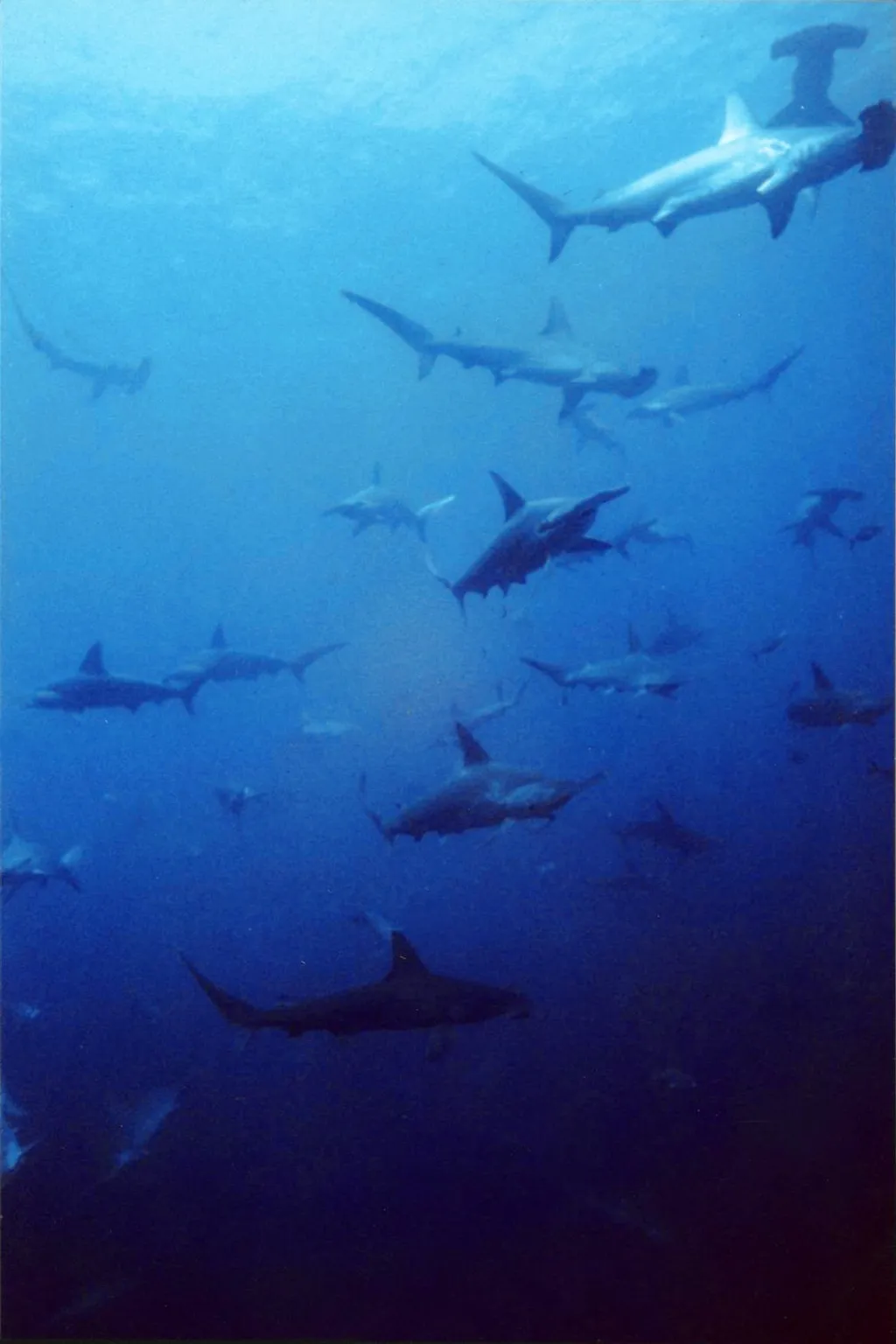
Photo by Seawatch.org via Wikimedia Commons
🧭 Where Schools Form
Galápagos (Darwin/Wolf) — liveaboard-only north islands; hundreds overhead in medium-strong current, 20–40 m. Socorro (Roca Partida, San Benedicto) — 24 h crossing from Baja; pinnacles in blue water. La Paz (El Bajo) — day boat from La Paz; summer/fall scalloped schools on seamount peaks. Bohol (Cabilao) — deeper walls Dec–Jun window. Banda Sea (Lucipara) — remote atoll aggregations. Maldives — select channel/outer reef itineraries.
🌊 Current, Depth & Gas
- Expect 25–40 m profiles — schools often hang just off the wall in the blue
- Strong currents common — reef hook or negative entry per operator protocol; Advanced Open Water minimum at many sites
- Nitrox extends bottom time — you may wait 10–20 min for the school to tighten
- Ascent discipline — don't chase upward into the school; hold your line and let them pass
📸 Photo Tips
- Shoot upward into the school — silhouettes against surface light are the classic frame
- Ultra-wide mandatory — a 200-shark school won't fit in standard wide-angle
- Low ISO, fast shutter — blue water at 30 m needs 1/125 s+ to freeze cephalofoil detail
- Include divers for scale — hammerhead schools look abstract without a reference
- Video often beats stills — the motion of the wall is the story
⚠️ Ethics & Conservation
- Critically Endangered — never touch, chase, or block path; no drone-style crowding from below
- Choose MPAs and regulated operators — Galápagos, Revillagigedo, Cabo Pulmo buffer zones set precedents
- Report encounters — photo-ID and eDNA projects use diver logs; date + GPS + depth adds value
- Avoid fin products — scalloped hammerheads are among the most finned species globally
Best Places to Dive with Scalloped Hammerhead Shark
Galapagos
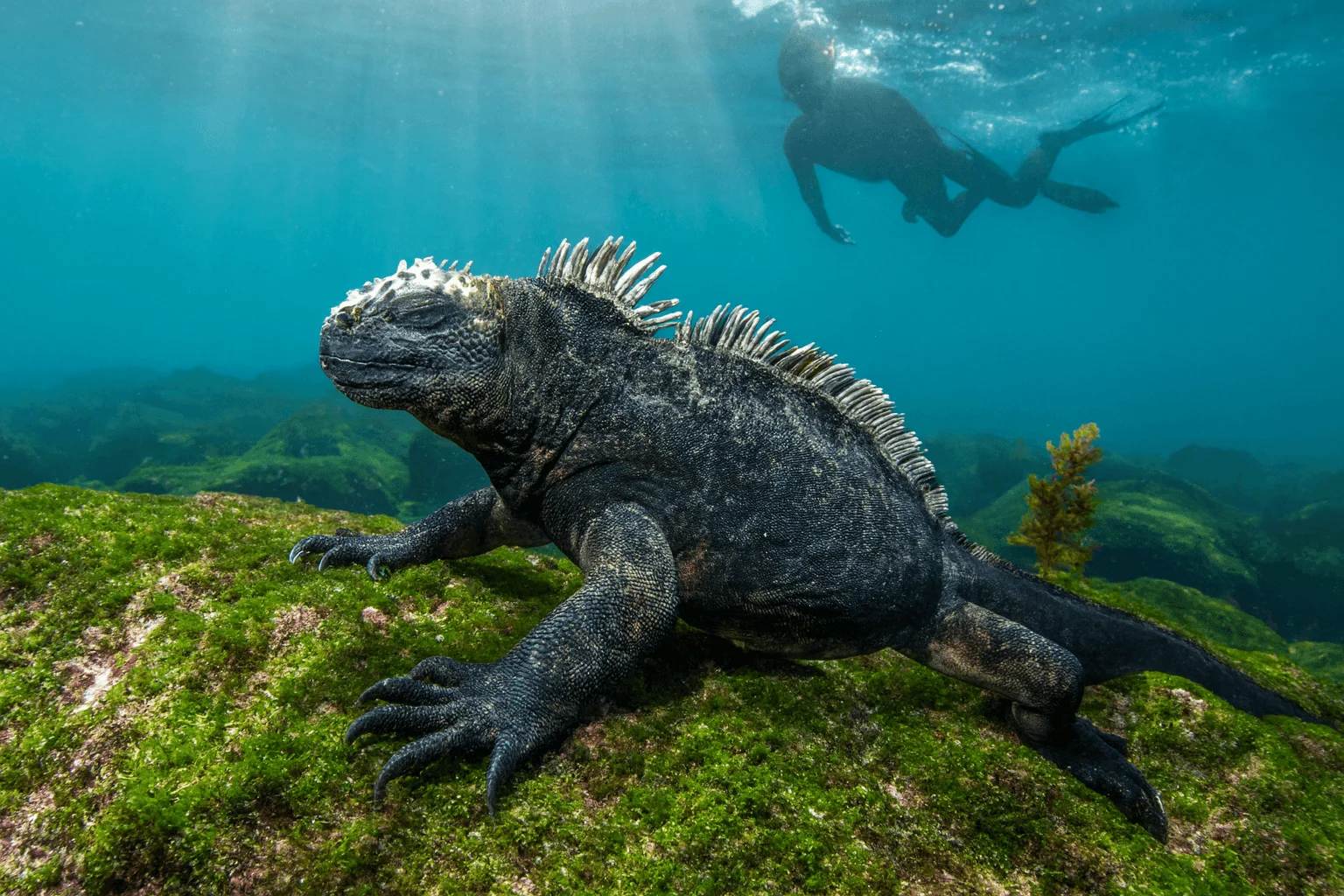
The Galápagos Islands sit 1 000 km off mainland Ecuador and are famous for their remarkable biodiversity both above and below the water. Created by volcanic hot spots and washed by the converging Humboldt, Panama and Cromwell currents, these remote islands offer some of the most exhilarating diving on the planet. Liveaboard trips venture north to Darwin and Wolf islands, where swirling schools of scalloped hammerheads and hundreds of silky and Galápagos sharks patrol the drop‑offs. Other sites host oceanic manta rays, whale sharks, dolphins, marine iguanas, penguins and playful sea lions. Strong currents, cool upwellings and surge mean the dives are challenging but incredibly rewarding. On land you can explore lava fields, giant tortoise sanctuaries and blue‑footed booby colonies.
La Paz
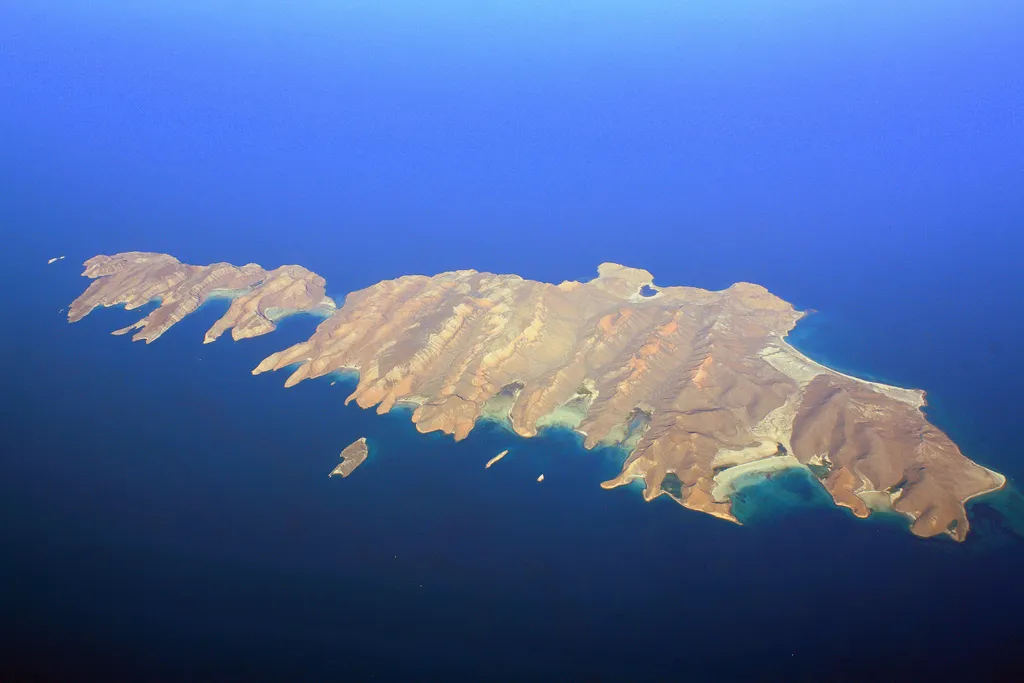
La Paz is the practical gateway to the southern Sea of Cortez—Jacques Cousteau's "world aquarium"—without Cabo crowds. Day boats run from the Malecón and local marinas out to Isla Espíritu Santo National Park for California sea lions at Los Islotes, shipwrecks in the San Lorenzo Channel, and blue-water seamounts like El Bajo. In winter, the Bay of La Paz hosts one of the world's most accessible whale shark snorkel seasons (scuba is not allowed in the refuge zone). ### What Makes It Different This is a city-based wildlife trip, not a remote reef camp. You sleep in a real Mexican capital, eat well on the waterfront, then motor 30–90 minutes to sites that punch far above their logistics. Los Islotes is the headline scuba day (playful juveniles at 5–18 m); whale sharks are a separate early-morning snorkel; El Bajo is the advanced pelagic add-on when current and season line up. ### Conditions and Dive Style Expect 2-tank boat days with a beach lunch on Espíritu Santo between dives. Water runs cool in winter (18–22 °C, 5 mm recommended) and warm in summer (28–30 °C). Visibility commonly 15–30 m, dropping when plankton blooms. Critical timing: Los Islotes closes to diving and snorkeling 1 June–31 August for breeding season under CONANP rules—plan around that if sea lions are the reason you booked.
Socorro
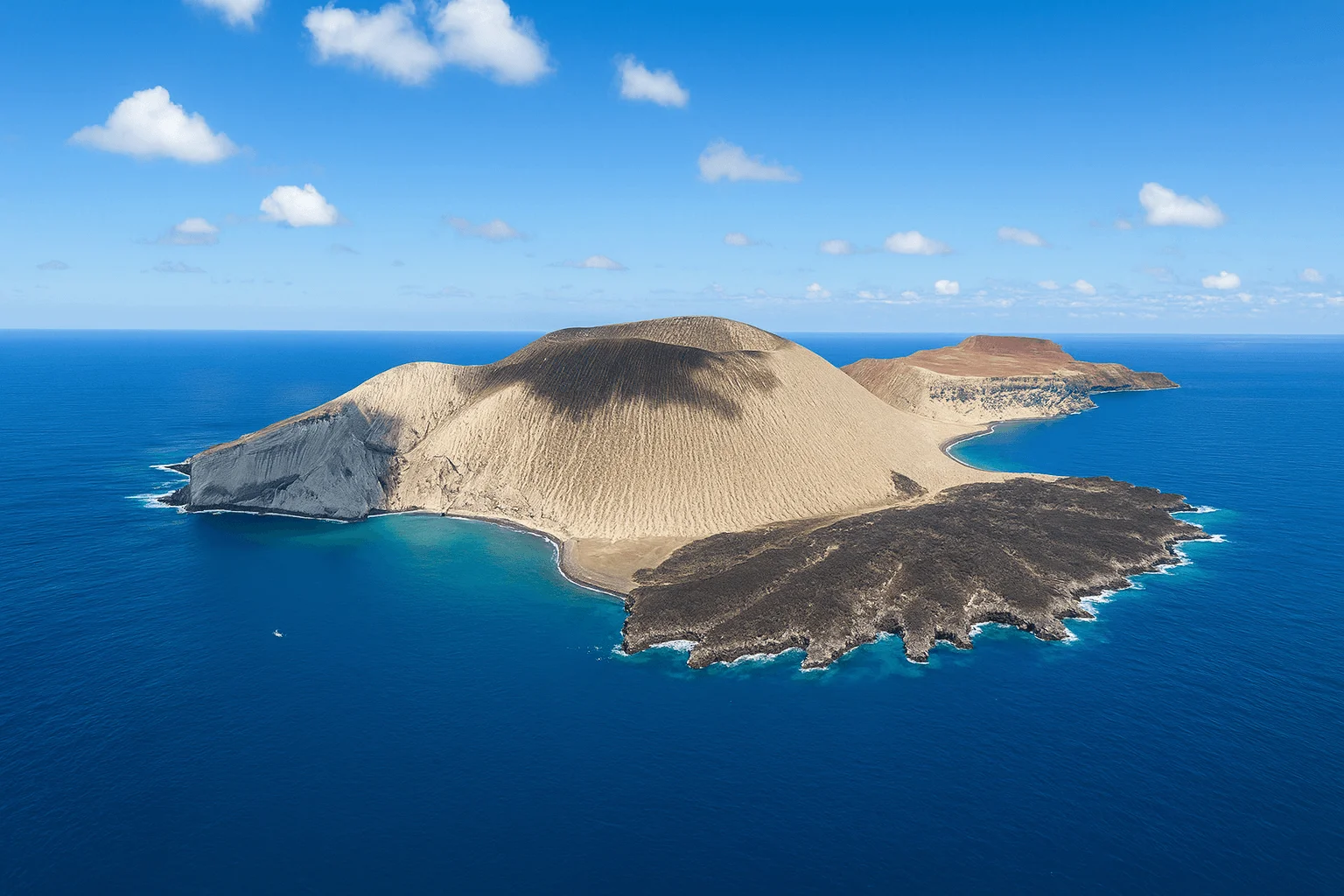
The Revillagigedo Archipelago—better known simply as Socorro—is Mexico’s answer to the Galápagos. Located 400 km off the Baja California coast, this remote chain of volcanic islands (San Benedicto, Socorro, Roca Partida and Clarion) can only be reached by liveaboard. The reward for the 24‑hour crossing is a pelagic wonderland where giant Pacific manta rays circle close enough to touch, hammerhead sharks school in the blue, and humpback whales breach beside the boat. Rugged pinnacles and walls drop into deep blue water, attracting a myriad of large predators and making Socorro one of the world’s great big‑animal dive destinations.
Bohol
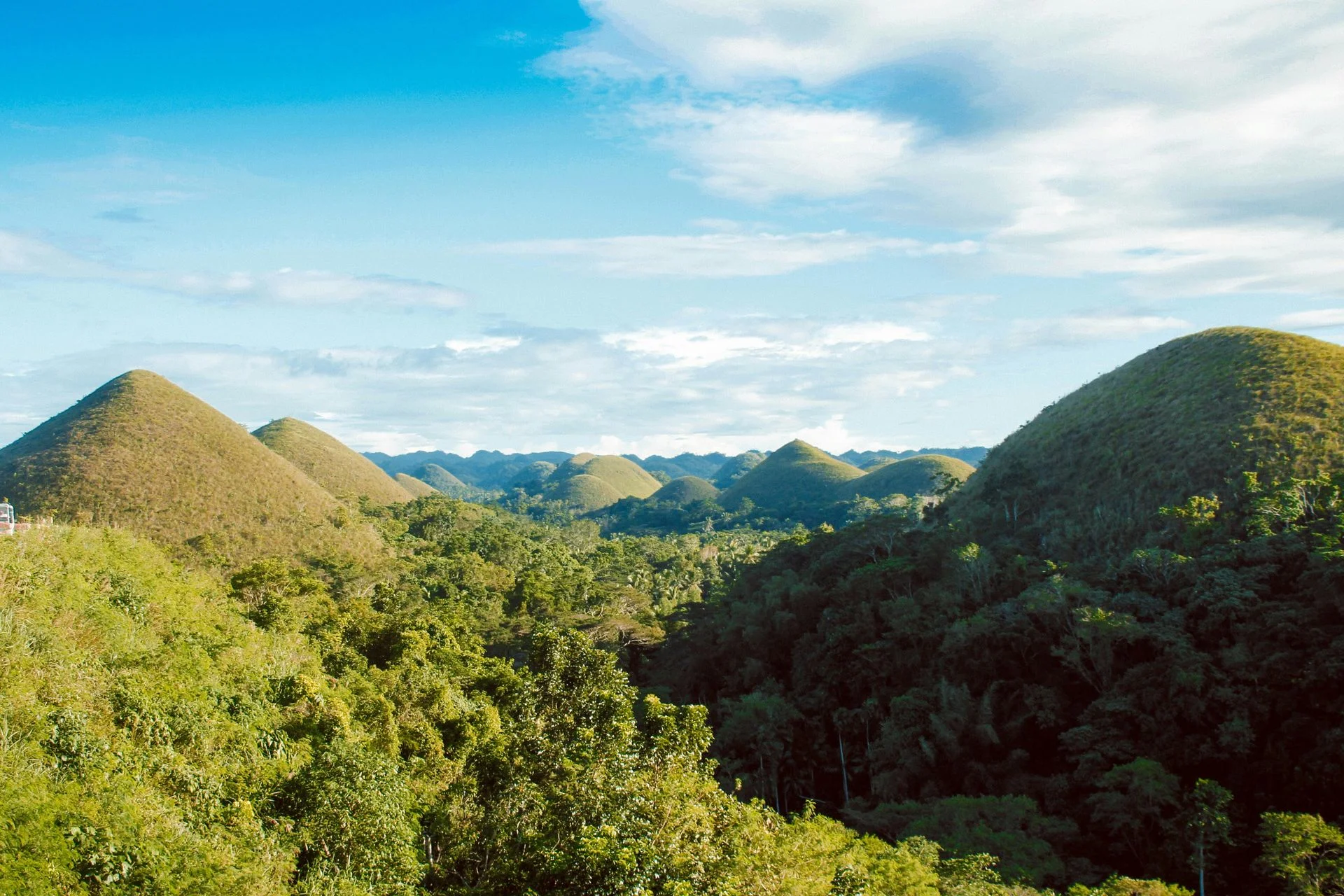
Bohol, an island province in the central Visayas of the Philippines, is a diver’s playground with a huge variety of sites. The main hub is Panglao Island, where Alona Beach serves as the launch point for local reef dives and day trips. Nearby Balicasag Island is world‑class: its 5‑ to 18‑m plateau drops into walls where clouds of jackfish and sardines swirl and sleepy green and hawksbill turtles munch on soft corals. To the west, Cabilao’s reefs hide hammerhead sharks and pygmy seahorses, while the remote east coast of Anda offers muck dives, turtle nurseries and even mantas and whale sharks. Other favorites include Napaling’s year‑round sardine balls, Pamilacan’s manta and shark‑filled walls and Cervera (Snake Island) with its resident sea snakes. Whether you love colourful coral gardens, deep walls, big pelagics or tiny critters, Bohol has something for every diver.
Maldives
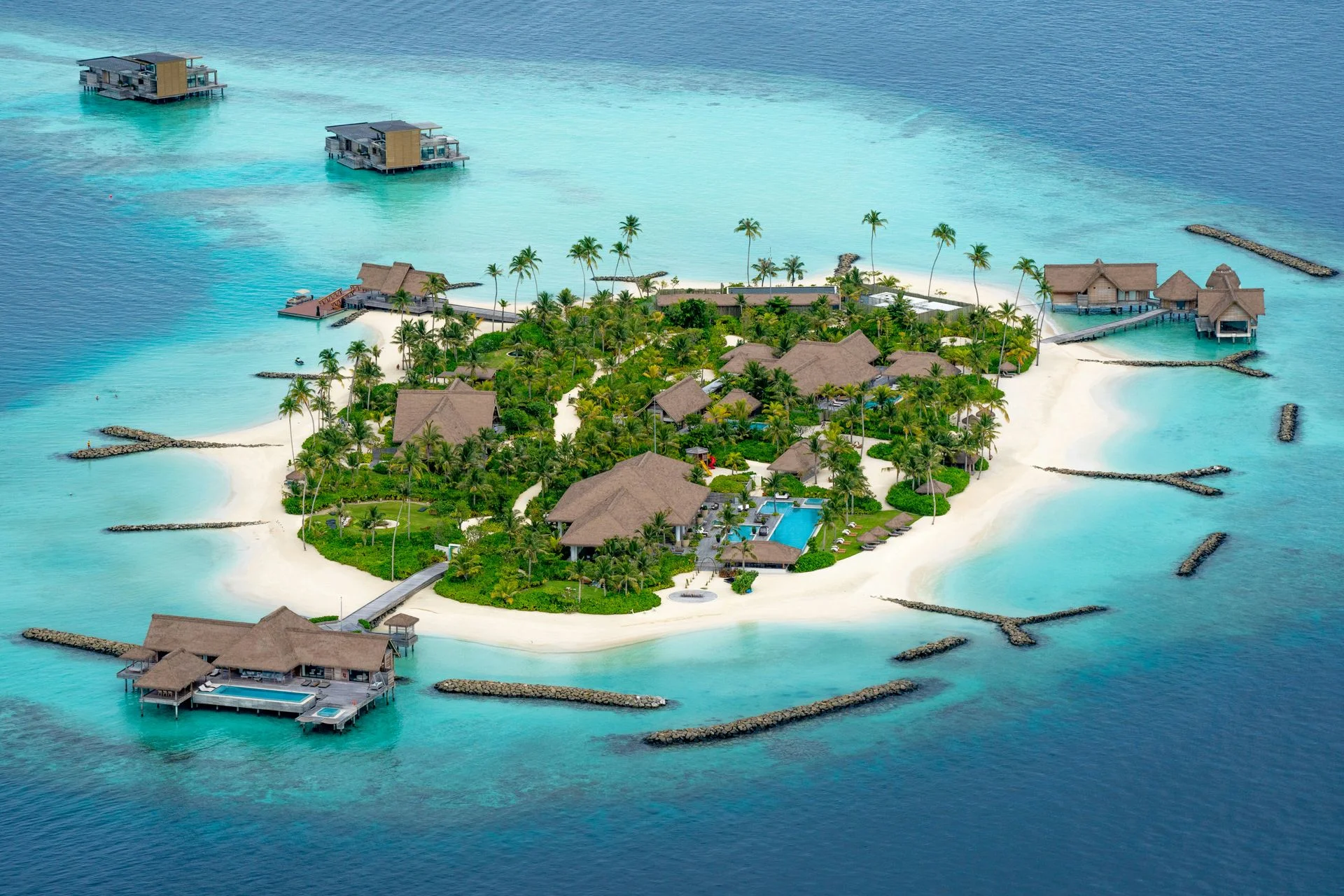
Scattered across the Indian Ocean like strings of pearls, the Maldives’ 26 atolls encompass more than a thousand low‑lying islands, reefs and sandbanks. Beneath the turquoise surface are channels (kandus), pinnacles (thilas) and lagoons where powerful ocean currents sweep past colourful coral gardens. This nutrient‑rich flow attracts manta rays, whale sharks, reef sharks, schooling jacks, barracudas and every reef fish imaginable. Liveaboards and resort dive centres explore sites such as Okobe Thila and Kandooma Thila in the central atolls, manta cleaning stations in Baa and Ari, and shark‑filled channels like Fuvahmulah in the deep south. Diving here ranges from tranquil coral slopes to adrenalin‑fuelled drifts through current‑swept passes, making the Maldives a true pelagic playground.
Banda Sea
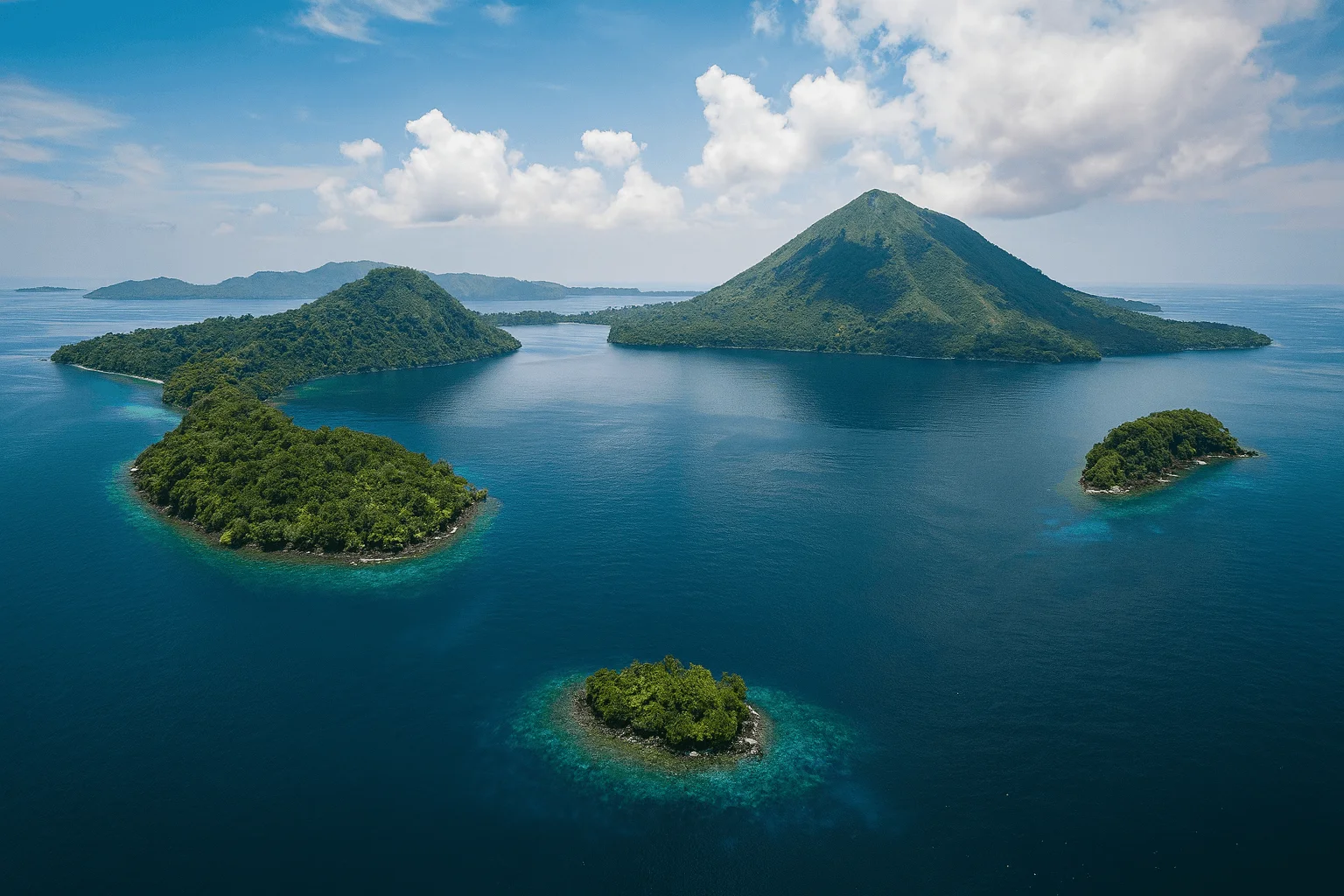
Hidden between Indonesia’s Maluku Islands lies the Banda Sea – an untouched stretch of ocean famous for its schools of hammerhead sharks and abundant sea snakes. Part of the Coral Triangle, this remote sea spans over half a million square kilometres and plunges to depths beyond 7 km. Cold, nutrient‑rich upwellings feed pristine reefs bursting with life: imagine gliding along steep walls encrusted with giant gorgonians while dogtooth tuna, thresher sharks and squadrons of mobula rays cruise past. Volcanic islands such as Manuk and Gunung Api rise from the blue, their warm vents attracting banded sea kraits by the dozen and drawing divers from all over the world. Because there are no large towns here, the Banda Sea is usually explored on liveaboards – the reward is some of Indonesia’s wildest and most exhilarating diving.