
Orangutan Crab
Achaeus japonicus
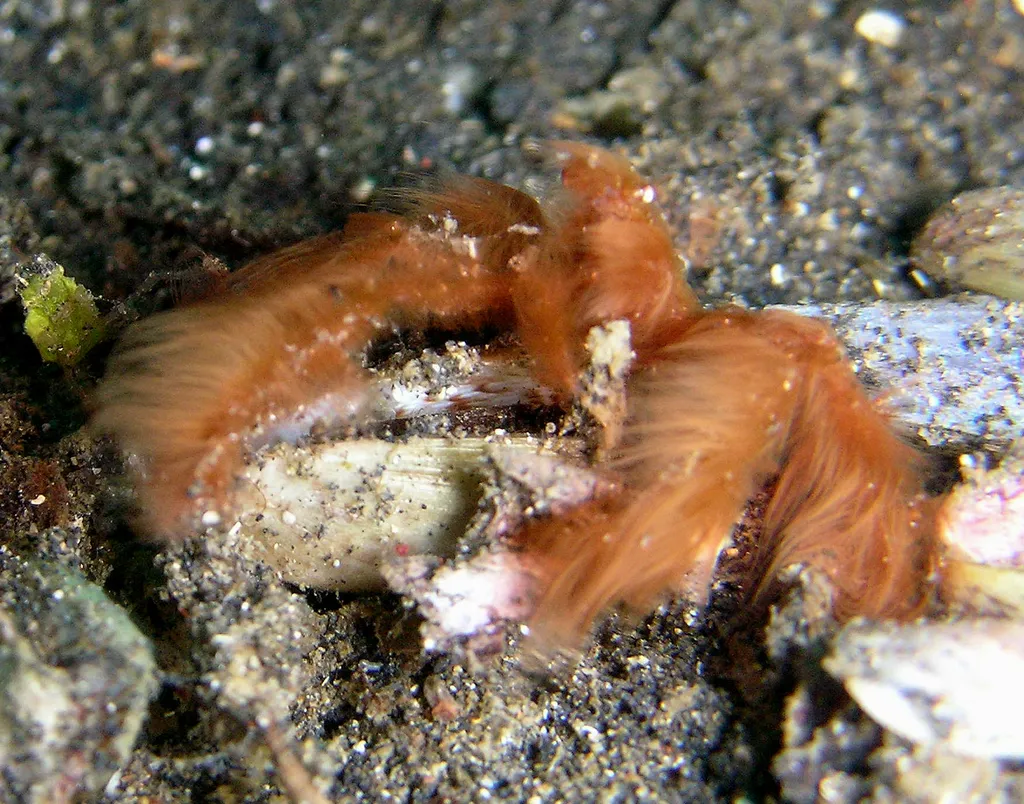
Photo by Steve Childs / CC BY 2.0 via Wikimedia Commons
The Orangutan Crab (Achaeus japonicus) is what happens when a decorator crab decides to go full red-carpet camouflage. Carapace about the size of a bottle cap, arms carpeted in fine reddish hairs, and a habit of sitting among bubble-coral polyps until it looks like part of the coral furniture. Guides often find it first not by spotting "a crab," but by noticing a furry red smudge that moves when the rest of the colony does not.
Field guides sometimes treat the famous "orang-utan crab" as a tentatively placed Oncinopus form, while WoRMS still carries Achaeus japonicus (De Haan, 1839). For divers the practical ID is the same: hairy red spider crab on Plerogyra / euphyllid hosts. Slow down, scan inflated bubble corals, and let your eyes separate fuzzy legs from polyps before you reach for the shutter.
🔬Classification
📏Physical Features
🌊Habitat Info
⚠️Safety & Conservation
Identification Guide
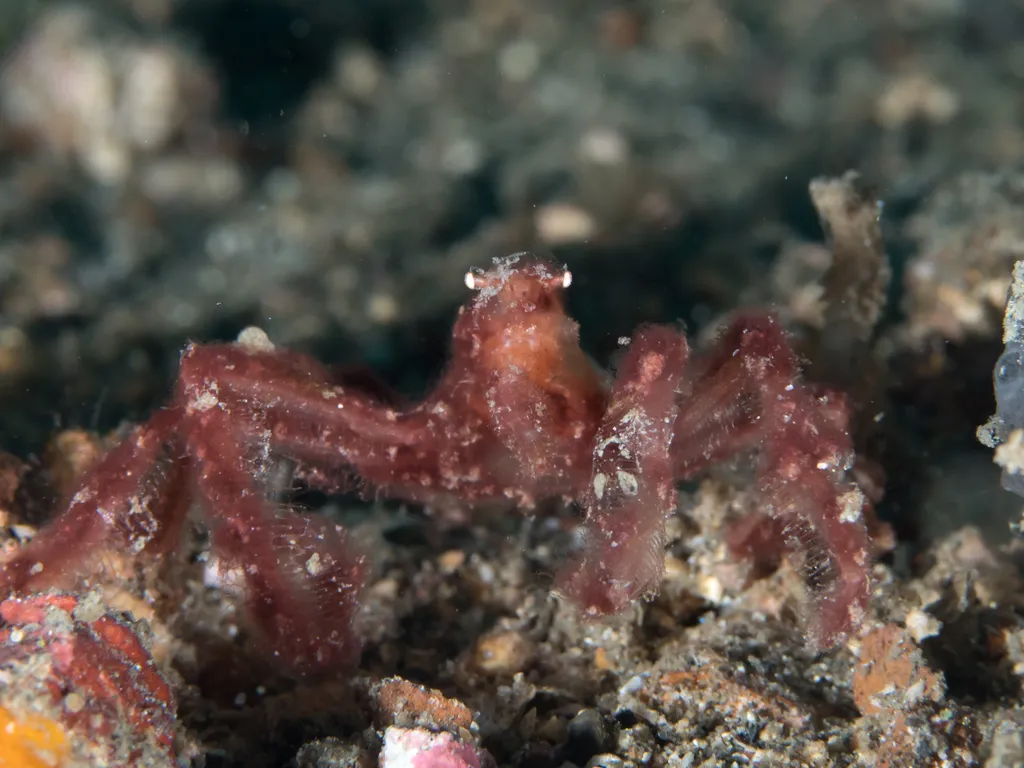
Photo by Rickard Zerpe / CC BY 2.0 via Wikimedia Commons
Search habitat before silhouette. Start on sheltered reef slopes with healthy Plerogyra, Physogyra, or Euphyllia colonies in the mid-teens of meters.
Field marks
- Very small carapace (~2 cm) with disproportionately long legs and claws
- Dense reddish-brown filamentous hairs on arms; often bits of detritus woven in
- Often perched among bubble-coral vesicles or tucked at the coral base
- Legs may hold the body slightly elevated above polyps rather than flat on sand
Confusion risks
- Other decorator spider crabs carry sponges/debris but lack the dense red "orangutan hair"
- Soft-coral squat lobsters and porcelain crabs share host corals but have different body plans
- At distance, a retracted crab can look like a rust-colored sponge patch—wait for a leg to twitch
Top 10 Fun Facts about Orangutan Crab
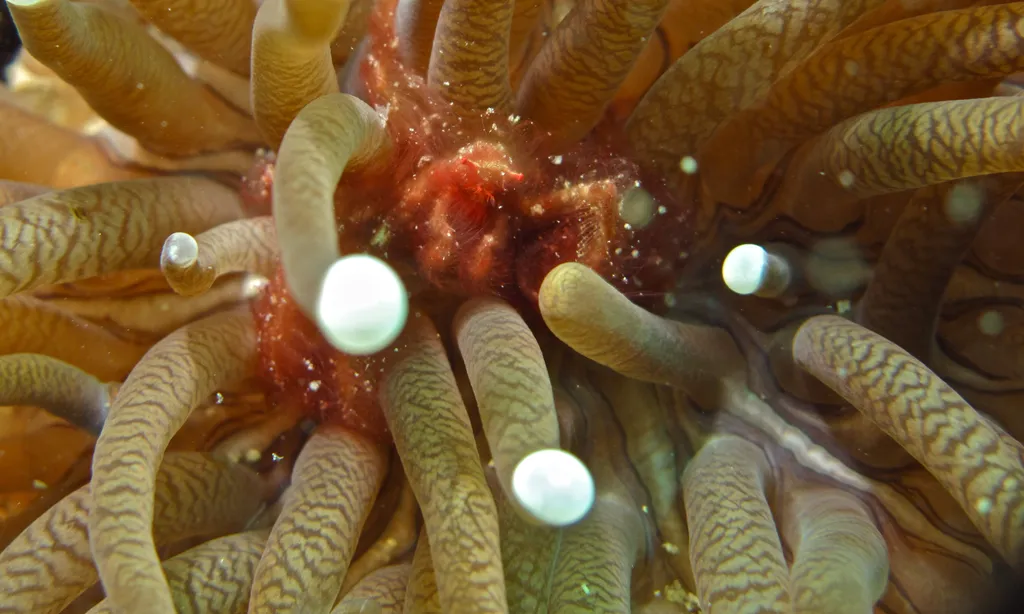
Photo by Bernard DUPONT from FRANCE / CC BY-SA 2.0 via Wikimedia Commons
1. Named for the hair, not the temper
Divers nicknamed it the orangutan crab because the arms look furred—dense setae trap silt and detritus until the crab resembles a tuft of coral fuzz.
2. A classic bubble-coral companion
Encounters cluster on Plerogyra sinuosa and related euphyllid hosts. Not every colony has a tenant, but when one does, the crab often sits in the "windows" between vesicles.
3. Decorator toolkit switched on
Like other spider crabs, it actively sticks debris into its setae. That DIY camouflage means two individuals on the same species can look oddly different under torchlight.
4. Tiny body, long reach
The carapace is small, but outstretched hairy arms push the silhouette far beyond what card-size estimates suggest—useful when framing with a 60–105 mm macro.
5. Taxonomy still argues while divers agree
Some Pacific ID books reassign the familiar "orang-utan crab" look-alike to Oncinopus sp. tentatively; scientific databases retain Achaeus japonicus. Shoot the animal you see; let journals quarrel.
6. Indo-Pacific reef regular
Central tropical Indo-Pacific distribution matches Coral Triangle and nearby macro hotspots—hence frequent sightings in Sulawesi, Philippines, Bali, and eastern Indonesia itineraries.
7. Probably harvests with its "hair"
The setae on the first walking legs appear to help intercept plankton and suspended particles; living on a mucus-rich coral also puts scrap-feeding opportunities next door.
8. Host welfare is part of the shot
Crowding a small bubble coral with fin kick or touching polyps can retract the colony and stress the host. Stay off the soft tissue; let the crab decide when to walk into frame.
9. Daytime is fine—if the coral is open
Unlike many muck crabs that only emerge at night, orangutan crabs are regularly found on day dives when host polyps/vesicles are fully inflated.
10. Guide eyes beat random swimming
Sites with dedicated critter guides (Lembeh, Anilao, Ambon, etc.) turn "maybe" into "there, on the third bubble colony." Ask specifically; they know which heads hold tenants.
Diving & Observation Notes
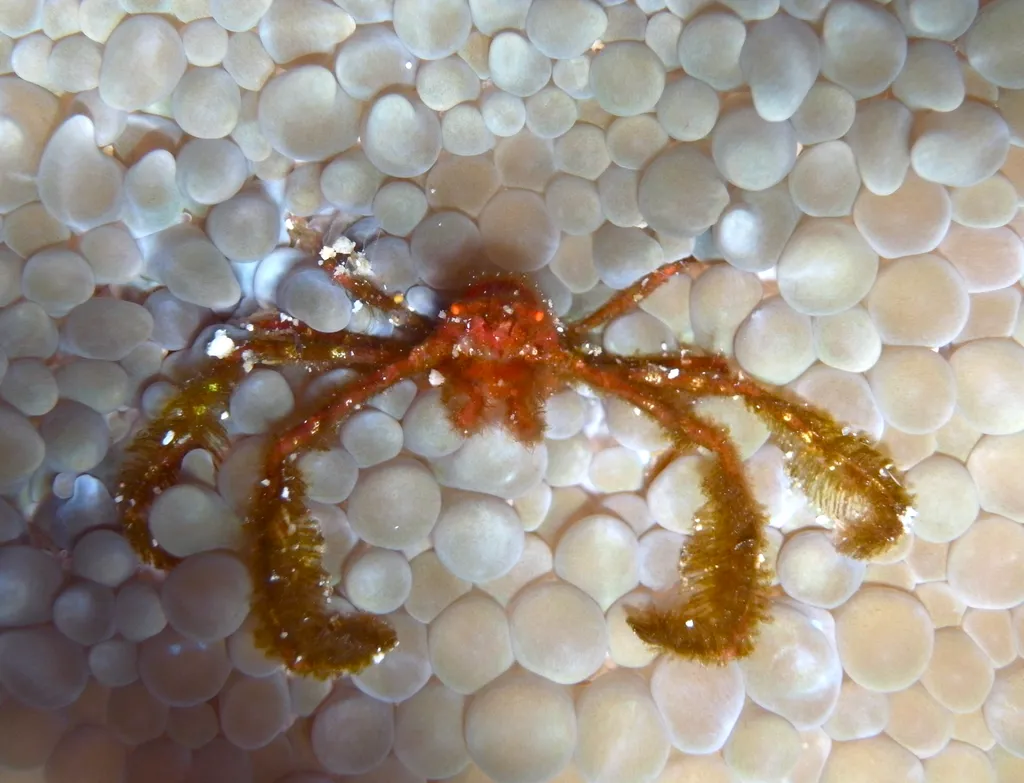
Photo by Sylke Rohrlach from Sydney / CC BY-SA 2.0 via Wikimedia Commons
🧭 Finding the right coral first
Build your search around host colonies, not sand. Drift slowly along mid-slope reefs, pause at healthy bubble coral heads, and scan vesicle gaps with a narrow torch beam held off-axis.
Approach and patience
Hover neutrally, keep fins still, and wait 20–30 seconds after arrival. Many crabs freeze, then resume walking once they decide you are not a predator. If the host retracts, back off and let it reinflate before retrying.
Photo notes
Use a moderate macro (60–100 mm), low ISO, and soft fill so red hairs render texture instead of blown specular highlights. Side angle often separates crab from polyps better than top-down. Include a vesicle edge for scale without crushing soft tissue.
Ethics
Never pry crabs off hosts or move coral heads for a cleaner background. If a guide points and moves on, follow—there are usually multiple residents nearby.
Best Places to Dive with Orangutan Crab
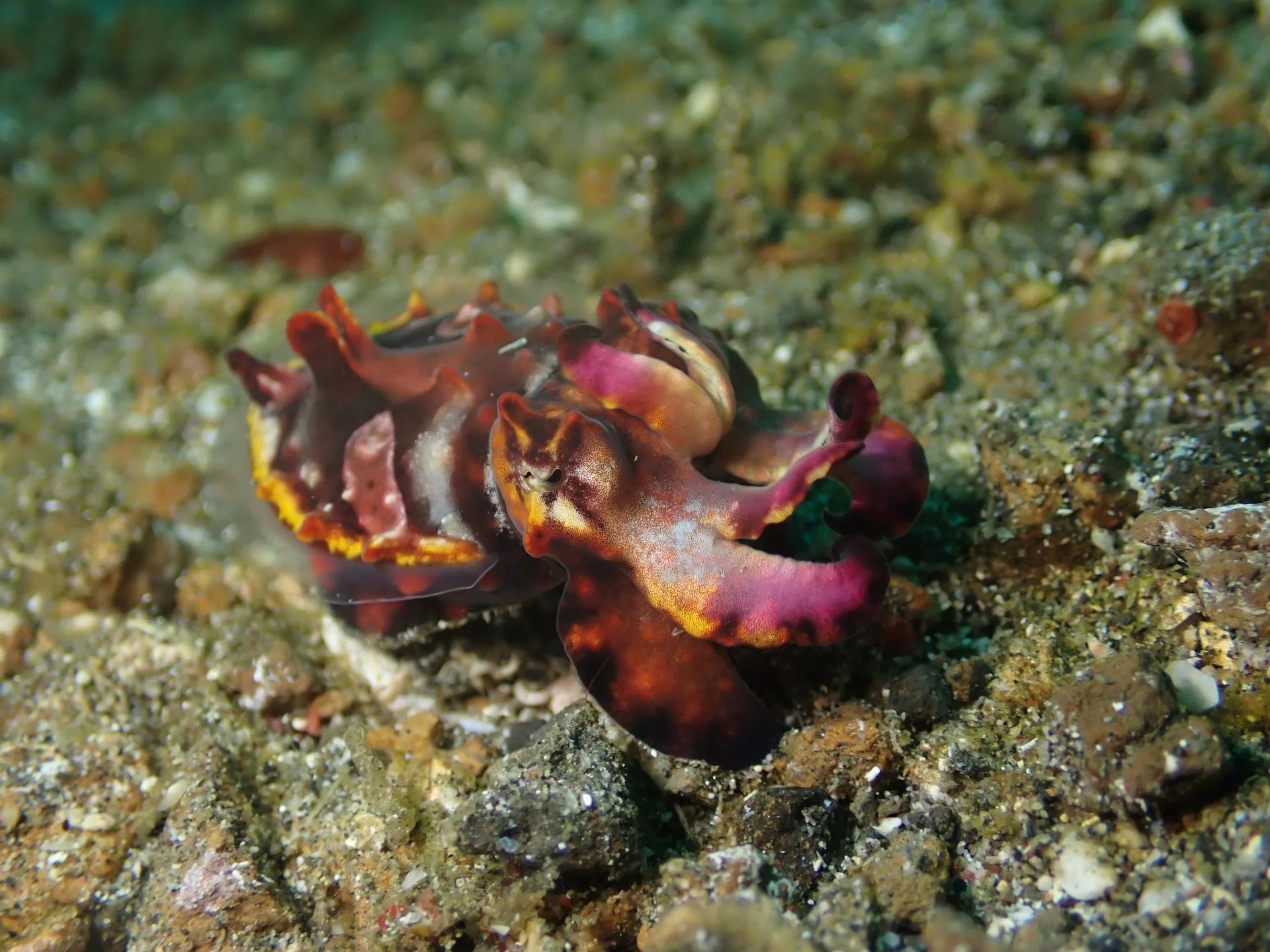
Lembeh
The Lembeh Strait in North Sulawesi has become famous as the muck‑diving capital of the world. At first glance its gently sloping seabed of black volcanic sand, rubble and discarded debris looks bleak. Look closer and it is teeming with weird and wonderful life: hairy and painted frogfish, flamboyant cuttlefish, mimic and blue‑ringed octopuses, ornate ghost pipefish, tiny seahorses, shrimp, crabs and a rainbow of nudibranchs. Most dives are shallow and calm with little current, making it an ideal playground for macro photographers. There are a few colourful reefs for a change of scenery, but Lembeh is all about searching the sand for critter treasures.
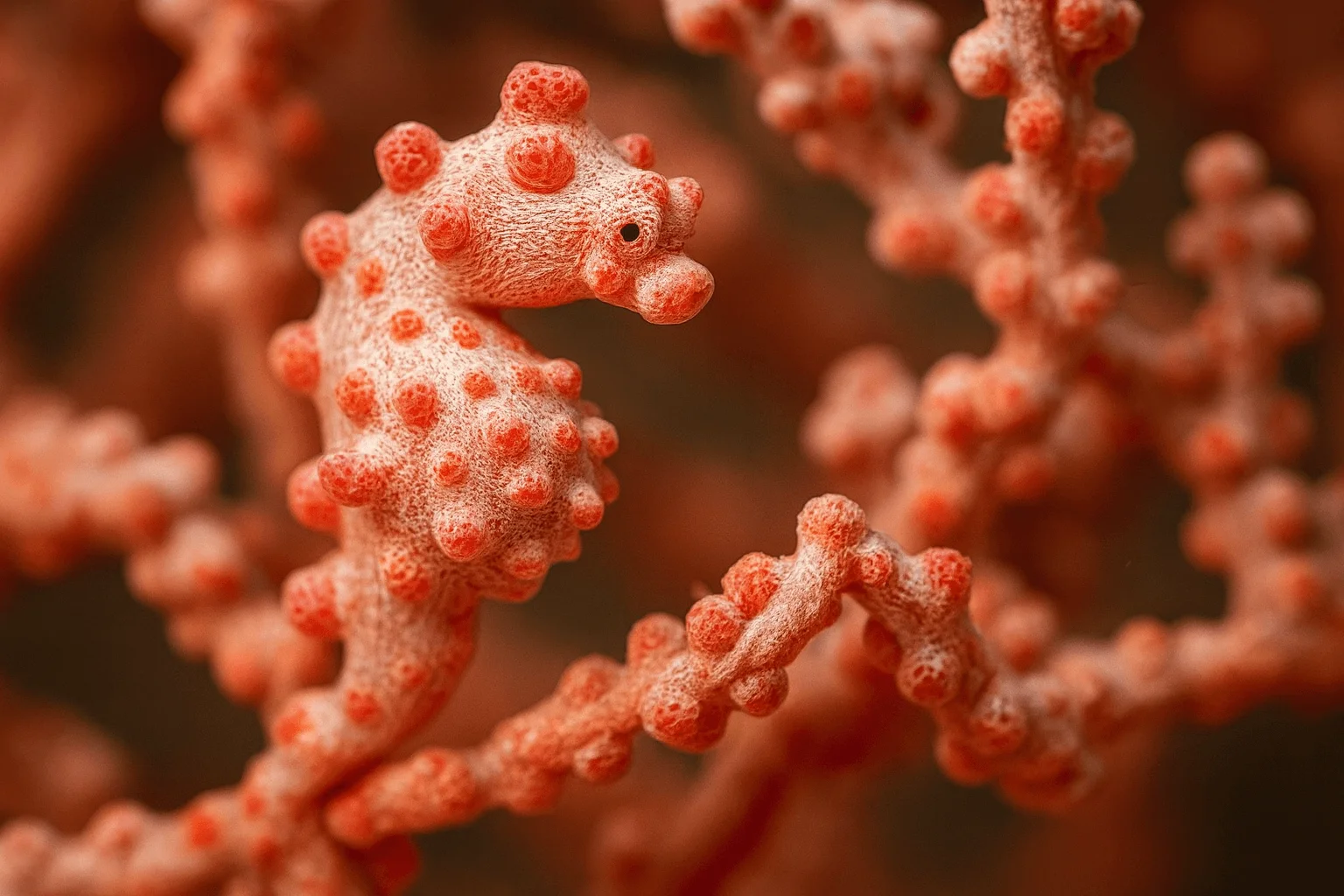
Anilao
Anilao, a small barangay in Batangas province just two hours south of Manila, is often called the macro capital of the Philippines. More than 50 dive sites fringe the coast and nearby islands, offering an intoxicating mix of coral‑covered pinnacles, muck slopes and blackwater encounters. Critter enthusiasts come for the legendary muck dives at Secret Bay and Anilao Pier, where mimic octopuses, blue‑ringed octopuses, wonderpus, seahorses, ghost pipefish, frogfish and dozens of nudibranch species lurk in the silt. Shallow reefs like Twin Rocks and Cathedral are covered in soft corals and teem with reef fish, while deeper sites such as Ligpo Island feature gorgonian‑covered walls and occasional drift. Because Anilao is so close to Manila and open year‑round, it’s the easiest place in the Philippines to squeeze in a quick diving getaway.
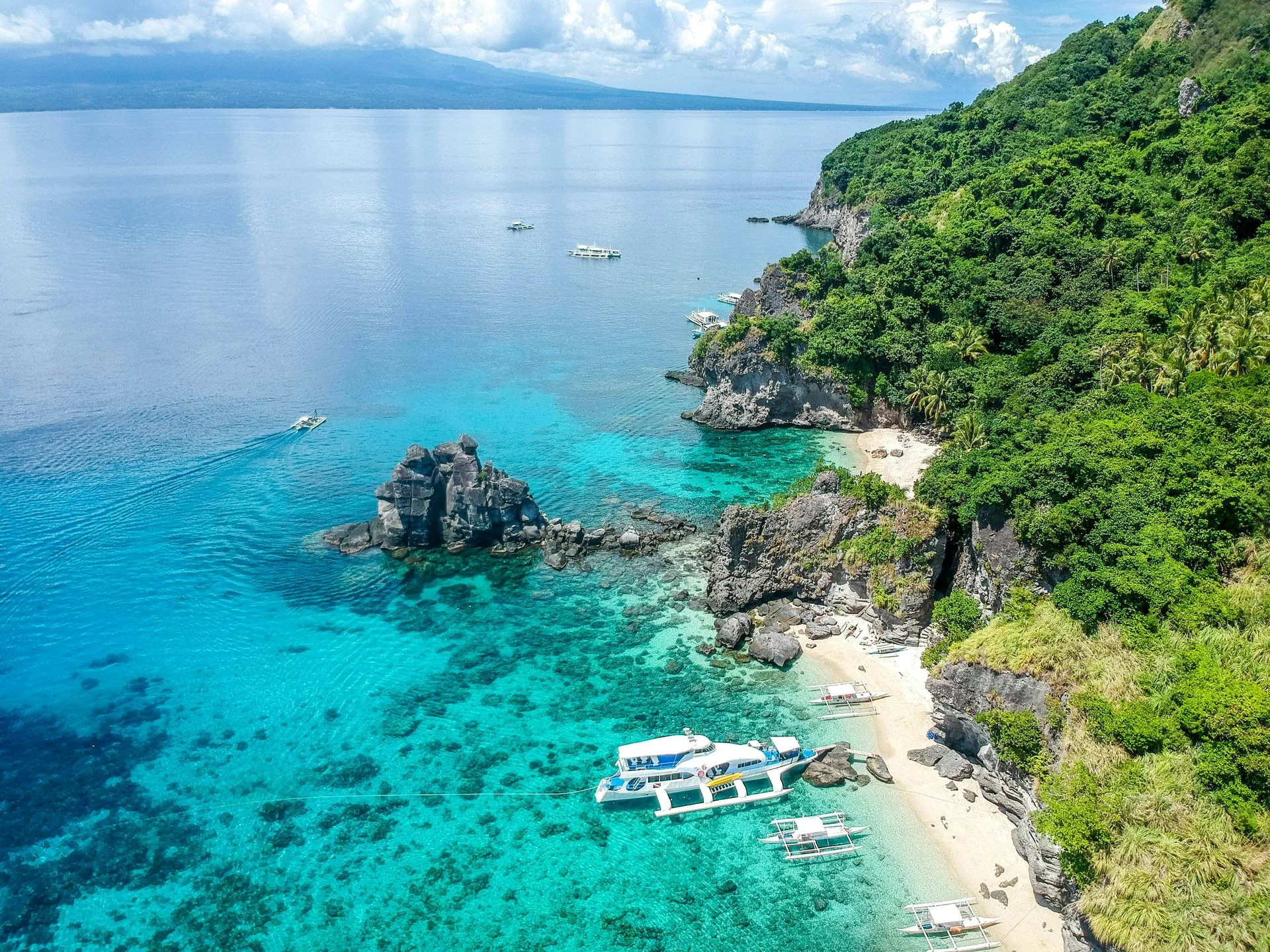
Dumaguete
Dumaguete on the southeast coast of Negros is the jumping‑off point for some of the Philippines’ most diverse diving. Along the nearby town of Dauin, a series of shallow marine sanctuaries and black‑sand slopes hide critters galore: frogfish, flamboyant cuttlefish, mimic octopus, ghost pipefish, seahorses, pipefish and nudibranchs. Artificial reefs made from car tyres and pyramids provide extra habitat. Offshore, Apo Island’s walls and plateaus burst with hard and soft corals, schooling jacks and barracudas, and friendly green turtles. With day trips to Oslob’s whale sharks or Bais’ dolphin‑watching, and excursions to nearby Siquijor, Dumaguete offers a perfect mix of macro muck diving and classic coral reefs.
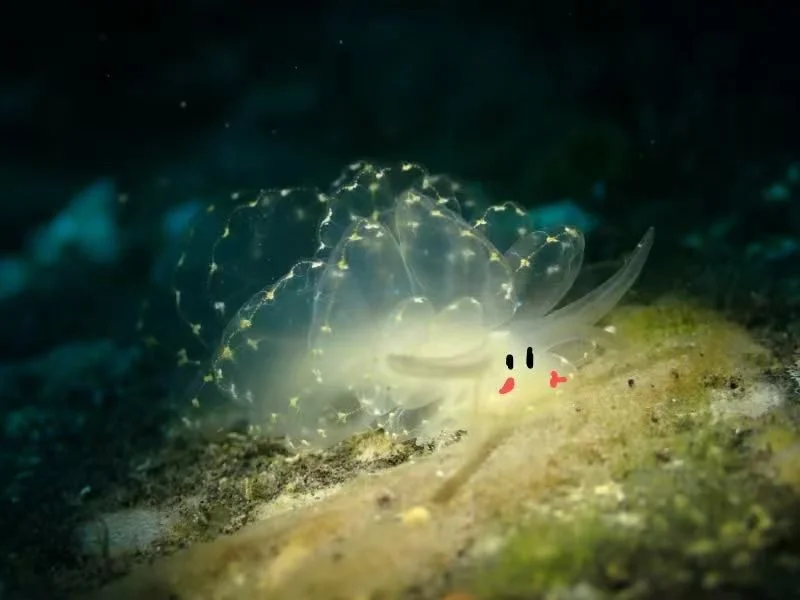
Tulamben(Bali)
Tulamben sits on Bali’s northeast coast and is best known for the USAT Liberty shipwreck – a 125‑metre cargo ship torpedoed in WWII that now lies just a short swim from shore. Warm water, mild currents and straightforward shore entries make diving here relaxed for all levels. Besides the wreck, divers can explore coral gardens, black‑sand muck sites and dramatic drop‑offs. Macro lovers will find nudibranchs, ghost pipefish, mimic octopus and pygmy seahorses, while big‑fish fans can encounter schooling jackfish, bumphead parrotfish and reef sharks. With a compact coastline packed with variety, Tulamben delivers world‑class wreck and critter diving without long boat rides.
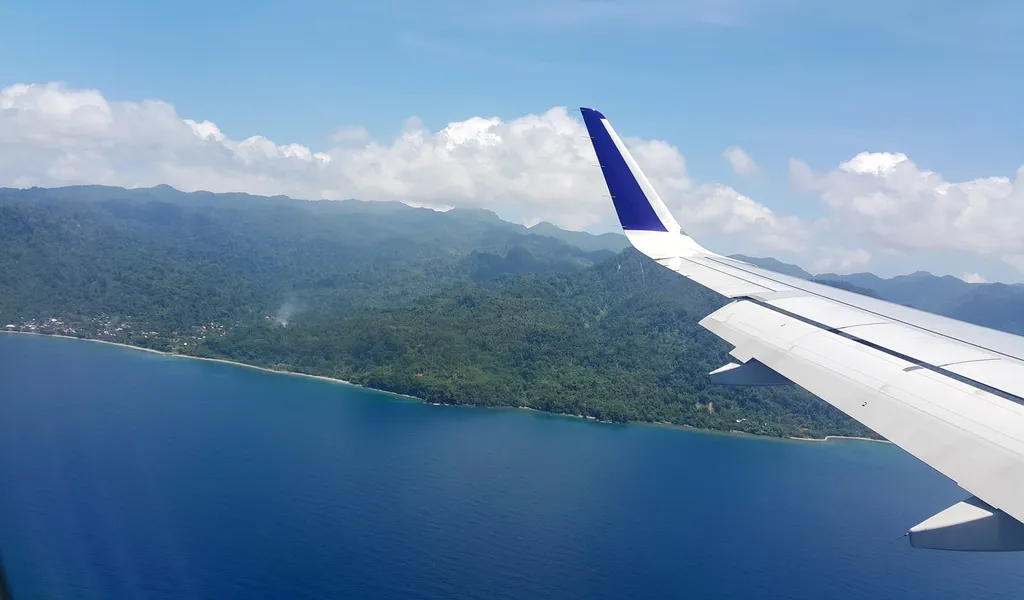
Ambon
Ambon sits in Indonesia’s Maluku (Spice Islands) and is one of the world’s elite muck destinations—often ranked alongside Lembeh for rare critters, without the crowds. The heart of the action is Ambon Bay around Laha village near the airport: black volcanic sand slopes, rubble, pier posts and discarded debris that somehow host psychedelic frogfish (endemic to Ambon waters), rhinopias, flamboyant cuttlefish, mimic and wonderpus octopuses, ghost pipefish and endless nudibranchs. Most bay dives stay 5–35 m with long bottom times that photographers love. When weather allows, the south and east coasts flip the script—healthy hard coral, walls, arches at Pintu Kota, the swim-throughs of Hukurila Cave, and the critter-coated Duke of Sparta wreck. Expect modest lodging in Laha or resort packages further around the bay; July–August monsoon often closes operators.
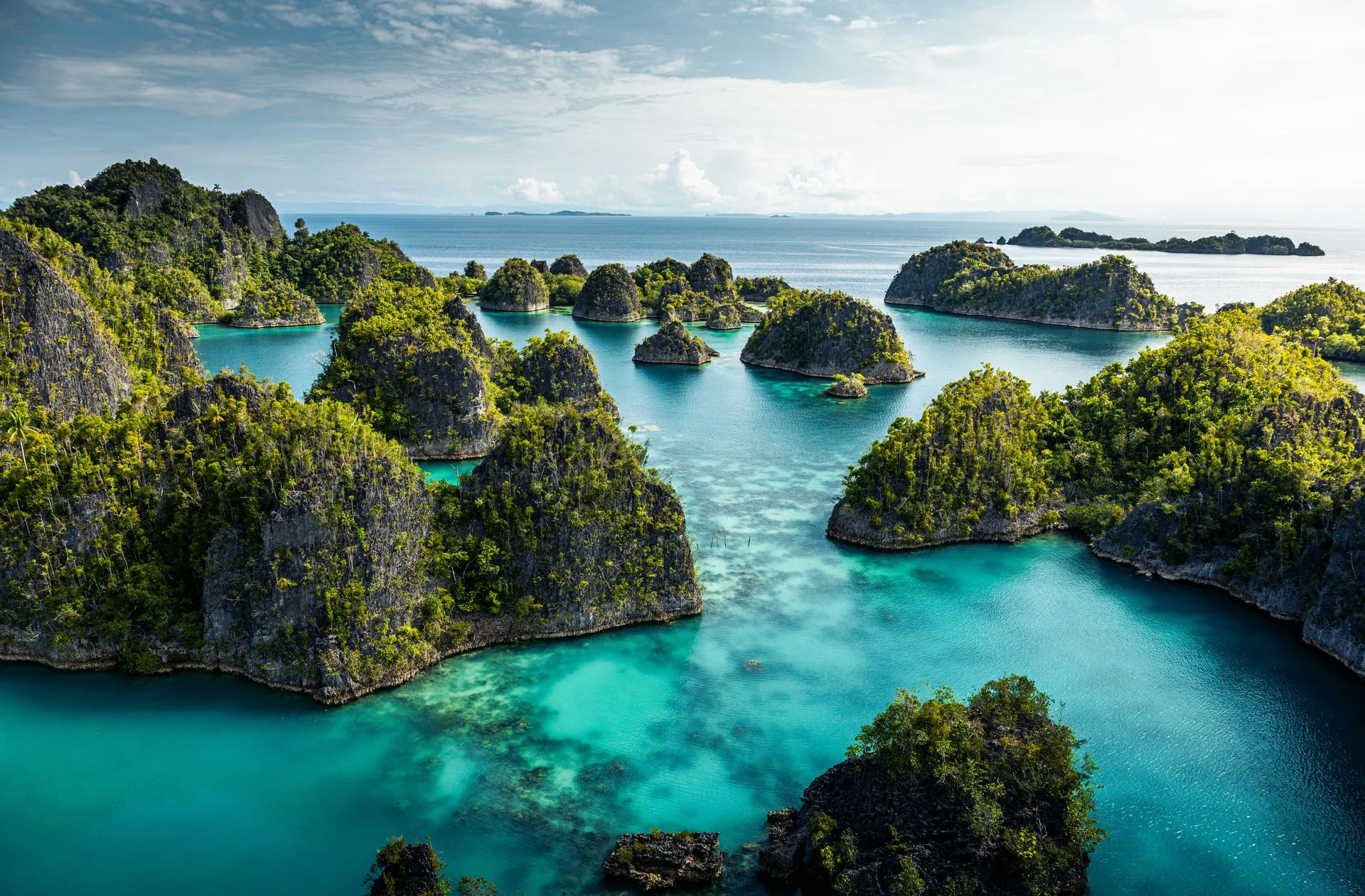
Raja Ampat
Raja Ampat, the “Four Kings,” is an archipelago of more than 1,500 islands at the edge of Indonesian West Papua. Its reefs sit in the heart of the Coral Triangle, where Pacific currents funnel nutrients into shallow seas and feed the world’s richest marine biodiversity. Diving here means gliding over colourful walls and coral gardens buzzing with more than 550 species of hard and soft corals and an estimated 1,500 fish species. You’ll meet blacktip and whitetip reef sharks on almost every dive, witness giant trevally and dogtooth tuna hunting schools of fusiliers, and encounter wobbegong “carpet” sharks, turtles, manta rays and dolphins. From cape pinnacles swarming with life to calm bays rich in macro critters, Raja Ampat offers endless variety. Above water, karst limestone islands and emerald lagoons provide spectacular scenery between dives.
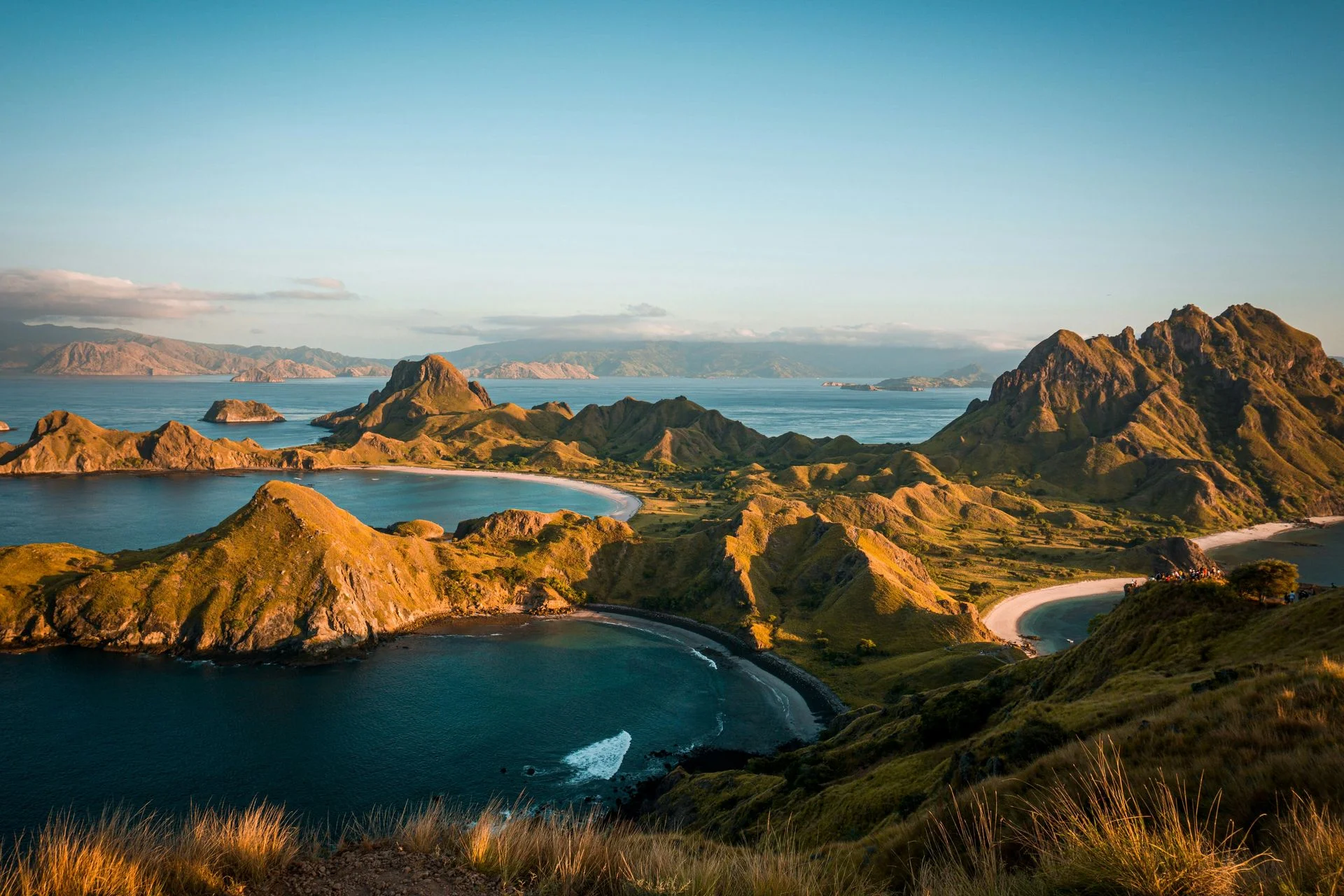
Komodo
Komodo National Park is a diver’s paradise full of marine diversity: expect healthy coral gardens, reef sharks, giant trevallies, countless schools of fish, and frequent manta ray sightings at sites like Manta Point and Batu Bolong. Drift dives and dramatic reef structures add excitement, while both macro lovers and big-fish fans will find plenty to love. Above water, the wild Komodo dragons roam, giving a touch of prehistoric wonder to the whole trip.
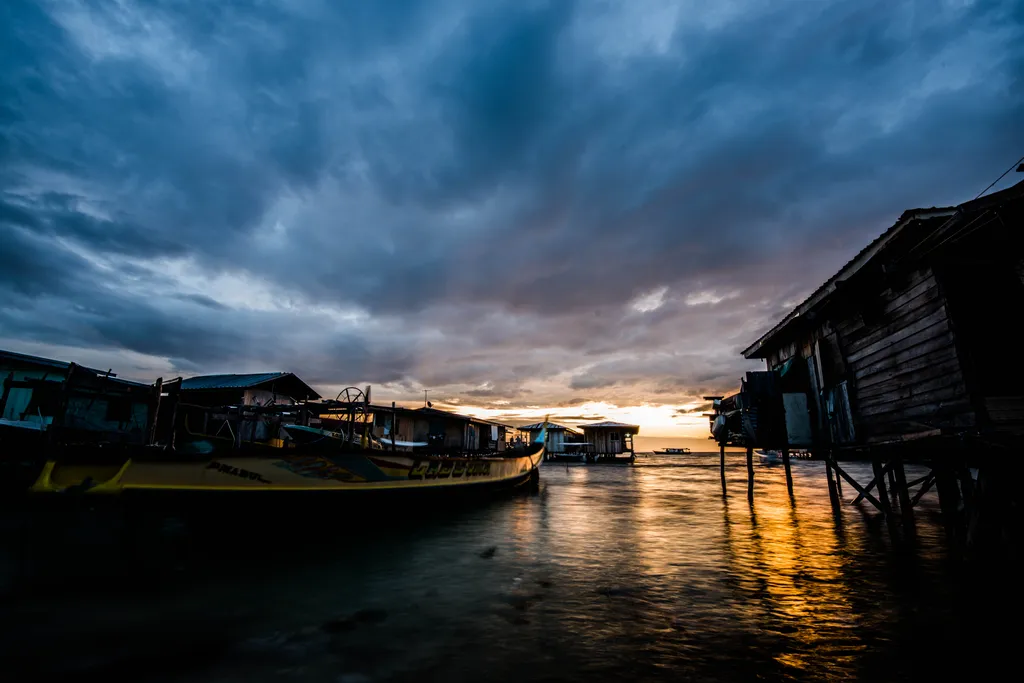
Mabul
Mabul is where you come to slow down and stare at sand. The island sits in the Semporna archipelago off eastern Sabah — a flat, palm-fringed speck ringed by shallow rubble slopes, artificial reef structures, and the occasional tyre stack that macro photographers lose their minds over. Visibility rarely tops 15 m and nobody cares: frogfish the size of your thumb, flamboyant cuttlefish pulsing purple and yellow, blue-ring octopus tucked in rubble, ornate ghost pipefish, ribbon eels, pygmy seahorses in sea fans, and nudibranchs on every spare surface. This is muck diving with resort convenience — walk from your bungalow to the boat, three dives before lunch, rinse and repeat. The signature sites circle the island and nearby Seaventures rig: Froggy Lair and Crocodile Avenue for classic critter hunts, Lobster Wall and Eel Garden when you want a bit of structure, Paradise 1 & 2 for mixed reef-and-rubble variety. Night dives here are excellent — mandarinfish mating dances at dusk, bobtail squid and Spanish dancer nudibranchs after dark. Most resorts run house-reef dives and unlimited shore access between boat trips. Sipadan's barracuda tornadoes and sheer walls are 45 minutes away by speedboat, and many packages include a day or two on permit — but that's the side dish. Base yourself on Mabul for a week of macro and you won't feel cheated if the permit lottery doesn't go your way. Bring a macro lens, a patient dive guide, and low expectations for viz; bring high expectations for critters.
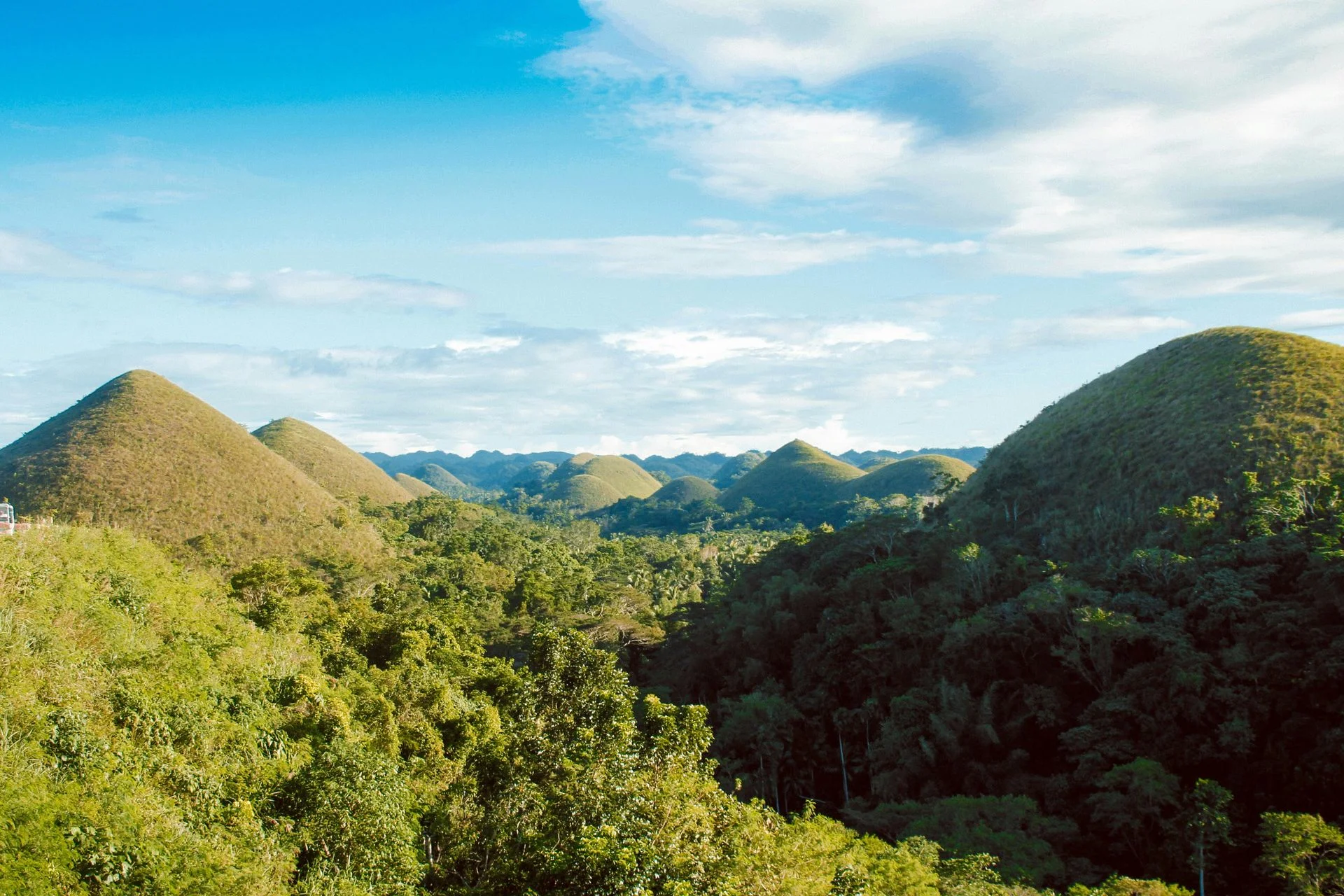
Bohol
Bohol, an island province in the central Visayas of the Philippines, is a diver’s playground with a huge variety of sites. The main hub is Panglao Island, where Alona Beach serves as the launch point for local reef dives and day trips. Nearby Balicasag Island is world‑class: its 5‑ to 18‑m plateau drops into walls where clouds of jackfish and sardines swirl and sleepy green and hawksbill turtles munch on soft corals. To the west, Cabilao’s reefs hide hammerhead sharks and pygmy seahorses, while the remote east coast of Anda offers muck dives, turtle nurseries and even mantas and whale sharks. Other favorites include Napaling’s year‑round sardine balls, Pamilacan’s manta and shark‑filled walls and Cervera (Snake Island) with its resident sea snakes. Whether you love colourful coral gardens, deep walls, big pelagics or tiny critters, Bohol has something for every diver.
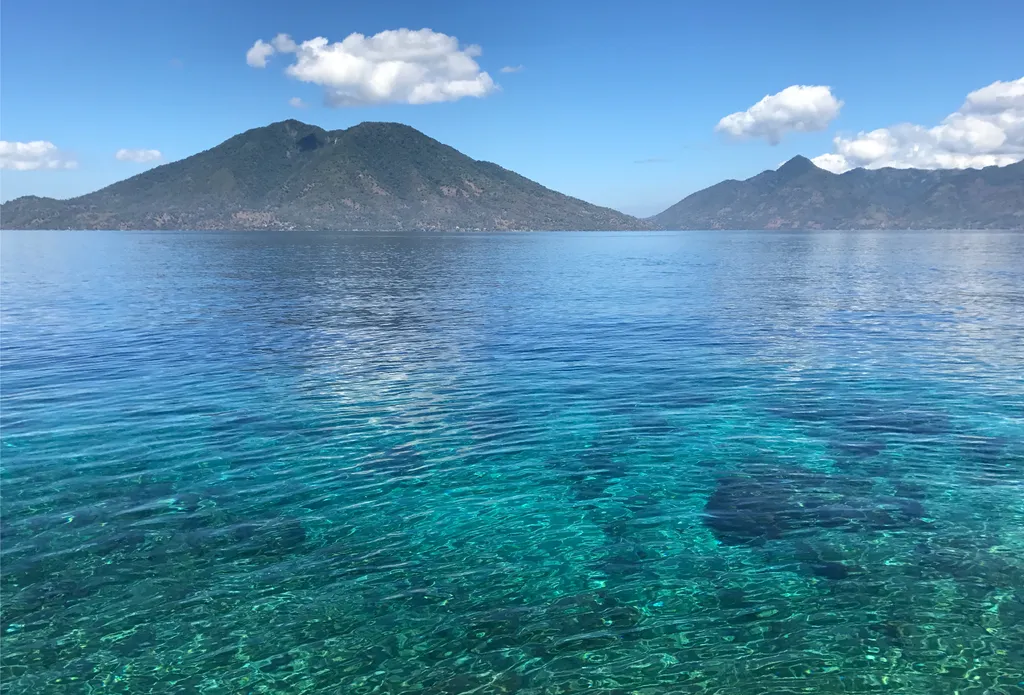
Alor
Alor rewards a trip that moves between two very different kinds of diving. In Pantar Strait, walls and coral slopes meet moving water, with schooling fish along exposed edges. Inside Kalabahi Bay, volcanic sand, rubble and silty bottoms turn the dive into a slow search for small animals. The diving area spans the shores of Alor, Pantar and Pura; where you stay affects which of these habitats fits comfortably into a boat day. Water movement explains much of the variation. Cold water enters the strait from the south, and local operators associate upwelling and stronger currents with new and full moons. A warm surface does not tell you what awaits below: a thermocline can change both the temperature and the demands of a dive. Site choice matters more than a single forecast for the archipelago. Build the itinerary around reefs, walls and macro life, with large animals as a possible encounter. There is no dependable shared season for hammerheads, mola or threshers on which to base a booking. A guide who can switch between exposed sites and sheltered searches is more useful than a fixed list of promised sightings.